Register Dynamics in the EFL Classroom: Investigating Teachers’ Language Styles in Indonesian Vocational School
DOI:
https://doi.org/10.24903/sj.v11i1.2053Keywords:
language style, teacher, vocational school, educationAbstract
Background:
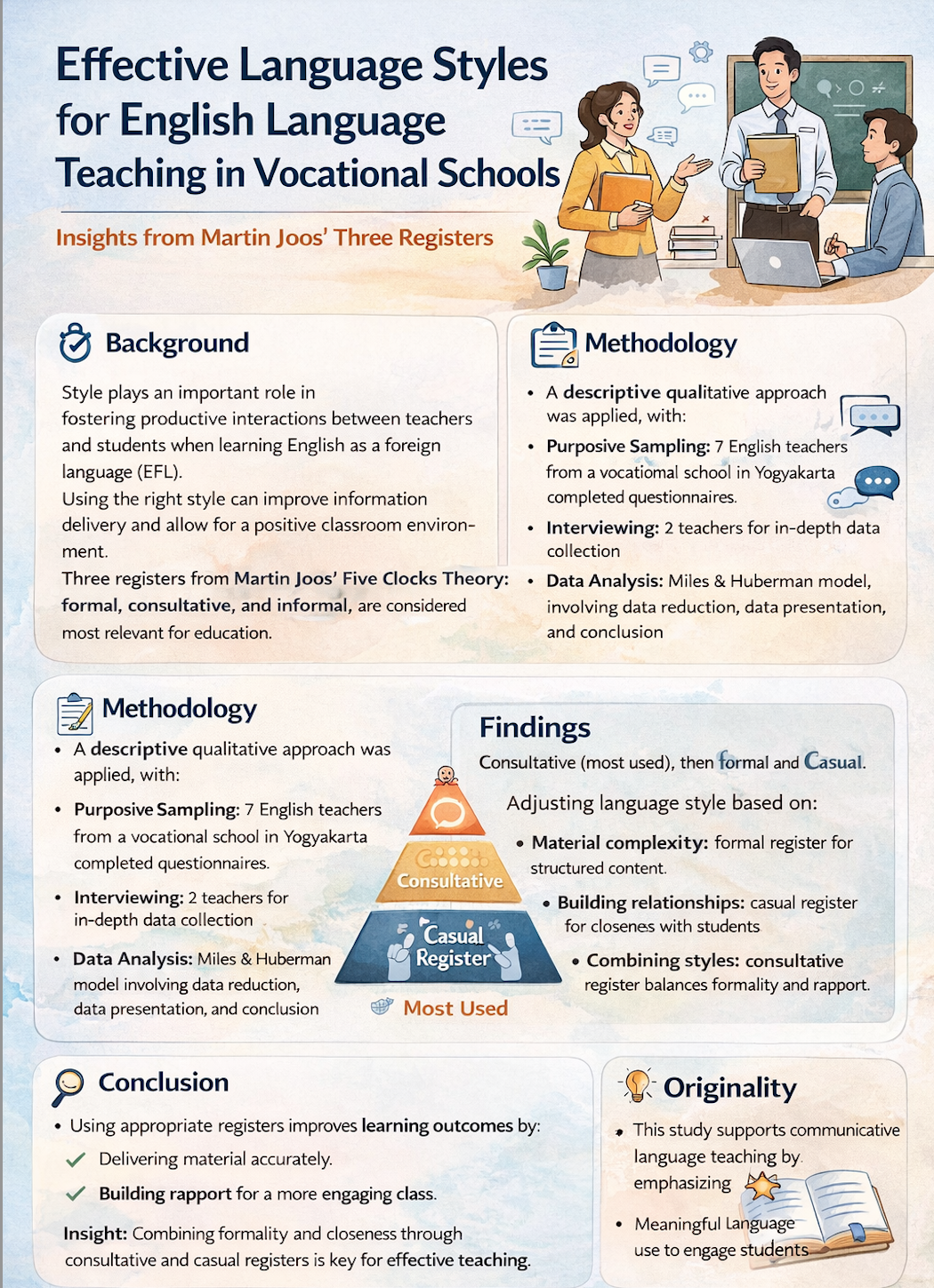
Style plays an important role in fostering productive interactions between teachers and students when learning English as a foreign language (EFL). Using the right style can improve information delivery and allow for the creation of a positive classroom environment. Three of Martin Joos' Five Clocks Theory: formal, consultative, and informal, are considered the most relevant in the context of Education. The findings are significant in helping teachers in vocational schools adjust their language style to enhance student communication and comprehension.
Methodology:
This study applied a descriptive qualitative approach with a purposive sampling technique. Seven English teachers from one of the vocational schools in Yogyakarta became respondents for the questionnaire, and two other teachers were interviewed for in-depth data. The data were analyzed using the Miles & Huberman model, which includes data reduction, data presentation, and conclusion.
Findings:
The questionnaire results showed that the consultative register, the formal, and the casual were the most to least used, respectively. In-depth interviews revealed that teachers adjusted their language style based on the context of delivering the material and the relational closeness with students. The formal register functions to deliver structurally complex material, while the casual register is used to build closer relationships with students.
Conclusion:
The use of registers helps improve learning outcomes by enabling teachers to deliver material accurately while building rapport with students, resulting in a more interactive learning environment, increased motivation, and a deeper understanding of the learning material. Combining formality and closeness through consultative and casual registers is an important strategy for teachers in adjusting their teaching approaches.
Originality:
This study contributes to the theory of communicative language teaching in which registers used by EFL teachers emphasize the meaningfulness of language. This study also contributes to classroom communicative theory by highlighting how teachers and students communicate to enhance students' engagement, social dynamics, and learning outcomes.
References
Afrilyasanti, R., Basthomi, Y., & Zen, E. L. (2023). EFL students’ participations and teachers’ roles in online discussion forum for critical media literacy learning. Contemporary Educational Technology, 15(2), ep414. https://doi.org/10.30935/cedtech/12965
Ambarsari, T. A. B., & Mujianto, G. (2022). Analisis variasi konsultatif pada gilir bicara dalam pembelajaran daring Bahasa Indonesia di SMK PGRI 1 Giri Banyuwangi. Jurnal Pendidikan Bahasa Dan Sastra Indonesia Undiksha, 12(1), 21–30. https://doi.org/10.23887/jjpbs.v12i1.43557
Anwar, K. (2019). Gaya komunikasi dan keterampilan berbahasa guru Bahasa Inggris dalam menciptakan iklim organisasi di SMK Penerbangan Hasanuddin Makassar. Idaarah, 3(2), 227–236. https://doi.org/10.24252/idaarah.v3i2.9742
Basturkmen, H. (2025). Learning a specialized register: An English for Specific Purposes research agenda. Language Teaching, 58(1), 57–68. https://doi.org/10.1017/S0261444823000472
Batmang, B., Gunawan, F., Abdul Samad, I., & Md Saad, M. S. (2018). The influence of lecturers’ language style toward higher students’ psychological condition in Indonesia. Arab World English Journal (AWEJ) Volume, 9. https://dx.doi.org/10.2139/ssrn.3308281
Butar A. K., Mahardika, F. A., Liandro, F. N., Faradia, R. E., & Nurhayati, E. (2023). Analisis penggunaan ragam bahasa pada mahasiswa Prodi Agribisnis UPN “Veteran” Jawa Timur. Jurnal Pemikiran dan Kajian Pendidikan, 7(5), 25–33.
Eka, D. A. (2014). Teachers’ and students’ perception of their roles in the teaching and learning of science. International Letters of Social and Humanistic Sciences, 08, 170–182. http://dx.doi.org/10.18052/www.scipress.com/ILSHS.19.170
Gunawan, F., Mayasari, R., Muna, W., & Masruddin, M. (2019). Lecturer's language style and students' academic self-efficacy in higher education of Indonesia. Arab World English Journal, 10(2), 77-87.
Holmes, J., & Wilson, N. (2022). An Introduction to Sociolinguistics (6th ed.). Routledge. https://doi.org/10.4324/9780367821852
Ideland, M. (2021). Google and the end of the teacher? How a figuration of the teacher is produced through an ed-tech discourse. Learning, Media and Technology, 46(1), 33–46. https://doi.org/10.1080/17439884.2020.1809452
Ikuenomore, M. O. (2024). Advancing vocational education: Language as a veritable tool for navigating challenges and unlocking opportunities. Akoka Journal of Vocational Education, 14(1), 34-43.
Indra, I., & Hamzah, H. (2018). An analysis of language style of teenagers found in Facebook status. English Language and Literature, 7(1), 98-105. https://doi.org/10.24036/ell.v7i1.9903
Joos, M. (1962). The five clocks: A linguistic excursion in the five styles of English usage. New York: Harcourt, Brace, and World.
Khoimah, K. (2019). A study of language styles used in the Queen movie. E-Link Journal, 6(2), 206–211. https://doi.org/10.30736/ej.v6i2.173
Maijala, M., & Mutta, M. (2024). The teacher’s role in robot-assisted language learning and its impact on classroom ecology. The EuroCALL Review, 30(2), 6–23. https://doi.org/10.4995/eurocall.2023.17018
Manurung, Y. C., Manurung, L. W., & Silitonga, H. (2024). An analysis of language style by teachers and students conversation. Scope: Journal of English Language Teaching, 9(1), 574-576. http://dx.doi.org/10.30998/scope.v9i1.24167
Mashitoh, S., & Wiyanto, M. S. (2023). Speech style communication on EFL classroom in senior high school. Prosiding Conference on Research and Community Services, 5(1), 531–538.
Maxwell, J. A. (2012). Qualitative research design: An interactive approach. Sage publications.
Merriam, S. B. (1998). Qualitative Research and Case Study Applications in Education. Revised and expanded from" Case Study Research in Education." ERIC.
Metz, M. (2021). Ideology, identity, and pedagogy in English language arts teachers’ linguistic styling in US classrooms. Linguistics and Education, 64, 100942.
Meyerhoff, M. (2018). Introducing sociolinguistics. Routledge. https://doi.org/10.4324/9780429507922
Miles, M. B., & Huberman, A. (2014). M., & Saldana, J.(2014). Qualitative Data Analysis: A Methods Sourcebook, 3.
Moore, E. (2004). Sociolinguistic style: A multidimensional resource for shared identity creation. Canadian Journal of Linguistics/Revue Canadienne de Linguistique, 49(3–4), 375–396. https://doi.org/10.1017/S0008413100003558
Muziatun, M., Achmad, S., & Samidu, P. W. (2020). Five language style analysis of the host in the tonight show talk show: A sociolinguistics analysis. English Review: Journal of English Education, 9(1), 115–124. https://doi.org/10.25134/erjee.v9i1.3784
Ningsi, I. S., Jabu, B., & Salija, K. (2022). The impacts of teachers’ speech styles in teaching English to EFL young learners. Celebes Journal of Language Studies, 117–124. https://doi.org/10.51629/cjls.v2i2.99
Pei, X. (2021). Managing foreign language classroom anxiety: A case study of interactions between EFL students. International Online Journal of Education and Teaching, 8(4), 2189–2203.
Potter-Nelson, E. M., & O’Neil, J. K. (2019). Role of teachers on education for sustainable development. Encyclopedia of Sustainability in Higher Education; Filho, WL, Ed.; Springer: Cham, Switzerland. https://doi.org/10.1007/978-3-030-11352-0_226
Puspasari, L., Risnawati, R. S., & Lismayanti, D. (2021). Teachers’ language style in teaching and learning English at secondary school. American Research Journal of Humanities Social Science, 4(3), 41–45.
Qin, Y., & Wang, P. (2021). How EFL teachers engage students: a multimodal analysis of pedagogic discourse during classroom lead-ins. Frontiers in Psychology, 12, 793495. https://doi.org/10.3389/fpsyg.2021.793495
Rose, D. (2018). Pedagogic register analysis: Mapping choices in teaching and learning. Functional Linguistics, 5(1), 3.
Simamora, R. M. P., & Sherina, S. (2022). An analysis of language styles used by the main characters in the dialogues in Business Proposal Series. Bahasa: Jurnal Keilmuan Pendidikan Bahasa Dan Sastra Indonesia, 4(2), 79–87. https://doi.org/10.26499/bahasa.v4i2.291
Sinaga, M., & Husein, R. (2018). Teachers’ language style with reference to sex differences in teaching English. 3rd Annual International Seminar on Transformative Education and Educational Leadership (AISTEEL 2018), 566–569. https://doi.org/10.2991/aisteel-18.2018.123
Sirait, Z., & Akmal, A. (2023). Ragam bahasa guru dalam interaksi kelas: Studi kasus pembelajaran Bahasa Indonesia di Mas Bahrul Uluum Al-Kamal. Journal of Science and Social Research, 6(3), 887-893. https://doi.org/10.54314/jssr.v6i3.3815
Tarigan, H. G. (1985). Pengajaran gaya bahasa. Bandung: Angkasa.
Tong, Z., An, F., & Cui, Y. (2024). Exploring teacher discourse patterns: Comparative insights from novice and expert teachers in junior high school EFL contexts. Heliyon, 10(16). https://doi.org/10.1016/j.heliyon.2024.e36435
Triyanto, Haryono, B., & Handayani, R. D. (2023). Civic education teachers’ role in transformation during the COVID-19 pandemic. South African Journal of Education, 43(si2), S1–S9. https://doi.org/10.15700/saje.v43ns2a2162
Williams, A., & Katz, L. (2001). The use of focus group methodology in education: Some theoretical and practical considerations, 5 (3). IEJLL: International Electronic Journal for Leadership in Learning.
Downloads
Published
Issue
Section
License
Copyright (c) 2026 Aditya Sahrul Akbar, Hanandyo Dardjito, Estri Oktarena Ikrarini

This work is licensed under a Creative Commons Attribution-ShareAlike 4.0 International License.
Authors retain copyright and grant the journal right of first publication with the work simultaneously licensed under a Creative Commons Attribution 4.0 International License that allows others to share the work with an acknowledgement of the work's authorship and initial publication in this journal.