Factors Influencing English Teachers’ Literacy in Assessment for Learning
DOI:
https://doi.org/10.24903/sj.v11i2.2249Keywords:
assessment for learning, AfL literacy, English teachers, teacher professional developmentAbstract
Background:
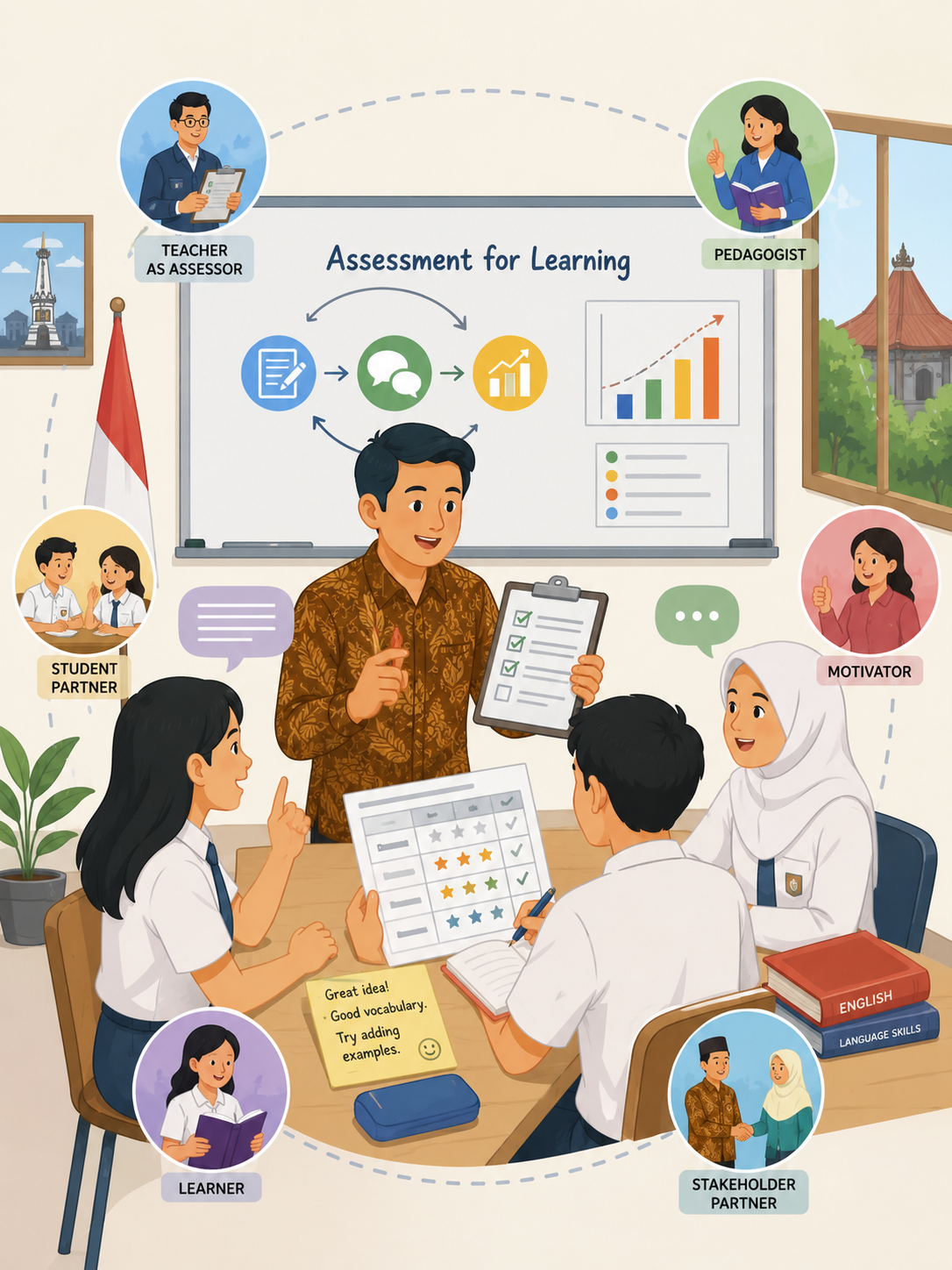
This research explores the factors influencing Assessment for Learning (AfL) literacy among senior high school English teachers in Yogyakarta, Indonesia, drawing on Alonzo's (2016) comprehensive six-dimensional framework. Examining AfL from a sociocultural viewpoint reveals the multifaceted roles of instructors as assessors, pedagogists, student partners, motivators, learners, and stakeholders (Gipps, 1999; Lave & Wenger, 1991). The expertise of teachers in assessment for learning significantly influences the quality of feedback, reflection, and educational outcomes, making assessment literacy essential for effective teaching.
Methodology:
This quantitative study employed a validated AfL literacy survey, derived from Alonzo (2016), and was administered to 250 English instructors within the Senior High School English Teacher Working Group in Yogyakarta. We employed Confirmatory Factor Analysis (CFA) and Multivariate Analysis of Variance (MANOVA) to investigate the dimensions of AfL literacy and to examine the influence of gender, education, experience, and institutional support on it.
Findings:
The results showed that educational attainment, teaching experience, and institutional support had a considerable impact on teachers' AfL literacy, while gender did not have a significant effect. Educators with Master’s degrees and over ten years of teaching experience demonstrated enhanced literacy in assessment for learning, particularly in the roles of assessors, pedagogists, and partners with students. Support from the institution enhanced teachers' confidence and sustained their engagement in assessment for learning practices.
Conclusion:
Transforming conceptual understanding into effective classroom practice requires continuous professional development, support from the school, and regular reflection on practices.
Originality:
This investigation extends Alonzo’s (2016) framework to the context of Indonesian EFL, systematically identifying demographic and institutional elements that affect AfL literacy, an area that has been rarely examined in educational research within Southeast Asia.
References
Alkharusi, H. A. (2009). Correlates of Teacher Education Students’ Academic Performance in an Educational Measurement Course. The International Journal of Learning: Annual Review, 16(2), 1–16. https://doi.org/10.18848/1447-9494/CGP/v16i02/46111
Alonzo, D. (2016). Development and application of a teacher assessment for learning (AfL) literacy tool [Unpublished doctoral dissertation]. University of New South Wales.
Amirian, S. M. R. (2025). Understanding EFL teachers’ formative assessment literacy: insights from a mixed-methods study. Language Testing in Asia, 15(1), 25. https://doi.org/10.1186/s40468-025-00363-y
Asanov, A. (2025). Examining EFL Teachers’ Assessment Literacy: Factors of Influence at Westminster International University in Tashkent. The Journal of Linguistic and Intercultural Education, 18(1), 7–32. https://doi.org/10.29302/jolie.2025.18.1.1
Chang, D. Y.-S., Lin, M. H., & Lee, J.-Y. (2024). Exploring language assessment literacy and needs of English teachers at senior high school level. Asia Pacific Journal of Education, 44(4), 854–872. https://doi.org/10.1080/02188791.2024.2313486
Coombe, C., Vafadar, H., & Mohebbi, H. (2020). Language assessment literacy: what do we need to learn, unlearn, and relearn? Language Testing in Asia, 10(1), 3. https://doi.org/10.1186/s40468-020-00101-6
Davidheiser, S. A. (2013). Identifying areas for high school teacher development: A study of assessment literacy in the Central Bucks School District [Doctoral dissertation]. Drexel University.
Gunawan, S. H., Dwianti, E., & Suryantono, G. (2025). Literacy assessment of English teachers: Need analysis for higher education contexts. Linguistics and Education Journal, 3(2), 046–051. https://doi.org/10.26877/lej.v3i2.22037
Hailaya, W. M. (2014). Teacher assessment literacy and student outcomes in the Province of Tawi-Tawi, Philippines [Doctoral dissertation]. The University of Adelaide.
Isnawati, I. (2023). EFL teachers’ assessment literacy. LLT Journal: A Journal on Language and Language Teaching, 26(2), 760–769. https://doi.org/10.24071/llt.v26i2.3654
Jawhar, S. S., & Subahi, A. M. (2020). The impact of specialty, sex, qualification, and experience on teachers’ assessment literacy at Saudi higher education. International Journal of Learning, Teaching and Educational Research, 19(5), 200–216. https://doi.org/10.26803/ijlter.19.5.12
Lam, R. (2019). Teacher assessment literacy: Surveying knowledge, conceptions and practices of classroom-based writing assessment in Hong Kong. System, 81, 78–89. https://doi.org/10.1016/j.system.2019.01.006
Latif, M. W. (2021). Exploring tertiary EFL practitioners’ knowledge base component of assessment literacy: implications for teacher professional development. Language Testing in Asia, 11(1), 19. https://doi.org/10.1186/s40468-021-00130-9
Levi, T., & Inbar-Lourie, O. (2020). Assessment literacy or language assessment literacy: Learning from the teachers. Language Assessment Quarterly, 17(2), 168–182. https://doi.org/10.1080/15434303.2019.1692347
Luthfiyyah, R., Basyari, I. W., & Dwiniasih, D. (2020). EFL secondary teachers’ assessment literacy: Assessment conceptions and practices. Journal on English as a Foreign Language, 10(2), 402–421. https://doi.org/10.23971/jefl.v10i2.2101
Mirizon, S. (2021). Teachers of English assessment literacy: Unveiling what they know and do. Indonesian Research Journal in Education |IRJE|, 5(1), 124–141. https://doi.org/10.22437/irje.v5i1.12834
Muhson, A., Mwakapemba, J. L., Siswanto, S., Prilanita, Y. N., & Susilowati, N. (2025). Teachers’ assessment literacy: The impact of gender, education, training, and work experience. Journal of Education and Learning (EduLearn), 19(3), 1410–1417. https://doi.org/10.11591/edulearn.v19i3.22040
Napanoy, J. B., & Peckley, M. K. (2020). Assessment literacy of public elementary school teachers in the Indigenous communities in northern Philippines. Universal Journal of Educational Research, 8(11B), 5693–5703. https://doi.org/10.13189/ujer.2020.082203
Nasution, I. (2024). English teachers’ assessment literacy in conducting assessment of learning. Global Expert: Jurnal Bahasa Dan Sastra, 11(2), 36–46. https://doi.org/10.36982/jge.v11i2.3277
Prastikawati, E. F., Mujiyanto, J., Saleh, M., & Fitriati, S. W. (2025). Factors influencing assessment decision-making of pre-service EFL teachers: Insights from the teaching practicum experience. Theory and Practice in Language Studies, 15(4), 1330–1339. https://doi.org/10.17507/tpls.1504.31
Putro, N. H. P. S., Damio, S. M., Sukarno, S., & Purnawan, A. (2022). Pre-service teachers’ literacy of assessment for learning. Asian Journal of University Education, 18(3). https://doi.org/10.24191/ajue.v18i3.18984
Sukarno, S., Putro, N. H. P. S., Fitrianingsih, I., Alsamiri, Y. A., Gharamah, F. M. A., & Tatin, I. A. G. (2024). Exploring the perceptions of literacy in assessment for learning among high school English teachers. REID (Research and Evaluation in Education), 10(2), 143–154. https://doi.org/10.21831/reid.v10i2.71324
Sultana, N. (2019). Language assessment literacy: an uncharted area for the English language teachers in Bangladesh. Language Testing in Asia, 9(1), 1. https://doi.org/10.1186/s40468-019-0077-8
Thi Bich Nguyen, D., Thi Hoai, N., & Vinh Quang, N. (2024). English teachers’ learning needs for language testing and assessment: An exploratory study. Journal of Science Educational Science, 3–12. https://doi.org/10.18173/2354-1075.2024-0041
Xu, Y., & Brown, G. T. L. (2017). University English teacher assessment literacy: A survey-test report from China. Studies in Language Assessment, 133–158. https://doi.org/10.58379/UZON5145
Downloads
Published
Issue
Section
License
Copyright (c) 2026 Sukarno, Nur Hidayanto Pancoro Setyo Putro, Ihtiara Fitrianingsih, Satrio Aji Pramono, Nita Magfiratul Jannah, Yasir A. Alsamiri, Fadhl Mohammed Awadh Gharamah

This work is licensed under a Creative Commons Attribution-ShareAlike 4.0 International License.
Authors retain copyright and grant the journal right of first publication with the work simultaneously licensed under a Creative Commons Attribution 4.0 International License that allows others to share the work with an acknowledgement of the work's authorship and initial publication in this journal.