EFL Students’ Perceptions of Reading for Pleasure in Indonesian Higher Education: Motivation, Habits, Material Preferences, and Language Skill Development
DOI:
https://doi.org/10.24903/sj.v11i1.2256Keywords:
reading for pleasure, motivation, EFL students, reading habits, material preferencesAbstract
Background:
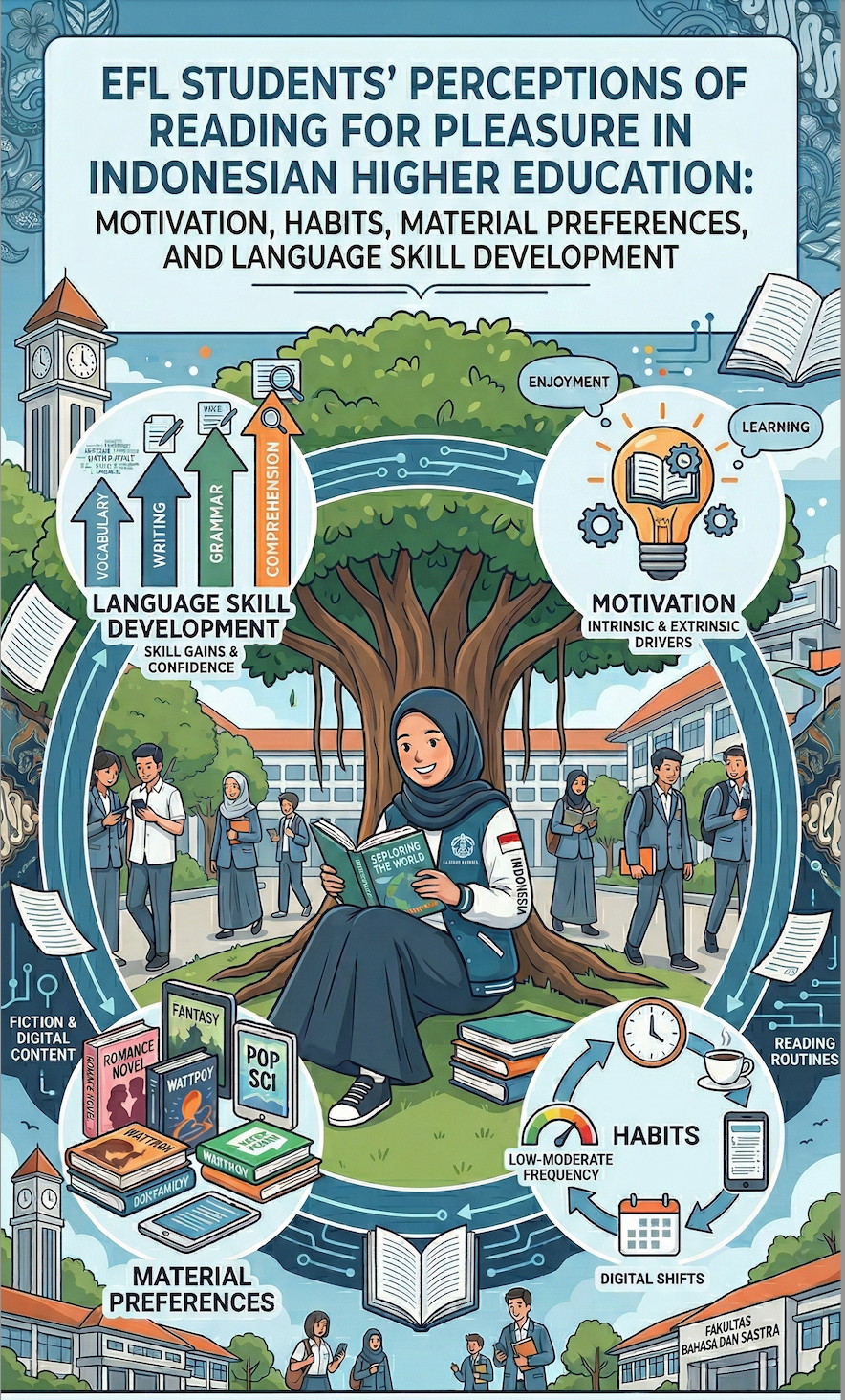
This study explores the EFL university students’ perceptions of Reading for Pleasure (RfP) in terms of reading motivation, reading habits, material preferences, and perceived English language skill development.
Methodology:
A quantitative descriptive research design was employed. Data collected from 35 second semester students of English Education at one of the private universities in Central Java by using a validated questionnaire.
Findings:
Results show that students have a high opinion of so-called RfP, especially its effect on vocabulary and reading comprehension (more than 80%). Much of the motivation is instrumental in nature, and students read to get better at reading rather than to enjoy it. The participation is still sporadic due to the time (71.4 %) and low institutional (42.9%) support for research. For media preference, the results show that materials of choice are fictional works (82.8%) and digital versions (74.3%), indicating change in reading habits. The findings of the regression analysis provide evidence that investment in reading as an activity has a greater effect on skill development (β = 1.50) than motivation, reinforcing the importance of turning motivation into practice over time.
Conclusion:
Students acknowledged the linguistic and academic benefits of RfP. The school-level practices, including organized RfP activities, rich materials and an autonomy supportive climate are critical to cultivation of consistent reading habits and comprehensive language knowledge. Use of longitudinal designs and digital/collaborative reading practice might provide further explanation to sustaining engagement.
Originality:
Despite the well-established influence, with evidence of its positive contributions on learners, few studies have addressed how motivation, reading habits, material preference and perceived skill development interrelate in Indonesian higher education.
References
Ahmad, Z., Tariq, D. M., Iqbal, Q., & Sial, T. A. (2021). Exploring the Factors Affecting the Development of Reading Habits among Children Library Philosophy and Practice. doi:https://digitalcommons.unl.edu/libphilprac/6307
Ahmed, S. (2016). Reading Habits and Attitudes of UMSKAL Undergraduates. International Journal of Applied Linguistics & English Literature, 5(2). doi:http://dx.doi.org/10.7575/aiac.ijalel.v.5n.2p.189
Aktar, S., & Akter, M. H. H. (2024). Understanding the pleasure reading habits of university students. International Journal of Information and Knowledge Studies, 4(1). doi: https://doi.org/10.54857/c8sd2z52
Alzubi, A. A. F., Nazim, M., & Ahmad, J. (2025). Identifying English as a foreign language students’ attitude to improving speaking skills through collaboration. Journal of Education and Learning, 19(1). doi: https://doi.org/10.11591/edulearn.v19i1.21333
Anggrainy, R., et al. (2024). Gamified reading activities and their effect on EFL learners’ motivation. Journal of English Language Teaching and Technology, 9(1), 15–30. https://doi.org/10.31458/jeltt.v9i1.2024
Anindita, C. (2020). EFL Students' Perception Towards Extensive Reading Practices in Higher Education Level. RETAIN, 8(4), 89-98.
Ateek, M. (2021). Extensive Reading in an EFL Classroom: Impact and Learners' Perceptions. Eurasian Journal of Applied Linguistics, 7(1). doi:https://10.32601/ejal.911195
Bui, T. N., & Macalister, J. (2021). Online extensive reading in an EFL context: Investigating reading fluency and perceptions. Reading in a Foreign Language, 33(1), 1–29. https://www.readinginforeignlanguage.org/
Chang, L., Wang, Y., Liu, J., Feng, Y., & Zhang, X. (2022). Study on factors influencing college students’ digital academic reading behavior. Frontiers in Psychology, 13. doi: https://doi.org/10.3389/fpsyg.2022.1007247
Cremin, T., & Scholes, L. (2024). Reading for pleasure: Policy and practice in global contexts. Literacy Research International, 45(2), 112–128. https://doi.org/10.1080/17482631.2024.112128
Creswell, J. W. (2019). Qualitative inquiry and research design: choosing among five approaches. Sustainability (Switzerland): SAGE Publications, Inc.
Day, R. R., & Bamford, J. (1998). Extensive reading in the second language classroom. Cambridge: Cambridge University Press. ISBN: 9780521568296.
Elvriza, M. S., & Nurcholis, I. A. (2025). The Impact of Extensive Reading of Novels on Students' English Vocabulary Acquisition. Indonesian Journal of Education, 1(3), 94-102. doi:http://dx.doi.org/10.71417/ije.v1i3.215
Fatimah, I. S., & Yulianto, S. W. (2025). Third Year University Students' Reading Habits and Perceptions of Reading for Pleasure: A Descriptive Study. Biormatika: Jurnal Ilmiah Fakultas Keguruan dan Ilmu Pendidikan, 11(1), 1-7. doi:https://doi.org/10.35569/biormatika.v11i1.1908
Fuentes, V. R. (2023). Reading in English is Like Neutral: A Qualitative Study of TEFL Undergraduates' Experiences of Reading in EFL in Chile. (Doctor of Philosophy Doctoral dissertation), University of York.
Hakiki, A., & Mardiana, S. (2024). Teacher competence and classroom environment in shaping reading motivation. Journal of Educational Research and Practice, 14(2), 88–105. https://doi.org/10.56789/jerp.v14i2.2024
Halum, Y. S., & Guna, S. (2023). EFL students’ reading habits: A study towards the use of digital tools. International Conference on Education, Humanities, Health and Agriculture Proceedings, 3, 15–16. https://doi.org/10.31219/osf.io/abcd1
Harimurti, K. F., Wulyani, A. N., & Setyowati, L. (2025). Exploring extensive reading implementation in higher education: A TPACK-based analysis. Journal on English as a Foreign Language, 15(1), 1-29. doi:https://doi.org/10.23971/jefl.v15i1.8638
Ibhar, M. Z. (2022). Reading motivation and EFL learners’ vocabulary development against interest in learning English moderated by teacher competence. J-SHMIC: Journal of English for Academic, 9(2), 9823. https://doi.org/10.25299/jshmic.2022.vol9(2).9823
Iwaniec, J., & Khaled, H. Y. (2024). Motivation and engagement in language learning. In A. Cirocki (Ed.), Cognitive and Educational Psychology for TESOL (pp. 131–149). Springer. https://doi.org/10.1007/978-3-031-66532-5_7
Juliari, I. G. A. I. T., Susila, I. K. D., & Juliani, N. P. (2024). School Literacy Movement and Parents’ Motivation on EFL Students’ Reading Interest. The Art of Teaching English as a Foreign Language, 5(2), 196–206. https://doi.org/10.36663/tatefl.v5i2.906
Karasu, O., & Tunaboylu, O. (2022). Pleasure Reading: The Gains of Student Teachers of English Obtained from a Reading Journey. The Eurasia Proceedings of Educational & Social Sciences (EPESS), 25, 194-201. doi:https://doi.org/10.55549/epess.1221495
Kayla, A., Nuraini, A., Ketaren, A. S., Nabilah, R. A., & Mulyati, Y. F. (2024). The Impact of Extensive Reading Course in EFL Students. IDEAS: Journal of Language Teaching and Learning, Linguistics and Literature, 12(2). doi:https://doi.org/10.24256/ideas.v12i2.5184
Khonamri, H., et al. (2024). Collaborative reading circles and their impact on EFL learners’ motivation. Journal of Language and Literacy Education, 10(1), 22–39. https://doi.org/10.12345/jlle.v10i1.2024
Krashen, S. D. (1982). Principles and practice in second language acquisition. Oxford: Pergamon Press. http://www.sdkrashen.com/content/books/principles_and_practice.pdf
Li, M., Ma, S., & Shi, Y. (2023). Examining the effectiveness of gamification as a tool promoting teaching and learning in educational settings: A meta-analysis. Frontiers in Psychology, 14, Article 1253549. https://doi.org/10.3389/fpsyg.2023.1253549
Marszalek, J. M., Balagna, D., Kim, A. K., & Patel, S. A. (2022). Self-concept and intrinsic motivation in foreign language learning: The connection between flow and the L2 self. Frontiers in Education, 7, 975163. https://doi.org/10.3389/feduc.2022.975163
Matyakhan, T., Chaowanakritsanakul, T., & Santos, J. A. L. (2024). Implementing gamification to enhance reading engagement and reading comprehension of Thai EFL university students. LEARN Journal, 17(1), 212–239. https://so04.tci-thaijo.org/index.php/LEARN/article/view/123456
Meniado, J. (2016). Metacognitive Reading Strategies, Motivation, and Reading Comprehension Performance of Saudi EFL Students. English Language Teaching, 9(3), 117-129. doi:https://doi.org/10.5539/elt.v9n3p117
Mustafa, S. K., Ali, O. S., Awlqadir, M. S., & Mahmood, R. J. (2021). INVESTIGATING FACTORS AFFECTING POOR READING CULTURE AMONG EFL UNIVERSITY STUDENTS. Education, Sustainability & Society, 4(1), 33-38. doi:http://doi.org/10.26480/ess.01.2021.33.38
Ounissi, A., Romly, R., & Tajuddin, A. J. A. (2025). The evolution of online extensive reading and web-based platforms in EFL/ESL: A narrative review of impacts, challenges, and future directions. Australian Journal of Applied Linguistics, 8(1), Article 102592. https://doi.org/10.29140/ajal.v8n1.102592
Putri, Z. F. S., & Damayanti, I. L. (2025). Pleasure reading, better understanding: A young EFL learner’s journey in digital extensive reading. Focus on Language Education and Research, 10(2), 196–206. https://doi.org/10.18196/ftl.v10i2.25269
Rahmaningtias, P., & Kusumastuti, D. (2019). A Survey of EFL Students’ Reading Habit. Proceeding of National Seminar of PBI (English Language Education), 417–421.
Rosenblatt, L. M. (1978). The reader, the text, the poem: The transactional theory of the literary work. Carbondale: Southern Illinois University Press.
Ryan, R. M., & Deci, E. L. (2000). Self-Determination Theory and the Facilitation of Intrinsic Motivation, Social Development, and Well-Being. American Psychologist, 55(1), 68-78. doi:http://dx.doi.org/10.1037/0003-066X.55.1.68
Saefatu, Y. I., Mustofa, A., & Retnaningdyah, P. (2023). EFL Students' Perceptions of Digital Extensive Reading Program in Junior High School Level. EDUKASIA: Jurnal Pendidikan dan Pembelajaran, 4(2). doi:https://doi.org/10.62775/edukasia.v4i2.354
Safei, N. H., & Ekasari, F. R. (2022). Positive contribution of extensive reading to EFL students’ learning. IDEAS: Journal of Language Teaching and Learning, Linguistics and Literature, 10(2), 2043–2054. https://doi.org/10.24256/ideas.v10i2.3232
Saito, A. (2025). Motivation and engagement in extensive reading: Insights from EFL learners at a science university. IAFOR Journal of Education, 13(1), 43–68. https://doi.org/10.22492/ije.13.1.03
Saville, J., Cooper, T., Edge, T., & Hunt, S. (2023). How can collaborative reading techniques impact confidence and belonging? Journal of Learning Development in Higher Education, 29, Article 1112. https://doi.org/10.47408/jldhe.v0i29.1112
Song, Y. (2024). Emotional engagement in reading: Implications for EFL literacy development. Applied Linguistics Review, 15(3), 245–263. https://doi.org/10.1515/applirev-2024-0023
Vogrinčič Čepič, A., et al. (2024). Institutional frameworks for fostering reading for pleasure: A systematic review. Journal of Literacy Policy Studies, 12(4), 301–322. https://doi.org/10.1080/17482631.2024.301322
Zhang, Z., Gao, X., & Liu, T. (2024). Enjoyment in foreign language learning: A systematic review. Heliyon, 10, e37215. https://doi.org/10.1016/j.heliyon.2024.e37215
Zhou, J. (2024). Extensive Reading. Cambridge University Press. https://doi.org/10.1017/9781108971234
Downloads
Published
Issue
Section
License
Copyright (c) 2026 Dyah Kusumastuti, Athayazhafirah Aulia Dien, Katim Lowe

This work is licensed under a Creative Commons Attribution-ShareAlike 4.0 International License.
Authors retain copyright and grant the journal right of first publication with the work simultaneously licensed under a Creative Commons Attribution 4.0 International License that allows others to share the work with an acknowledgement of the work's authorship and initial publication in this journal.