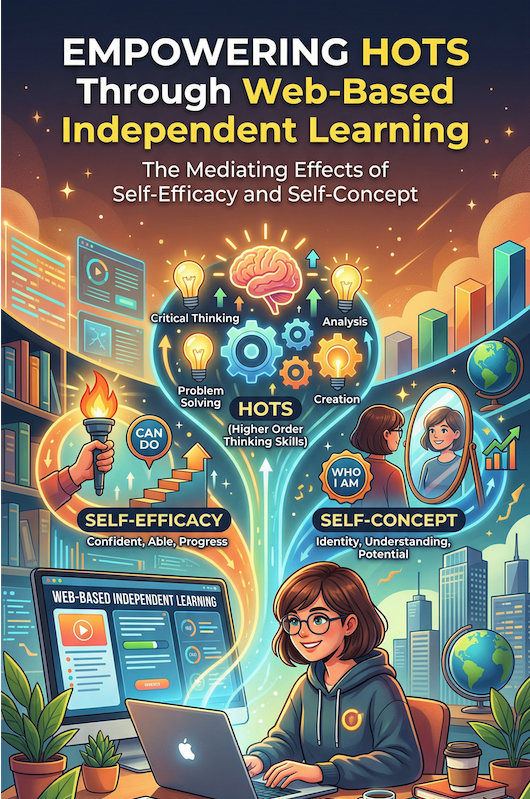
Empowering HOTS Through Web-Based Independent Learning: The Mediating Effects of Self-Efficacy and Self-Concept
DOI:
https://doi.org/10.24903/sj.v11i1.2322Keywords:
web-based independent learning, self-efficacy, self-concept, higher-order thinking skills, translation learningAbstract
Background:
This study investigates the effect of web-based independent learning (WBIL) on students’ higher-order thinking skills (HOTS), with self-efficacy (SE) and self-concept (SC) as mediating variables, within the context of translation learning in higher education.
Methodology:
A quantitative research design was employed using Partial Least Squares Structural Equation Modeling (PLS-SEM). Data were collected from 55 undergraduate students enrolled in translation-related courses through validated instruments measuring WBIL, SE, SC, and HOTS.
Findings:
The findings indicate that WBIL has a significant positive effect on both self-efficacy and self-concept. Furthermore, both SE and SC significantly predict students’ HOTS, with self-efficacy emerging as the stronger predictor. Mediation analysis reveals that SE and SC partially mediate the relationship between WBIL and HOTS, indicating that WBIL enhances higher-order thinking skills both directly and indirectly through psychological mechanisms. This study contributes to the literature by providing empirical evidence of the WBIL–HOTS relationship specifically within translation learning, a context that requires complex cognitive processes such as analysis, evaluation, and creative decision-making. Unlike prior studies that primarily focus on general digital learning or STEM contexts, this research highlights the role of psychological factors in shaping higher-order thinking in language-based disciplines.
Conclusion:
The findings underscore the importance of integrating learner autonomy and psychological readiness in designing effective web-based learning environments for translation education.
Originality:
This study provides empirical evidence of the WBIL–HOTS relationship specifically within translation learning, a context requiring complex cognitive processes. Unlike prior studies focusing primarily on general digital learning or STEM contexts, this research highlights the crucial role of psychological factors in shaping higher-order thinking in language-based disciplines.
References
Abdullah, M. N. L. Y., Saw Fen, T., Samsudin, M. A., Tze Ying, S., & Chorng Yuan, F. (2024). Factors Influencing Undergraduate Students’ Online Learning Outcomes: A Structural Equation Modeling. Sage Open, 14(2), 21582440241261834. https://doi.org/10.1177/21582440241261834
Almakky, H. (2024). Integrating Translation and Web-Based Learning into Higher Education: Challenges, Self-Esteem, and the Quest for Academic Excellence among Arabic-Speaking Students. International Journal of Learning, Teaching and Educational Research, 23(6), 640–661. https://doi.org/10.26803/ijlter.23.6.30
Althewini, A. (2025). Navigating Online Language Learning: The Impact of Self-Efficacy and Self-Regulation on Student Success. Arab World English Journal, (11), 380–392. https://doi.org/10.24093/awej/call11.23
Anwar, R. S., Salam, A., Haryandi, S., & Rahman, N. F. A. (2023). Effectiveness of the CinQASE Web Integrated Learning Model to Train Higher Order Thinking Skills. Jurnal Ilmiah Pendidikan Fisika, 7(2), 309. https://doi.org/10.20527/jipf.v7i2.9191
Arianto, F., Sumarno, A., Setyaedhi, H. S., Shofiana, F. R., & Hanif, M. (2026). DEEP DIGITAL LEARNING (DDL) MODEL EFFECT ON HIGHER EDUCATION CRITICAL THINKING AND PROBLEM-SOLVING SKILLS: A QUASI-EXPERIMENTAL STUDY. JURNAL EDUSCIENCE, 13(1), 39–50. https://doi.org/10.36987/jes.v13i1.8272
Azizah, N., Rahardjo, D. T., & Probosari, R. M. (2022). The Relationship Between Learning Motivation and Self-Concept with Higher Order Thinking Skills (Hots) on VIII Grade Science Subjects. PAEDAGOGIA, 25(1), 31. https://doi.org/10.20961/paedagogia.v25i1.50536
Bandura, A. (2012). On the Functional Properties of Perceived Self-Efficacy Revisited. Journal of Management, 38(1), 9–44. https://doi.org/10.1177/0149206311410606
Barnard, L., Lan, W. Y., To, Y. M., Paton, V. O., & Lai, S.-L. (2009). Measuring self-regulation in online and blended learning environments. The Internet and Higher Education, 12(1), 1–6. https://doi.org/10.1016/j.iheduc.2008.10.005
Blum, D., Davis, E. E., Gibson, K., Phillips, R. L., Jeyaraj, A. S. S., & Winters, B. (2021). “I’ve never cried with a stranger before”: A pedagogy of discomfort, emotion and hope for immigrant justice. International Journal of Qualitative Studies in Education, 34(8), 763–781. https://doi.org/10.1080/09518398.2021.1962564
Bolaños-Medina, A. (2014). Self-efficacy in translation. Translation and Interpreting Studies, 9(2), 197–218. https://doi.org/10.1075/tis.9.2.03bol
Brashi, A. (2022). Self-Efficacy in the Prediction of GPA and Academic Computer Use in Undergraduate Translation Students at a Saudi University. Frontiers in Psychology, 13, 865581. https://doi.org/10.3389/fpsyg.2022.865581
Burkšaitienė, N. (2025). Web-based Learning Technologies in Translation Studies: Undergraduate Students’ Views. Journal of Education Culture and Society, 16(2), 425–440. https://doi.org/10.15503/jecs2025.3.425.440
Chemers, M. M., Hu, L., & Garcia, B. F. (2001). Academic self-efficacy and first year college student performance and adjustment. Journal of Educational Psychology, 93(1), 55–64. https://doi.org/10.1037/0022-0663.93.1.55
Chen, R., Liu, Y., & Gong, Y. (2025). Impact of Self-Concept and Self-Efficacy on Foreign Language Learners in Online and Face-to-Face Learning Contexts in China. Sage Open, 15(4), 21582440251356441. https://doi.org/10.1177/21582440251356441
Chernovaty, L., & Kovalchuk, N. (2021). Psycholinguistic Aspects of the Development of Students’ Critical Approach to the Solution of Terminological Problems in Online Translation Learning. East European Journal of Psycholinguistics, 8(2), 25–35. https://doi.org/10.29038/eejpl.2021.8.2.che
Guo, J.-P., Yang, L.-Y., Zhang, J., & Gan, Y.-J. (2022). Academic self-concept, perceptions of the learning environment, engagement, and learning outcomes of university students: Relationships and causal ordering. Higher Education, 83(4), 809–828. https://doi.org/10.1007/s10734-021-00705-8
Hair, J. F., Hult, G. T. M., Ringle, C. M., Sarstedt, M., Danks, N. P., & Ray, S. (2021). Partial Least Squares Structural Equation Modeling (PLS-SEM) Using R: A Workbook. Springer International Publishing. https://doi.org/10.1007/978-3-030-80519-7
Handayani, S., Suryana, N., & Adeliani, C. S. M. (2024). DESIGNING WEB-BASED LEARNING TO ENHANCE STUDENTS’ HIGHER ORDER THINKING SKILLS (HOTS). English Journal Literacy Utama, 8(2), 117–130. https://doi.org/10.33197/ejlutama.v8i2.252
Hariadi, B., Jatmiko, B., & Sunarto, D. (2022). Higher Order Thinking Skills Based Learning Outcomes Improvement with Blended Web Mobile Learning Model. International Journal of Instruction, 15(2), 565–578. https://doi.org/10.29333/iji.2022.15231a
Holenstein, M., Bruckmaier, G., & Grob, A. (2022). How do self‐efficacy and self‐concept impact mathematical achievement? The case of mathematical modelling. British Journal of Educational Psychology, 92(1), e12443. https://doi.org/10.1111/bjep.12443
Huang, H.-W., Lin, Q., & Darragh, J. J. (2020). Understanding EFL Learners’ Self-efficacy of Collaborative Translation in a Blended English Course. Proceedings of the 2020 4th International Conference on E-Education, E-Business and E-Technology, 78–83. https://doi.org/10.1145/3404649.3404661
Kirmizi, O. (2015). The interplay among academic self-concept, self-efficacy, self-regulation and academic achievement of higher education l2 learners. Journal of Higher Education and Science, 5(1), 32. https://doi.org/10.5961/jhes.2015.107
Lin, B., & Hsieh, C. (2001). Web-based teaching and learner control: A research review. Computers & Education, 37(3–4), 377–386. https://doi.org/10.1016/S0360-1315(01)00060-4
Marczak, M. (2018). Translation Pedagogy in the Digital Age: How digital technologies have been altering translator education. Angles, 7. https://doi.org/10.4000/angles.895
Marsh, H. W., Ellis, L. A., Parada, R. H., Richards, G., & Heubeck, B. G. (2005). A Short Version of the Self Description Questionnaire II: Operationalizing Criteria for Short-Form Evaluation With New Applications of Confirmatory Factor Analyses. Psychological Assessment, 17(1), 81–102. https://doi.org/10.1037/1040-3590.17.1.81
Marsh, H. W., & Martin, A. J. (2011). Academic self‐concept and academic achievement: Relations and causal ordering. British Journal of Educational Psychology, 81(1), 59–77. https://doi.org/10.1348/000709910X503501
Mebarki, A. (2024). Using e-learning for translation subjects in Algerian universities: The reality of distance education. Global Journal of Foreign Language Teaching, 14(2), 102–114. https://doi.org/10.18844/gjflt.v14i2.8969
Mohammed, T. A. S., & Al-Sowaidi, B. (2023). Enhancing Instrumental Competence in Translator Training in a Higher Education Context: A Task-Based Approach. Theory and Practice in Language Studies, 13(3), 555–566. https://doi.org/10.17507/tpls.1303.03
Muftah, M. (2022). The effects of web-based language learning on university students’ translation proficiency. International Journal of Innovative Research in Education, 9(2), 106–117. https://doi.org/10.18844/ijire.v9i2.8496
Nurulwati, N., Afdar, C. R., Zakaria, S., & Yusrizal, Y. (2022). The Relationship of Self-Efficacy Towards High Level of Thinking Ability of USK Physics Education Student in Basic Physics I Course. Jurnal Pendidikan Sains Indonesia, 10(3), 527–537. https://doi.org/10.24815/jpsi.v10i3.24153
Rohmah, M., Rahmadani, R., Ismail, K., Rifa’i, N., & Damayanti, M. (2023). ANALISIS HIGHT ORDER THINKING SKILL BERDASARKAN SELF CONFIDENCE DAN SELF EFFICACY (STUDI PADA MAHASISWA PRODI PENDIDIKAN EKONOMI UNIVERSITAS NURUL HUDA). UTILITY: Jurnal Ilmiah Pendidikan Dan Ekonomi, 7(02), 107–132. https://doi.org/10.30599/utility.v7i02.2781
S, K., & Salim, S. (2024). IMPLEMENTATION OF INDEPENDENT LEARNING TO IMPROVE SELF-EFFICACY AND LEARNING MOTIVATION. KLASIKAL : JOURNAL OF EDUCATION, LANGUAGE TEACHING AND SCIENCE, 6(2), 493–499. https://doi.org/10.52208/klasikal.v6i2.1184
Saikia, R. (2020). A study on self-concept. International Education & Research Journal, 6((6)), 1–2.
Tyas, E. H., & Naibaho, L. (2021). HOTS LEARNING MODEL IMPROVES THE QUALITY OF EDUCATION. International Journal of Research -GRANTHAALAYAH, 9(1), 176–182. https://doi.org/10.29121/granthaalayah.v9.i1.2021.3100
Wahida, S. R., Baidowi, B., Lu’luilmaknun, U., & Turmuzi, M. (2021). Pengaruh self concept terhadap kemampuan berpikir tingkat tinggi mata pelajaran matematika siswa kelas VIII F SMPN 1 Mataram. Griya Journal of Mathematics Education and Application, 1(4), 703–710. https://doi.org/10.29303/griya.v1i4.54
Wilson, L. O., & Leslie, C. (2016). Anderson and Krathwohl Bloom’s Taxonomy Revised.
Zahra Nur Fadila, Suyit Ratno, Zahra Fadila Nst, Fauziah Nur Panjaitan, Naomi Priska Aprilia Hutapea, Meita Krisnadya Lumban Gaol, David Sitepu, & Hanny Pebri Olivia. (2024). Analisis Penerapan Model Pembelajaran Kreatif dan Inovatif Berbasis Hots di Era Digital. Jurnal Pendidikan, Bahasa Dan Budaya, 3(4), 125–134. https://doi.org/10.55606/jpbb.v3i4.4616
Zimmerman, B. J. (2002). Becoming a Self-Regulated Learner: An Overview. Theory Into Practice, 41(2), 64–70. https://doi.org/10.1207/s15430421tip4102_2
Downloads
Published
Issue
Section
License
Copyright (c) 2026 Refika Andriani, Akhsanul In’am, Adolf Bastian, Andi Idayani, Destina Kasriyati

This work is licensed under a Creative Commons Attribution-ShareAlike 4.0 International License.
Authors retain copyright and grant the journal right of first publication with the work simultaneously licensed under a Creative Commons Attribution 4.0 International License that allows others to share the work with an acknowledgement of the work's authorship and initial publication in this journal.