A Bibliometric Analysis of Translation Studies in Indonesia: Mapping Trends and Research Trajectories
DOI:
https://doi.org/10.24903/sj.v11i1.2342Keywords:
Translation Studies, Bibliometric Analysis, Research Trends, Indonesia, Digital TranslationAbstract
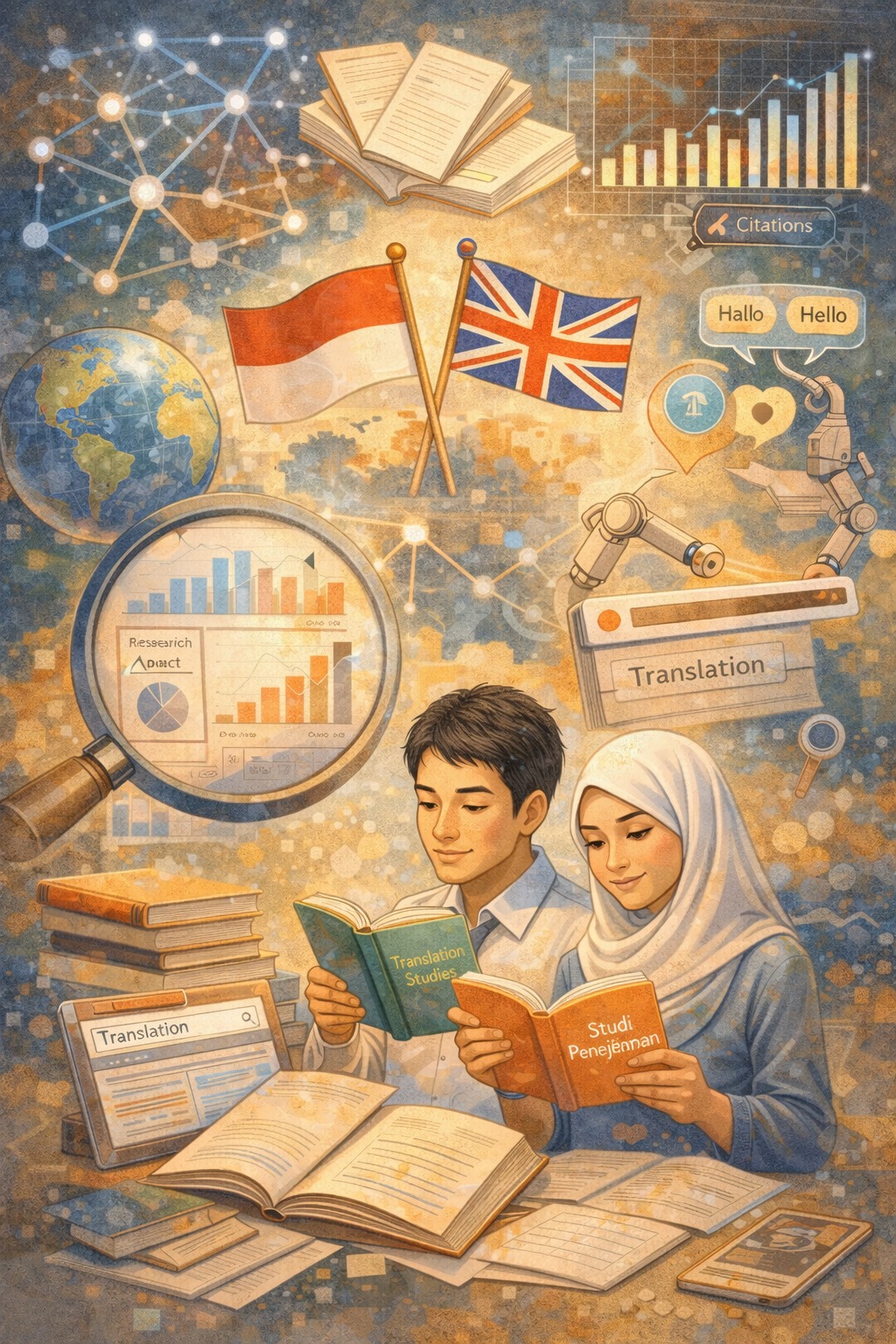
Background: Translation Studies has expanded internationally through bibliometric, computational, and interdisciplinary developments, yet the publication trajectory of Translation Studies in Indonesia has not been mapped systematically. A bibliometric overview is therefore needed to identify the field’s thematic concentration, collaboration patterns, and publication visibility. Methodology: This study employed a bibliometric design using records retrieved from Scopus and selected Indonesian peer-reviewed journals published between 2014 and 2025. After eligibility filtering, 137 Indonesia-focused records and 7,113 international reference records were analyzed using Biblioshiny. Findings: Indonesian Translation Studies was dominated by humanistic, pedagogical, and culturally oriented themes, whereas corpus-based, computational, and machine-translation topics appeared less frequently. In contextual comparison with the international reference set, the Indonesian corpus showed slower thematic diversification and lower visibility of technology-oriented translation research. Conclusion:These findings indicate that Indonesian Translation Studies is growing, but its publication profile remains more concentrated in humanistic and pedagogical domains than in technology-oriented and corpus-based areas. This pattern matters because it influences how the field may engage with emerging methods, international collaboration, and wider scholarly visibility in contemporary Translation Studies.
Originality:This study provides a bibliometric mapping of Indonesian Translation Studies based on peer-reviewed publication records and situates the national corpus in contextual comparison with an international reference set.
References
Aji, A. F., Winata, G. I., Koto, F., & Cahwajiya, S. (2022). One Country, 700+ Languages: NLP Challenges for Underrepresented Languages and Dialects in Indonesia. ArXiv: Computation and Language, 1–24.
Amini, M., Ravindran, L., & Lee, K.-F. (2024). Implications of using AI in Translation Studies: Trends, Challenges, and Future Direction. Asian Journal of Research in Education and Social Sciences, 6(1), 740–754. https://doi.org/10.55057/ajress.2024.6.1.67
Aria, M., & Cuccurullo, C. (2017). Bibliometrix: An R-tool for comprehensive science mapping analysis. Journal of Informetrics, 11(4), 959–975.
Bonvini, L., Taddei, S., Caini, S., Calugi, S., Bugli, G., Tarchi, L., Chiari, S., Galli, I., Giunti, I., Marino, C., Tavano, S., Castellini, G., Ricca, V., Lucarelli, S., Dalle Grave, R., & Pisano, T. (2025). Child eating disorder examination (ChEDE) interview and child eating disorder examination questionnaire (ChEDE-Q): psychometric properties of the Italian versions. Eating and Weight Disorders - Studies on Anorexia, Bulimia and Obesity, 30(1). https://doi.org/10.1007/s40519-025-01737-0
Brandenberger, J., Stedman, I., Stancati, N., Sappleton, K., Kanathasan, S., Fayyaz, J., & Singh, D. (2025). Using artificial intelligence based language interpretation in non-urgent paediatric emergency consultations. BMC Health Services Research, 25(1), 138.
Budiharjo, B. (2024). Artificial intelligence in translation: The menace, promise, and response to technology and superseded practice. In Advances in Social Science, Education and Humanities Research (Vol. 1, pp. 681–694). Atlantis Press.
Chandra, R., & Wahyuni, S. (2019). Translation strategies in English-Bahasa Indonesia text conversion: A case study on student translators. Indonesian Journal of Applied Linguistics, 9(1), 99–110.
Cronin, M. (2010). Translation and globalization: A sociological approach. Routledge.
Dewi, H. D. (2019). Translation Studies Research Development in Indonesia. Jurnal Humaniora, 31(2), 152. https://doi.org/10.22146/jh.v31i2.38872
Donthu, N., Kumar, S., Mukherjee, D., Pandey, N., & Lim, W. M. (2021). How to conduct a bibliometric analysis: An overview and guidelines. Journal of Business Research, 133, 285–296.
Fan, K., & Chunlei, W. (2023). Translation Studies in the Era of AI: Characteristics, Fields and Significance. International Journal of Translation and Interpretation Studies, 3(4), 68–77. https://doi.org/10.32996/ijtis.2023.3.4.7x
Hostiuc, S., et al. (2016). Ethical challenges in medical translation: A review of practices and concerns. Medical Ethics Journal, 11(3), 223–240.
Jung, J. Y., Tyack, L., & von Davier, M. (2024). Combining machine translation and automated scoring in international large-scale assessments. Large-Scale Assessments in Education, 12(1), 10. https://doi.org/10.1186/s40536-024-00199-7
Kumar, S. (2019). Co-authorship networks: A review of the literature. Aslib Journal of Information Management, 71(5), 591–615. https://doi.org/10.1108/AJIM-09-2018-0203
Lucie, R., Jean-Noel, V., Paul, M., Philippe, K., Laurent, B., & Marie-Hélène, L.-F. (2025). Linguistic-cultural validation of a French version of the oral health assessment tool. BMC Oral Health, 25(1). https://doi.org/10.1186/s12903-025-05488-3
Lyu, C., Du, Z., Xu, J., Duan, Y., Wu, M., Lynn, T., Aji, A. F., Wong, D. F., Liu, S., & Wang, L. (2023). A Paradigm Shift: The Future of Machine Translation Lies with Large Language Models. ArXIV.
Marczak, M. (2018). Emergentist approaches in translation education: Rethinking the curriculum. Translation Pedagogy, 15(1), 102–123.
Raîche, C., Lapointe, J., Villafane‐Bernier, C., Chiquette, J., Bouchard, K., Pelletier, S., Omeranovic, A., Fortier, P., Brousseau, C., Lauzier, S., Hébert, J., Dorval, M., & Nabi, H. (2025). Cross‐cultural adaptation and validation of a French version of the perceived personal control questionnaire as an outcome measure instrument for genetic counseling. Journal of Genetic Counseling, 34(2). https://doi.org/10.1002/jgc4.1989
Sánchez-Gijón, P. (2022). Translation quality and efficiency in the era of artificial intelligence: A critical review of machine translation tools. Translation & Technology, 9(2), 134–156.
Ulfa, R. (2023). The impact of Google Translate on student translation competence: Challenges and opportunities in the Indonesian context. Language & Translation Studies, 18(4), 76–90.
Vaswani, A., Shazeer, N., Parmar, N., Uszkoreit, J., Jones, L., Gomez, A. N., ... & Polosukhin, I. (2017). Attention is all you need. Advances in Neural Information Processing Systems, 30, 5998-6008.
Wahyuni, S., et al. (2023). Translation quality in specialized texts: A case study of anatomy book translations in Indonesia. Journal of Professional Translation, 12(3), 112–127.
Wang, L., Wloka, B., & Lepage, Y. (2025). Eliciting analogical reasoning from language models in retrieval-augmented translation under low-resource scenarios. Neurocomputing, 630(3). https://doi.org/10.1016/j.neucom.2025.129680
Wang, Y., & Chen, F. (2023). Corpus-based translation research in China: Trends and future directions. Journal of Chinese Translation Studies, 15(1), 55–78.
Yagahara, A., Uesugi, M., & Yokoi, H. (2025). Exploration of the optimal deep learning model for english-Japanese machine translation of medical device adverse event terminology. BMC Medical Informatics and Decision Making, 25(1), 66.
Yan, L., & Wang, J. (2022). Translation education in the digital age: The role of data science in translator training. Translation & Digital Humanities, 10(2), 98–115.
Yin, Y., & Zhong, Z. (2024). Eye-tracking methodologies in translation research: Cognitive insights into translation processes. Journal of Translation Cognition, 7(1), 43–65.
Zhang, X., & Zhang, Y. (2013). Integrating CAT tools into translation curricula: A pedagogical perspective. Journal of Translation Education, 6(2), 210–227.
Zhang, Y., & Cai, L. (2015). The role of machine translation in translation pedagogy: Evaluating its impact on student learning. Translation & Technology Journal, 5(1), 56–74.
Downloads
Published
Issue
Section
License
Copyright (c) 2026 Novriyanto Napu, Usman Pakaya, Hanisah Hanafi, Amirullah Abduh

This work is licensed under a Creative Commons Attribution-ShareAlike 4.0 International License.
Authors retain copyright and grant the journal right of first publication with the work simultaneously licensed under a Creative Commons Attribution 4.0 International License that allows others to share the work with an acknowledgement of the work's authorship and initial publication in this journal.