Visual Communication in Prehistoric Public Spaces: A Linguistic Landscape Study of Liangkabori Cave
DOI:
https://doi.org/10.24903/sj.v11i2.2360Keywords:
Semiotic landscape, Visual semiotics, Prehistoric communication, Rock art, Liangkabori CaveAbstract
Background:
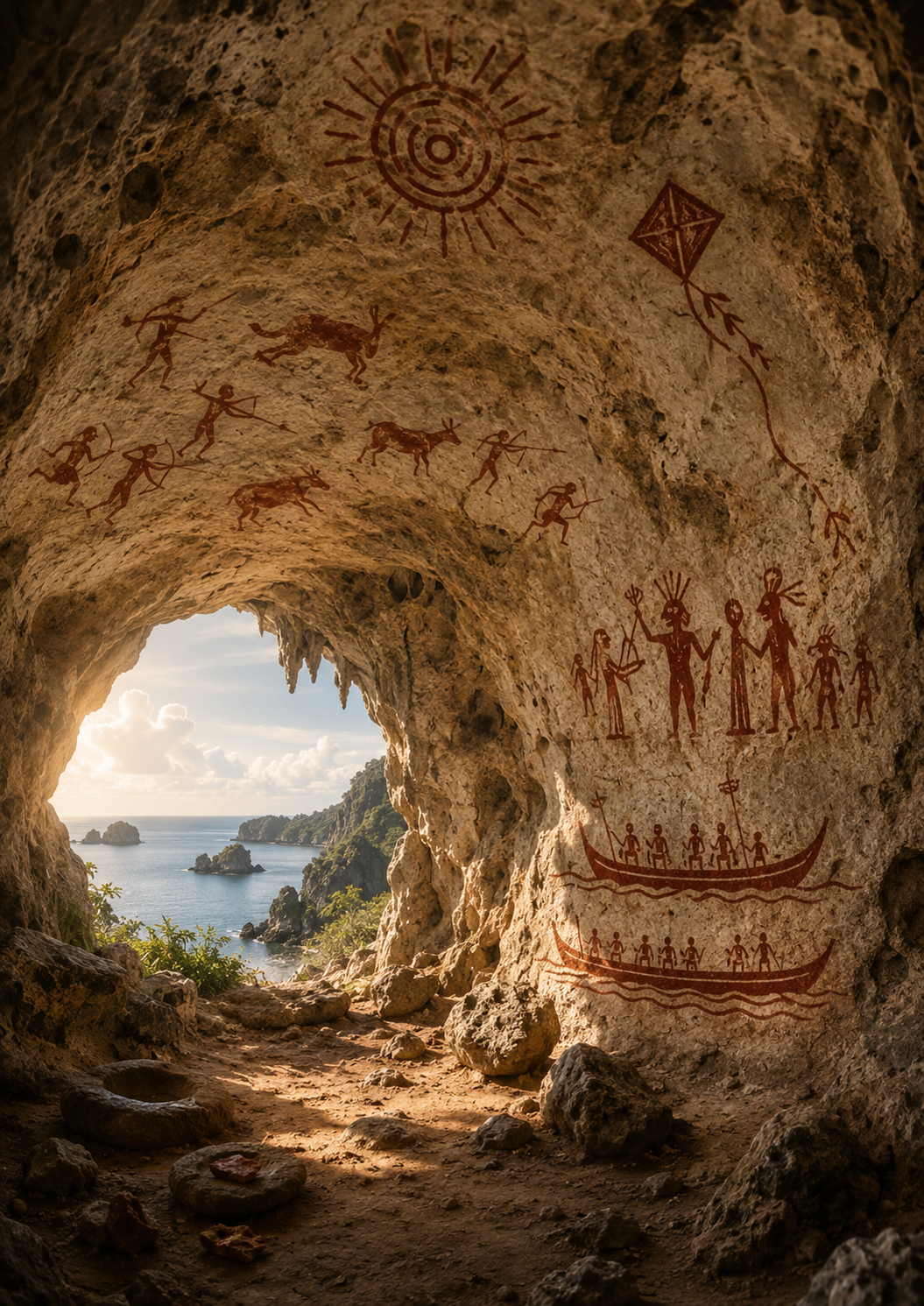
Linguistic landscape studies have predominantly focused on written texts in contemporary public spaces. This study extends the concept of Semiotic Landscapes to pre-literate contexts by examining the pictograms of Liangkabori Cave in Muna as a form of prehistoric public communication. This study aims to analyze how the pictograms in Liangkabori Cave function as elements of a prehistoric semiotic landscape that convey visual communication and social meaning.
Methodology:
This qualitative study applies a visual semiotics approach integrated with archaeological analysis. Data were obtained from hematite-based pictograms, supported by 3D scanning and spectroscopic analysis to examine painting techniques on karst surfaces.
Findings:
The pictograms appear to serve both informational and symbolic functions. Hunting and boat motifs suggest representations of subsistence strategies and maritime orientation. The kite motif may indicate an understanding of basic aerodynamic principles and communal practices, while the sun symbol can be interpreted as reflecting cosmological beliefs. These findings are interpretive and do not directly represent verifiable historical intentions.
Conclusion:
Liangkabori Cave can be understood as a form of prehistoric visual communication system. The findings suggest that visual representations were likely used to convey ecological knowledge, maritime practices, and belief systems. However, these interpretations remain tentative and highlight the importance of further interdisciplinary research and conservation efforts.
Originality:
This study contributes to linguistic landscape research by extending its scope to prehistoric contexts and proposing rock art as a form of semiotic landscape in pre-literate societies.
References
Ali Okto, Meliawati1, Hasria, Muliddin, Arisona1, Suryawan, S. (2023). Studi Geomorfologi Karst Pulau Muna , Provinsi Sulawesi Tenggara dan Potensinya Sebagai Geowisata. Jurnal Geosains Dan Remote Sensing (JGRS), 4(1), 27–36.
Artawa, K., Mulyawan, I. W., Satyawati, M. S., & Erawati, N. K. R. (2020). Balinese in Public Spaces (A Lingustic Landscapes Study in Kuta Village). Journal of Critical Reviews, 7(7), 6–10. https://doi.org/10.31838/jcr.07.07.02
Artawa, K., Paramarta, I. M. S., Mulyanah, A., & Atmawati, D. (2023). Centripetal and centrifugal interconnection on hotel and restaurant linguistic landscape of Bali, Indonesia. Cogent Arts & Humanities, 10(1). https://doi.org/10.1080/23311983.2023.2218189
Barni, M. & Bagna, C. (2010). Linguistic Landscape and Language Vitality. In E. Shohamy; E. Ben-Rafael & M.Barni (Ed.), Linguistic Landscape in the City (pp. 3–18). Multilingual Matters. https://doi.org/10.21832/9781847692993-010
Beeh, N., Nenotek, S. A., Snae, A., & Benu, N. N. (2023). Multilinguisticism in the Linguistic Landscape of Transportation in Kupang. LiNGUA: Jurnal Ilmu Bahasa Dan Sastra, 17(2), 187–198. https://doi.org/10.18860/ling.v17i2.17737
Ben-Rafael, E., Shohamy, E., Hasan Amara, M., & Trumper-Hecht, N. (2006). Linguistic Landscape as Symbolic Construction of the Public Space: The Case of Israel. In D. Gorter (Ed.), Linguistic Landscape: A New Approach to Multilingualism (pp. 7–30). Multilingual Matters.
Cindi Claudia Aridin, Syahrun, A. T. H. (2024). Identifikasi kerusakan gambar cadas pada situs gua la kolumbu desa liangkabori kecamatan lohia kabupaten muna. Sangia : Jurnal Penelitian Arkeologi (Journal of Archaeology Research), 8(2), 106–120.
Creswell, J. W. (2016). Research Design: Pendekatan Metode Kualitatif, Kuantitatif, dan Campuran(4th ed.). Pustaka Pelajar.
Gorter, D. (2006). Introduction: The study of the linguistic landscape as a new approach to multilingualism. International Journal of Multilingualism, 3(1), 1–6. https://doi.org/10.1080/14790710608668382
Gorter, D. (2013). Linguistic landscapes in a multilingual world. Annual Review of Applied Linguistics, 33, 190–212. https://doi.org/10.1017/S0267190513000020
Gorter, D. (2018). Methods and Techniques for Linguistic Landscape Research: About Definitions, Core Issues and Technological Innovations. In M. Pütz & N. Mundt (Eds.), Expanding the Linguistic Landscape: Linguistic Diversity, Multimodality and the Use of Space as a Semiotic Resource (pp. 38–55). Multilingual Matters. https://doi.org/10.21832/PUTZ2159
Herdiani, E., & Yondri, L. (2024). Suku Muna Di Kawasan Liang Kobori Kabupaten Muna. Prosiding Seminar Hasil Penelitian Dan Pkm Isbi Bandung Tahun 2024, 118–126.
Iye, R., Simpen, I. W., Sedeng, I. N., Netra, I. M., Said, I. M., & Abida, F. I. N. (2023). Language contextualization in public space in Maluku Province: A landscape linguistics study. Cogent Arts and Humanities, 10(1). https://doi.org/10.1080/23311983.2023.2247648
Jaworski, A., & Thurlow, C. (Eds.). (2010). Semiotic landscapes: Language, image, space. Continuum.
Landry, R., & Bourhis, R. Y. (1997). Linguistic landscape and ethnolinguistic vitality: An empirical study. Journal of Language and Social Psychology, 16(1), 23–49. https://doi.org/10.1177/0261927X970161002
Marten, H. F., Mensel, L. Van, & Gorter, D. (2012). in the Linguistic Landscape (pp. 1–15).
Miyagawa, S., Lesure, C., & Nóbrega, V. A. (2018). Cross-modality information transfer: A hypothesis about the relationship among prehistoric cave paintings, symbolic thinking, and the emergence of language. Frontiers in Psychology, 9, Article 115. https://doi.org/10.3389/fpsyg.2018.00115
Mooney, A., & Evans, B. (2023). Linguistic Landscapes. In Language, Society and Power (Vol. 1, Issue December, pp. 94–127). https://doi.org/10.4324/9781003120957-5
Muhlhausler, A. P. (2001). The Ecolinguistics Reader: Language, Ecologi and Eviroment. Continuum.
PH. and Chang, Y. C. (2009). Qualitative, quantitative, and mixed methods approaches. Research Design Qualitative Quantitative and Mixed Methods Approaches. In Research Design (Vol. 4, Issue June). Sage Publications.
Pomorska, K & Rudy, S. (eds). (1987). Roman Jakobson. Language in Literature. Harvard University Press.
Sanubarianto, S. T. &, & Wekin, C. T. (2020). Humanitatis Journal of Language and Literature Humanitatis Journal of Language and Literature. Humanitatis: Journal of Language and Literature, 7(1), 83–98.
Shohamy, E., Ghazaleh-Mahajneh, M. A. (2012). Linguistic Landscape as a Tool for Interpreting Language Vitality: Arabic as a ‘Minority’ Language in Israel. In L. Van Gorter, D., Marten, H.F., and Mansel (Ed.), Minority Languages in the Linguistic Landscape (pp. 89–106). Palgrave Macmillan. https://doi.org/https://doi.org/10.1057/9780230360235_6
Sope, A. (2023). Potensi Arkeologis : Gambar Cadas Kompleks Gua Prasejarah Liang. Sangia : Jurnal Penelitian Arkeologi (Journal of Archaeology Research), 7(1), 1–23.
Tang, M., Erawati, E., & Nur, M. (2020). Pelestarian Kawasan Gua-Gua Prasejarah Liang Kabori Kabupaten Muna ( Sebuah Perspektif Kepariwisataan ) ( Preservation Of The Prehistorical Caves of Liang Kabori In Muna Regency ( A Tourism Perspective ). Asian Journal of Environment, History and Heritage, 4(December), 33–46.
Van Mensel, L., Vandenbroucke, M. & R. B. (2016). Linguistic landscapes and language policies.’ In: C. Helot, M. Barni, R. Janssens, & C. Bagna (Ed.). Oxford Handbook of Language and Society Linguistic, December, 423–449.
Vesya, N. F., & Datang, F. A. (2022). Lanskap Linguistik Stasiun Mrt Lebak Bulus Grab. Prosiding Konferensi Linguistik Tahunan Atma Jaya (KOLITA), 20(20), 232–243. https://doi.org/10.25170/kolita.20.3800
Wang, X., & Xu, D. (2018). The mismatches between minority language practices and national language policy in Malaysia: A linguistic landscape approach. Kajian Malaysia, 36(1), 105–125. https://doi.org/10.21315/km2018.36.1.5
Downloads
Published
Issue
Section
License
Copyright (c) 2026 Risman Iye, Dian B, Nur Haizah Aopmonaim , Fithriyah Indah Nur Abida, Susiati

This work is licensed under a Creative Commons Attribution-ShareAlike 4.0 International License.
Authors retain copyright and grant the journal right of first publication with the work simultaneously licensed under a Creative Commons Attribution 4.0 International License that allows others to share the work with an acknowledgement of the work's authorship and initial publication in this journal.