Warning the Nation: A Sociopragmatic Analysis of Institutional Speech Acts in Indonesia’s BMKG Online Weather Alerts
DOI:
https://doi.org/10.24903/sj.v11i2.2365Keywords:
sociopragmatics, speech acts, disaster communication, early warning systemsAbstract
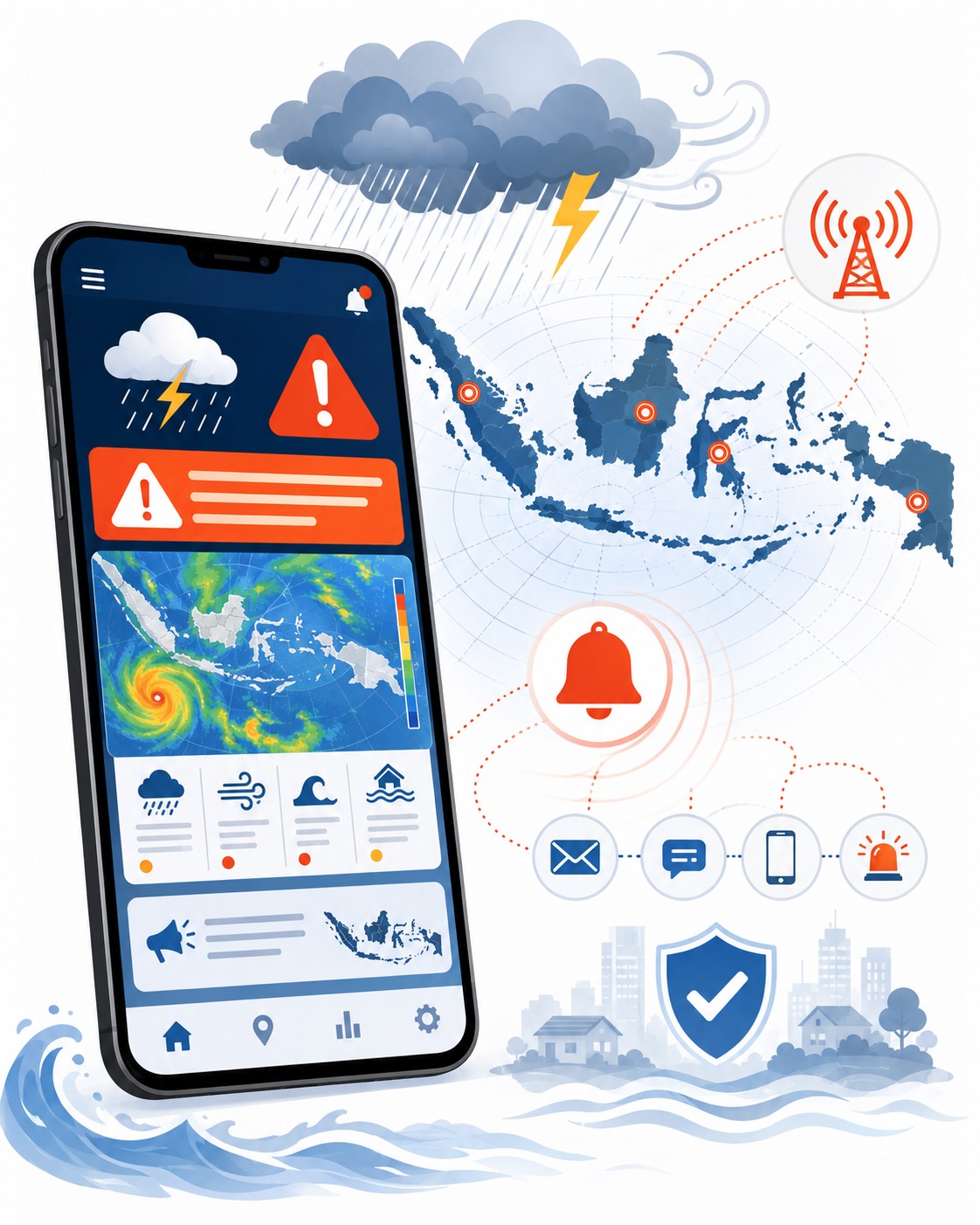
Background:In nations like Indonesia that are vulnerable to natural disasters, early warning systems are essential. Warning messages serve as institutional speech acts in addition to providing meteorological information, with the communicative function of influencing public behavior and risk perception. However, whether these intended functions translate into actual audience effects is an empirical question outside the purview of this textual study. The purpose of this study is to investigate the linguistic realization of speech act configurations and design techniques in BMKG online weather early warning messages.
Methodology: The analysis uses a corpus of 120 online weather early warning texts produced by BMKG, Indonesia's national meteorological office, between November 2025 and February 2026, using a qualitative corpus-assisted design with descriptive quantitative mapping. Findings: The results show the forms of BMKG warnings are very uniform with the integration of the directive, predictive and representational speech acts. The use of language for institutional attribution lends the project authority and credibility, but temporal deixis, modality, intensity, and spatial definition also build urgency. 93.3% of the corpus contained a seven-move structure that was found repeatedly, with content pieces changing systematically depending on forecast confidence and danger categorization. Conclusion:The study shows that the BMKG’s online alerts are a stable institutional genre in which the pragmatic strategy and linguistic form are always in accordance with the public risk communication. The data offer a textual baseline for further investigation of audience reception and behavioural response.
Originality:This study contributes to pragmatics and corpus-assisted discourse analysis by providing empirical evidence of the realisation of institutional speech acts in digitally mediated early warning communication in a multilingual setting.
References
Austin, J. L. (1975). How to do things with words. Harvard university press.
Aven, Terje & Renn, O. (2010). Risk , Governance and Society (16 (ed.); Sixth Edit, Vol. 16). Springer.
Bavel, J. J. V., Baicker, K., Boggio, P. S., Capraro, V., Cichocka, A., Cikara, M., Crockett, M. J., Crum, A. J., Douglas, K. M., Druckman, J. N., Drury, J., Dube, O., Ellemers, N., Finkel, E. J., Fowler, J. H., Gelfand, M., Han, S., Haslam, S. A., Jetten, J., … Willer, R. (2020). Using social and behavioural science to support COVID-19 pandemic response. Nature Human Behaviour, 4(5), 460–471. https://doi.org/10.1038/s41562-020-0884-z
Bednarek, M., & Caple, H. (2020). “Value added”: Language, image and news values. Discourse, Context and Media, 1(2–3), 103–113. https://doi.org/10.1016/j.dcm.2012.05.006
Buchanan, R., & Kendall, D. (2023). Communicating Climate Change in the Heartland. 76, 1–8. https://doi.org/10.1130/abs/2023am-392450
Cap, P. (2013). Proximization. The pragmatics of symbolic distance crossing. 220.
Cohen, J. (1968). Weighted kappa: Nominal scale agreement provision for scaled disagreement or partial credit. Psychological Bulletin, 70(4), 213.
Coombs, T. W. (2023). Ongoing Crisis Communication: Planning, Managing, and Responding (Suxth Edit). SAGE.
Creswel, John W. & Creswel, J. D. (2023). Research Design: Qualitative, Quantitative, and Mixed Methods Approaches. Manual Therapy, 16(1), 103. https://doi.org/10.1016/j.math.2010.09.003
Dallo, I., Stauffacher, M., & Marti, M. (2022). Actionable and understandable? Evidence-based recommendations for the design of (multi-) hazard warning messages. International Journal of Disaster Risk Reduction, 74, 102917.
Dryhurst, S., Schneider, C. R., Kerr, J., Freeman, A. L. J., Recchia, G., van der Bles, A. M., Spiegelhalter, D., & van der Linden, S. (2020). Risk perceptions of COVID-19 around the world. Journal of Risk Research, 23(7–8), 994–1006. https://doi.org/10.1080/13669877.2020.1758193
Guerra, J. P. (2023). Review of Egbert, Jesse, Douglas Biber and Bethany Gray. 2022. Designing and Evaluating Language Corpora: A Practical Framework for Corpus Representativeness. Cambridge: Cambridge University Press. Research in Corpus Linguistics (RiCL), 11(1), 147–155. https://doi.org/10.1017/9781316584880
Haoxing, Z., & System, C. (2020). Critical Discourse Analysis into Practice. Book Publisher International, First Edit, 1–116.
Hatirn, B., Mason, I., Stephens, J., Gibbons, J., & Pennycook, A. (1989). Language and power Discourse and the translator. New York, 253.
Houston, J. B., Hill, R., Spialek, M. L., & First, J. (2020). pd. (2013). The Role of Social Media in Crisis. Strategic Intelligence Management, 93–107. https://doi.org/10.1016/b978-0-12-407191-9.00009-0
Kádár, D. Z., & Haugh, M. (2013). Understanding politeness. books.google.com.
Keskin, B. (2018). Van Dijk, Poell, and de Wall, The Platform Society: Public Values in a Connective World (2018). Markets, Globalization & Development Review, 03(03). https://doi.org/10.23860/mgdr-2018-03-03-08
Krzyżanowski, M., & Krzyżanowska, N. (2022). Narrating the ‘new normal’ or pre-legitimising media control? COVID-19 and the discursive shifts in the far-right imaginary of ‘crisis’ as a normalisation strategy. Discourse and Society, 33(6), 805–818. https://doi.org/10.1177/09579265221095420
Krzyżanowski, M., Wodak, R., Bradby, H., Gardell, M., Kallis, A., Krzyżanowska, N., Mudde, C., & Rydgren, J. (2023). Discourses and practices of the New Normal Towards an interdisciplinary research agenda on crisis and the normalization of anti- and post‑democratic action. Journal of Language and Politics, 22(4), 415–437. https://doi.org/10.1075/jlp.23024.krz
Lorés, R. (2024). Mediating expert knowledge: The use of pragmatic strategies in digital research digests. Journal of Pragmatics, 232, 26–40. https://doi.org/10.1016/j.pragma.2024.08.007
McEnery, T., & Brezina, V. (2022). Fundamental Principles of Corpus Linguistics. In Fundamental Principles of Corpus Linguistics (1st ed.). Cambridge University Press. https://doi.org/10.1017/9781107110625.011
Mesinioti, P., & Angouri, J. (2025). Reports from British Association for Applied Linguistics with Cambridge University Press seminars 2024: Multimodality in applied linguistic research: current trends and methodological implications. Language Teaching, 58(1), 133–135. https://doi.org/10.1017/S0261444824000429
Penuel, K., & Statler, M. (2014). Risk Governance. Encyclopedia of Disaster Relief. https://doi.org/10.4135/9781412994064.n250
Pérez-Guerra, J. (2023). Review of Egbert, Jesse, Douglas Biber and Bethany Gray. 2022. Designing and Evaluating Language Corpora: A Practical Framework for Corpus Representativeness. Cambridge: Cambridge University Press. ISBN: 978-1-107-15138-3. DOI: https://doi.org/10.1017/978. Research in Corpus Linguistics, 11(1), 147–155. https://doi.org/10.32714/ricl.11.01.06
Piller, I. (2016). Linguistic diversity and social justice: An introduction to applied sociolinguistics (Vol. 10). Oxford University Press Oxford.
Piller, I. (2018). Linguistic Diversity and Social Justice: An Introduction to Applied Sociolinguistics. 11(1), 461–465. https://doi.org/10.53956/jfde.2018.115
Seeger, M. W. T. S. & R. L. U. (2009). Book Reviews: Book Reviews. Perspectives in Public Health, 59, 288. https://doi.org/10.1177/1757913910379198
Spolsky, B. (2021). Rethinking Language Policy. Rethinking Language Policy, 1–272. https://doi.org/10.1080/01434632.2022.2127616
Sutton, J., Fischer, L., & Wood, M. M. (2021). Tornado Warning Guidance and Graphics: Implications of the Inclusion of Protective Action Information on Perceptions and Efficacy. Weather, Climate, and Society, Nws 2020. https://doi.org/10.1175/wcas-d-21-0097.1
Downloads
Published
Issue
Section
License
Copyright (c) 2026 Budi Purnomo, Widyashanti Kunthara Anindita

This work is licensed under a Creative Commons Attribution-ShareAlike 4.0 International License.
Authors retain copyright and grant the journal right of first publication with the work simultaneously licensed under a Creative Commons Attribution 4.0 International License that allows others to share the work with an acknowledgement of the work's authorship and initial publication in this journal.