Exploring EFL University Students’ Experiences of Engaging with ChatGPT-Generated Feedback during Academic Writing: A Qualitative Case Study
DOI:
https://doi.org/10.24903/sj.v11i2.2397Keywords:
ChatGPT, AI-generated feedback, learner engagement, feedback literacy, EFL academic writingAbstract
Background:
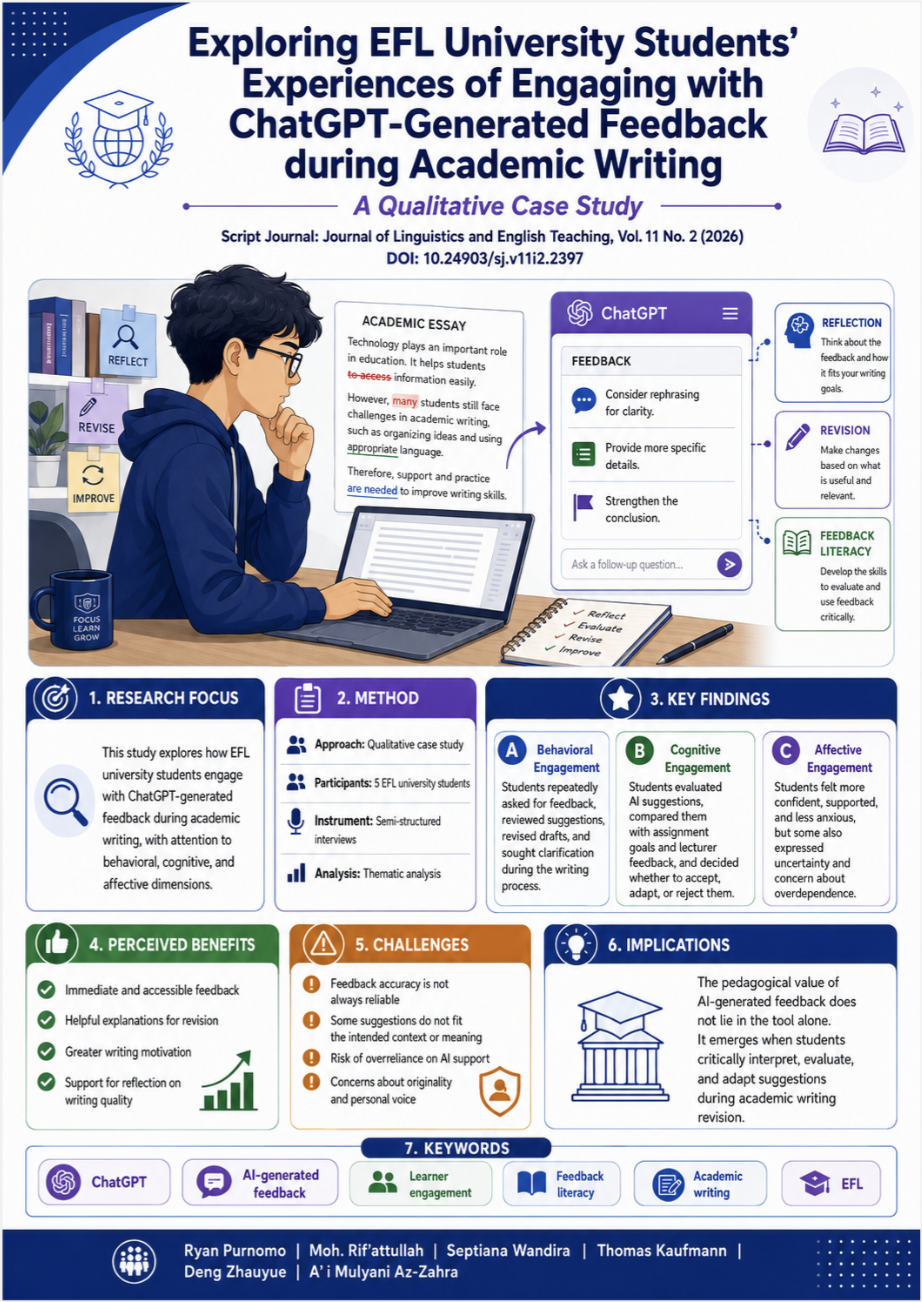
This study investigates how EFL university students engage with ChatGPT-generated feedback during academic writing, focusing on behavioral, cognitive, and affective dimensions. Although generative AI is increasingly used as a feedback tool in EFL contexts, limited research has examined how students interpret, evaluate, and respond to AI-generated feedback as part of the writing process.
Methodology:
This qualitative case study involved five EFL university students who had experience using ChatGPT as a feedback tool during academic writing tasks. Data were collected through semi-structured interviews exploring students’ reported experiences, perceptions, and decision-making processes when interacting with ChatGPT-generated feedback. The interview data were analyzed thematically to identify perceived behavioral, cognitive, and affective dimensions of AI-mediated feedback engagement.
Findings:
The findings suggest that participants reported engaging with ChatGPT-generated feedback through iterative revision, evaluative judgment, and emotional regulation, reflecting behavioral, cognitive, and affective dimensions of feedback engagement. Participants also perceived several affordances of ChatGPT, including immediate responses, explanatory support, and motivational encouragement, while simultaneously reporting challenges related to feedback accuracy, contextual appropriateness, and potential overreliance. These findings indicate that the pedagogical value of AI-generated feedback is not inherent in the technology itself but may emerge through learners’ critical interpretation, evaluation, and adaptation of AI suggestions during the revision process.
Originality:
This study provides qualitative insights into EFL students’ engagement with AI-generated feedback by examining their self-reported experiences of interacting with ChatGPT during academic writing revision. The findings reveal how students perceived behavioral, cognitive, and affective dimensions of engagement, including their reported practices of seeking, evaluating, and applying AI-generated feedback, as well as their emotional responses toward AI-assisted writing. Rather than providing direct evidence of students’ revision processes, this study offers an in-depth understanding of how learners interpret and negotiate ChatGPT feedback within their academic writing experiences.
References
Ahmad, O., Maliha, H., & Ahmed, I. (2024). AI syndrome: An intellectual asset for students or a progressive cognitive decline. Asian Journal of Psychiatry, 94, Article 103969. https://doi.org/10.1016/j.ajp.2024.103969
Ali, N., Ahmed, L., & Rose, S. (2018). Identifying predictors of students’ perception of and engagement with assessment feedback. Active Learning in Higher Education, 19(3), 239–251. https://doi.org/10.1177/1469787417735609
Baltà-Salvador, R., El-Madafri, I., Brasó-Vives, E., & Peña, M. (2025). Empowering engineering students through artificial intelligence (AI): Blended human–AI creative ideation processes with ChatGPT. Computer Applications in Engineering Education, 33, Article e22817. https://doi.org/10.1002/cae.22817
Bearman, M., Ryan, J., & Ajjawi, R. (2023). Discourses of artificial intelligence in higher education: A critical literature review. Higher Education, 86, 369–385. https://doi.org/10.1007/s10734-022-00937-2
Braun, V., & Clarke, V. (2006). Using thematic analysis in psychology. Qualitative Research in Psychology, 3(2), 77–101. https://doi.org/10.1191/1478088706qp063oa
Carless, D. (2023). Teacher feedback literacy, feedback regimes and iterative change: Towards enhanced value in feedback processes. Higher Education Research & Development, 42(8), 1890–1904. https://doi.org/10.1080/07294360.2023.2203472
Carless, D., & Boud, D. (2018). The development of student feedback literacy: Enabling uptake of feedback. Assessment & Evaluation in Higher Education, 43(8), 1315–1325. https://doi.org/10.1080/02602938.2018.1463354
Chong, S. W. (2021). Reconsidering student feedback literacy from an ecological perspective. Assessment & Evaluation in Higher Education, 46(1), 92–104. https://doi.org/10.1080/02602938.2020.1730765
Han, Y., & Xu, Y. (2021). Student feedback literacy and engagement with feedback: A case study of Chinese undergraduate students. Teaching in Higher Education, 26(2), 181–196. https://doi.org/10.1080/13562517.2019.1648410
Hasib, M., & Islam, M. S. (2025). How university students in Bangladesh engage with ChatGPT: A qualitative study. PLOS ONE, 20(9), Article e0333089. https://doi.org/10.1371/journal.pone.0333089
Järvelä, S., Zhao, G., Nguyen, A., & Chen, H. (2025). Hybrid intelligence: Human–AI coevolution and learning. British Journal of Educational Technology, 56(2), 455–468. https://doi.org/10.1111/bjet.13560
Koltovskaia, S., Rahmati, P., & Saeli, H. (2024). Graduate students’ use of ChatGPT for academic text revision: Behavioral, cognitive, and affective engagement. Journal of Second Language Writing, 65, Article 101130. https://doi.org/10.1016/j.jslw.2024.101130
Polakova, P., & Ivenz, P. (2024). The impact of ChatGPT feedback on the development of EFL students’ writing skills. Cogent Education, 11(1), Article 2410101. https://doi.org/10.1080/2331186X.2024.2410101
Rawas, S. (2024). ChatGPT: Empowering lifelong learning in the digital age of higher education. Education and Information Technologies, 29(6), 6895–6908. https://doi.org/10.1007/s10639-023-12114-8
Vygotsky, L. S. (1978). Mind in society: The development of higher psychological processes (M. Cole, V. John-Steiner, S. Scribner, & E. Souberman, Eds.). Harvard University Press.
Wang, C., & Wang, Z. (2025). Investigating L2 writers’ critical AI literacy in AI-assisted writing: An APSE model. Journal of Second Language Writing, 67, Article 101187. https://doi.org/10.1016/j.jslw.2025.101187
Werdiningsih, I., Marzuki, Indrawati, I., Rusdin, D., Ivone, F. M., Basthomi, Y., & Zulfahreza. (2024). Revolutionizing EFL writing: Unveiling the strategic use of ChatGPT by Indonesian master’s students. Cogent Education, 11(1), Article 2399431. https://doi.org/10.1080/2331186X.2024.2399431
Wilcoxen, C. L., & Lemke, J. (2021). Preservice teachers’ perceptions of feedback: The importance of timing, purpose, and delivery. Journal of University Teaching & Learning Practice, 18(8), Article 14. https://doi.org/10.53761/1.18.8.14
Winstone, N. E., Nash, R. A., Parker, M., & Rowntree, J. (2017). Supporting learners’ agentic engagement with feedback: A systematic review and a taxonomy of recipience processes. Educational Psychologist, 52(1), 17–37. https://doi.org/10.1080/00461520.2016.1207538
Yan, D., & Zhang, S. (2024). L2 writer engagement with automated written corrective feedback provided by ChatGPT: A mixed-method multiple case study. Humanities and Social Sciences Communications, 11, Article 1086. https://doi.org/10.1057/s41599-024-03543-y
Yin, R. K. (2009). Case study research: Design and methods (4th ed.). SAGE Publications.
Zhan, Y., & Yan, Z. (2025). Students’ engagement with ChatGPT feedback: Implications for student feedback literacy in the context of generative artificial intelligence. Assessment & Evaluation in Higher Education. Advance online publication. https://doi.org/10.1080/02602938.2025.2471821
Downloads
Published
Issue
Section
License
Copyright (c) 2026 Ryan Purnomo Ryan, Moh Rif'attullah Rif'attullah, Septiana Wandira Septiana, Thomas Kaufmann Thomas, Deng Zhauyue Deng, A'i Mulyani Az-Zahra Mulyani

This work is licensed under a Creative Commons Attribution-ShareAlike 4.0 International License.
Authors retain copyright and grant the journal right of first publication with the work simultaneously licensed under a Creative Commons Attribution 4.0 International License that allows others to share the work with an acknowledgement of the work's authorship and initial publication in this journal.