Domain-Specific Platform Alignment Predicts EFL Proficiency at an Indonesian University
DOI:
https://doi.org/10.24903/sj.v11i2.2267Keywords:
Mobile-cloud platforms, EFL language proficiency, domain-platform alignment, multiple linear regression, 3T region Indonesia, higher educationAbstract
Background:
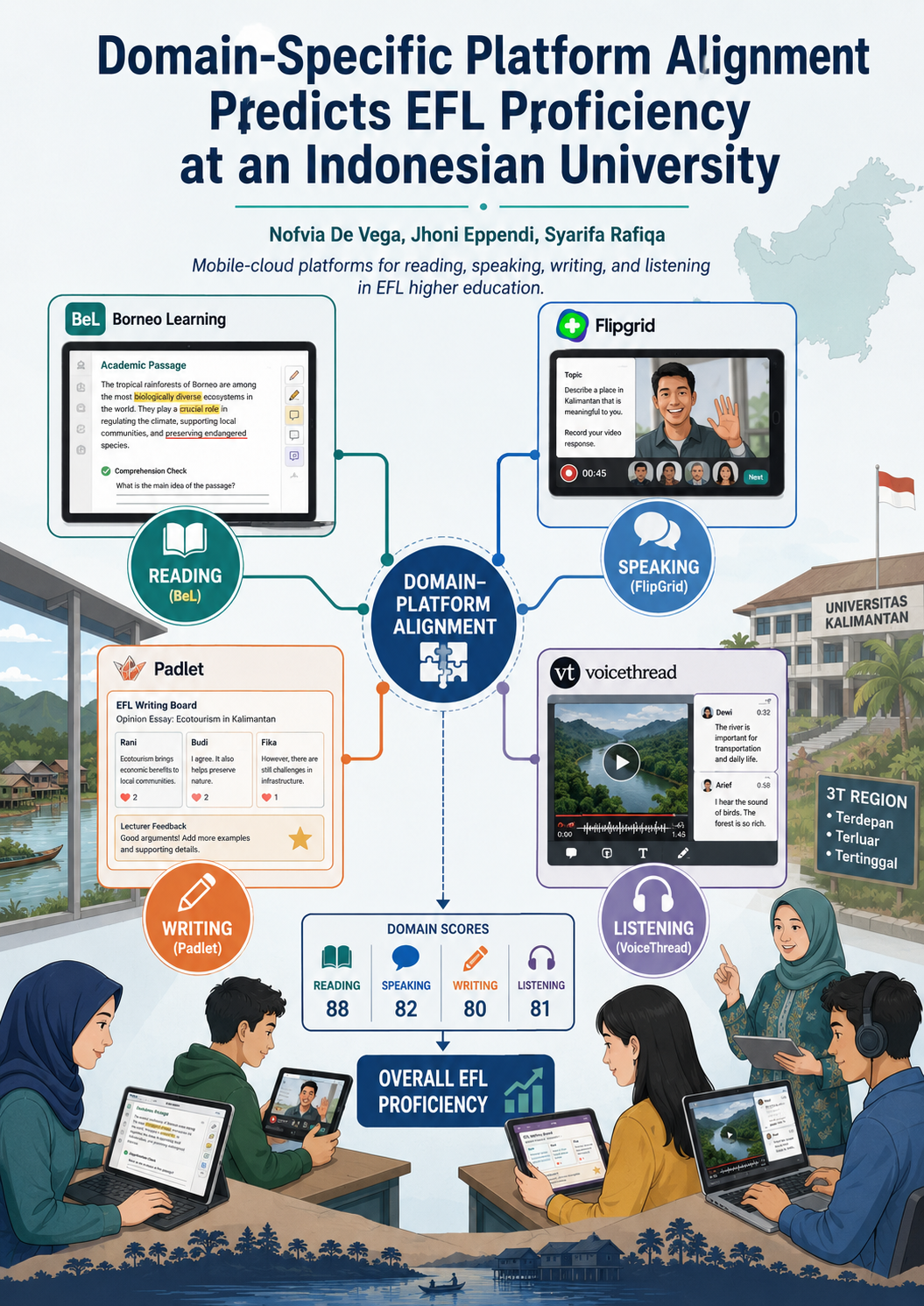
This study examines how four mobile-cloud platforms, BeL (reading), FlipGrid (speaking), Padlet (writing), and VoiceThread (listening), were integrated into EFL instruction through a domain-platform alignment model at a 3T-region Indonesian university. The study compares domain-level contributions to composite proficiency and does not claim to isolate platform-specific causal effects.
Methodology:
A quasi-experimental pre-test and post-test design was employed with 55 university students in advanced language courses. Stratified random sampling ensured proficiency-level representation. A 12-week structured intervention assigned each platform to one skill domain. Four participants were excluded for completing fewer than 80% of tasks, yielding a final sample of 51. Multiple linear regression was applied following verification of classical assumptions.
Findings:
The regression model was statistically significant (R = 0.960, R² = 0.921, F = 146.27, p < .001), with all four domain scores significant at p < .001. The R² value is largely expected given that the Total Language Proficiency Score is mathematically derived from the same four domain predictors, reflecting a compositional rather than independent predictive relationship. Standardized coefficients indicated reading as the strongest contributor (β = .433), followed by listening (β = .371), writing (β = .367), and speaking (β = .356). Post-intervention score improvements are reported as descriptive observations only, as no separate inferential pre-test to post-test analysis per domain pairing was conducted.
Conclusion:
These findings offer preliminary descriptive support for domain-differentiated platform use in 3T-region EFL higher education. Model explanatory power should be interpreted cautiously given the compositional constraint, and platform-specific causal claims require further experimental evidence.
Originality:
This study introduces a structured domain-platform alignment model enabling principled, domain-level comparison of platform integration within a single EFL study design.
References
Akram, H., Yingxiu, Y., Al-Adwan, A. S., & Alkhalifah, A. (2021). Technology Integration in Higher Education During COVID-19: An Assessment of Online Teaching Competencies Through Technological Pedagogical Content Knowledge Model. Frontiers in Psychology, 12. https://doi.org/10.3389/fpsyg.2021.736522
Alenezi, M. (2023). Digital Learning and Digital Institution in Higher Education. Education Sciences, 13(1), 88. https://doi.org/10.3390/educsci13010088
Amhag, L., Hellström, L., & Stigmar, M. (2019). Teacher Educators’ Use of Digital Tools and Needs for Digital Competence in Higher Education. Journal of Digital Learning in Teacher Education, 35(4), 203–220. https://doi.org/10.1080/21532974.2019.1646169
Andringa, S., & Godfroid, A. (2020). Sampling Bias and the Problem of Generalizability in Applied Linguistics. Annual Review of Applied Linguistics, 40, 134–142. https://doi.org/10.1017/S0267190520000033
Asratie, M. G., Wale, B. D., & Aylet, Y. T. (2023). Effects of using educational technology tools to enhance EFL students’ speaking performance. Education and Information Technologies, 28(8), 10031–10051. https://doi.org/10.1007/s10639-022-11562-y
Baki, Y. (2020). The Effect of Critical Reading Skills on the Evaluation Skills of the Creative Reading Process. Eurasian Journal of Educational Research, 20(88), 1–26. https://doi.org/10.14689/ejer.2020.88.9
Chamba, L. T., & Chikusvura, N. (2024). Future-proofing quality education using integrated assessment systems. Quality Education for All, 1(1), 240–255. https://doi.org/10.1108/QEA-11-2023-0014
Chen, C.-M., Li, M.-C., & Lin, M.-F. (2022). The effects of video-annotated learning and reviewing system with vocabulary learning mechanism on English listening comprehension and technology acceptance. Computer Assisted Language Learning, 35(7), 1557–1593. https://doi.org/10.1080/09588221.2020.1825093
Chien, S.-Y., Hwang, G.-J., & Jong, M. S.-Y. (2020). Effects of peer assessment within the context of spherical video-based virtual reality on EFL students’ English-Speaking performance and learning perceptions. Computers & Education, 146, 103751. https://doi.org/10.1016/j.compedu.2019.103751
Dunn, T. J., & Kennedy, M. (2019). Technology Enhanced Learning in higher education; motivations, engagement and academic achievement. Computers & Education, 137, 104–113. https://doi.org/10.1016/j.compedu.2019.04.004
Dzvinchuk, D., Radchenko, O., Kachmar, O., Myskiv, I., & Dolinska, N. (2020). Analysis of Platforms and Tools of Open Study in the Conditions of Postmodern Education. Revista Romaneasca Pentru Educatie Multidimensionala, 12(3), 125–143. https://doi.org/10.18662/rrem/12.3/313
Estrada, P., Wang, H., & Farkas, T. (2020). Elementary English Learner Classroom Composition and Academic Achievement: The Role of Classroom-Level Segregation, Number of English Proficiency Levels, and Opportunity to Learn. American Educational Research Journal, 57(4), 1791–1836. https://doi.org/10.3102/0002831219887137
Groening, C., & Binnewies, C. (2019). “Achievement unlocked!” - The impact of digital achievements as a gamification element on motivation and performance. Computers in Human Behavior, 97, 151–166. https://doi.org/10.1016/j.chb.2019.02.026
Guillén-Gámez, F. D., Mayorga-Fernández, M. J., Bravo-Agapito, J., & Escribano-Ortiz, D. (2021). Analysis of Teachers’ Pedagogical Digital Competence: Identification of Factors Predicting Their Acquisition. Technology, Knowledge and Learning, 26(3), 481–498. https://doi.org/10.1007/s10758-019-09432-7
Gullifer, J. W., Kousaie, S., Gilbert, A. C., Grant, A., Giroud, N., Coulter, K., … Titone, D. (2021). Bilingual language experience as a multidimensional spectrum: Associations with objective and subjective language proficiency. Applied Psycholinguistics, 42(2), 245–278. https://doi.org/10.1017/S0142716420000521
Holubnycha, L., Kostikova, I., Kravchenko, H., Simonok, V., & Serheieva, H. (2019). Cloud Computing for University Students’ Language Learning. Revista Romaneasca Pentru Educatie Multidimensionala, 55–69. https://doi.org/10.18662/rrem/157
Huang, A. Y. Q., Lu, O. H. T., & Yang, S. J. H. (2023). Effects of artificial Intelligence–Enabled personalized recommendations on learners’ learning engagement, motivation, and outcomes in a flipped classroom. Computers & Education, 194, 104684. https://doi.org/10.1016/j.compedu.2022.104684
Kilinç, E., & Tarman, B. (2022). Citizenship types, social media use and speaking a foreign language as predictors of global competence. Citizenship Teaching & Learning, 17(1), 49–62. https://doi.org/10.1386/ctl_00081_1
Koo, T. K., & Li, M. Y. (2016). A Guideline of Selecting and Reporting Intraclass Correlation Coefficients for Reliability Research. Journal of Chiropractic Medicine, 15(2), 155–163. https://doi.org/10.1016/j.jcm.2016.02.012
Liu, S., & Da, J. (2021). Technology in Chinese Language Teaching. In The Palgrave Handbook of Chinese Language Studies (pp. 1–41). Singapore: Springer Singapore. https://doi.org/10.1007/978-981-13-6844-8_3-1
Marienko, M., Nosenko, Y., Sukhikh, A., Tataurov, V., & Shyshkina, M. (2020). Personalization of learning through adaptive technologies in the context of sustainable development of teachers’ education. E3S Web of Conferences, 166, 10015. https://doi.org/10.1051/e3sconf/202016610015
Mayer, R. E. (2024). The Past, Present, and Future of the Cognitive Theory of Multimedia Learning. Educational Psychology Review, 36(1), 8. https://doi.org/10.1007/s10648-023-09842-1
Metsäpelto, R.-L., Poikkeus, A.-M., Heikkilä, M., Husu, J., Laine, A., Lappalainen, K., … Suvilehto, P. (2022). A multidimensional adapted process model of teaching. Educational Assessment, Evaluation and Accountability, 34(2), 143–172. https://doi.org/10.1007/s11092-021-09373-9
Mohamed, S., & Adnan, F. (2020). Feedback in Computer-Assisted Language Learning: A Meta-Analysis. Tesl-Ej, 24(2), n2.
Nation, K. (2019). Children’s reading difficulties, language, and reflections on the simple view of reading. Australian Journal of Learning Difficulties, 24(1), 47–73. https://doi.org/10.1080/19404158.2019.1609272
Núñez-Canal, M., de Obesso, M. de las M., & Pérez-Rivero, C. A. (2022). New challenges in higher education: A study of the digital competence of educators in Covid times. Technological Forecasting and Social Change, 174, 121270. https://doi.org/10.1016/j.techfore.2021.121270
Pirdayanti, N. P. A., Nitiasih, P. K., Budiarta, L. G. R., & Adnyayanti, N. L. P. E. (2022). The Impact of Videos Based Discovery Learning Towards Young Learners’ Speaking Skill During Pandemic Covid-19. Jurnal Pedagogi Dan Pembelajaran, 5(2), 285–292. https://doi.org/10.23887/jp2.v5i2.45556
Rahayu, Weda, S., Muliati, & De Vega, N. (2024). Artificial Intelligence in writing instruction: A self-determination theory perspective. XLinguae, 17(1), 234–244. https://doi.org/10.18355/XL.2024.17.01.16
Rahimi, R. A., & Oh, G. S. (2024). Rethinking the role of educators in the 21st century: navigating globalization, technology, and pandemics. Journal of Marketing Analytics, 12(2), 182–197. https://doi.org/10.1057/s41270-024-00303-4
Saubern, R., Urbach, D., Koehler, M., & Phillips, M. (2020). Describing increasing proficiency in teachers’ knowledge of the effective use of digital technology. Computers & Education, 147, 103784. https://doi.org/10.1016/j.compedu.2019.103784
Saykili, A. (2019). Higher Education in The Digital Age: The Impact of Digital Connective Technologies. Journal of Educational Technology and Online Learning, 2(1), 1–15. https://doi.org/10.31681/jetol.516971
Selfa-Sastre, M., Pifarré, M., Cujba, A., Cutillas, L., & Falguera, E. (2022). The Role of Digital Technologies to Promote Collaborative Creativity in Language Education. Frontiers in Psychology, 13. https://doi.org/10.3389/fpsyg.2022.828981
Septiyana, L., Safitri, A., & Aminatun, D. (2021). The Correlation Between EFL Learners Cohesion and Their Reading Comprehension. Journal of Research on Language Education, 2(2), 68. https://doi.org/10.33365/jorle.v2i2.1154
Su, F., & Zou, D. (2022). Technology-enhanced collaborative language learning: theoretical foundations, technologies, and implications. Computer Assisted Language Learning, 35(8), 1754–1788. https://doi.org/10.1080/09588221.2020.1831545
Verma, J. P., & G. Abdel‐Salam, A. (2019). Testing Statistical Assumptions in Research. Wiley. https://doi.org/10.1002/9781119528388
Walker, R. (2020). Facilitating Active Learning Opportunities for Students Through the Use of Technology-Enhanced Learning Tools: The Case for Pedagogic Innovation and Change. In Teaching Learning and New Technologies in Higher Education (pp. 117–133). Singapore: Springer Singapore. https://doi.org/10.1007/978-981-15-4847-5_9
Downloads
Published
Issue
Section
License
Copyright (c) 2026 Nofvia De Vega, Jhoni Eppendi, Syarifa Rafiqa

This work is licensed under a Creative Commons Attribution-ShareAlike 4.0 International License.
Authors retain copyright and grant the journal right of first publication with the work simultaneously licensed under a Creative Commons Attribution 4.0 International License that allows others to share the work with an acknowledgement of the work's authorship and initial publication in this journal.