Questioning the Promise of Dialogic Feedback: Engagement Challenges Across Proficiency Levels in EFL Writing
DOI:
https://doi.org/10.24903/sj.v11i2.2477Keywords:
Challenges, Dialogic Feedback, EFL Writing, Proficiency, Students’ EngagementAbstract
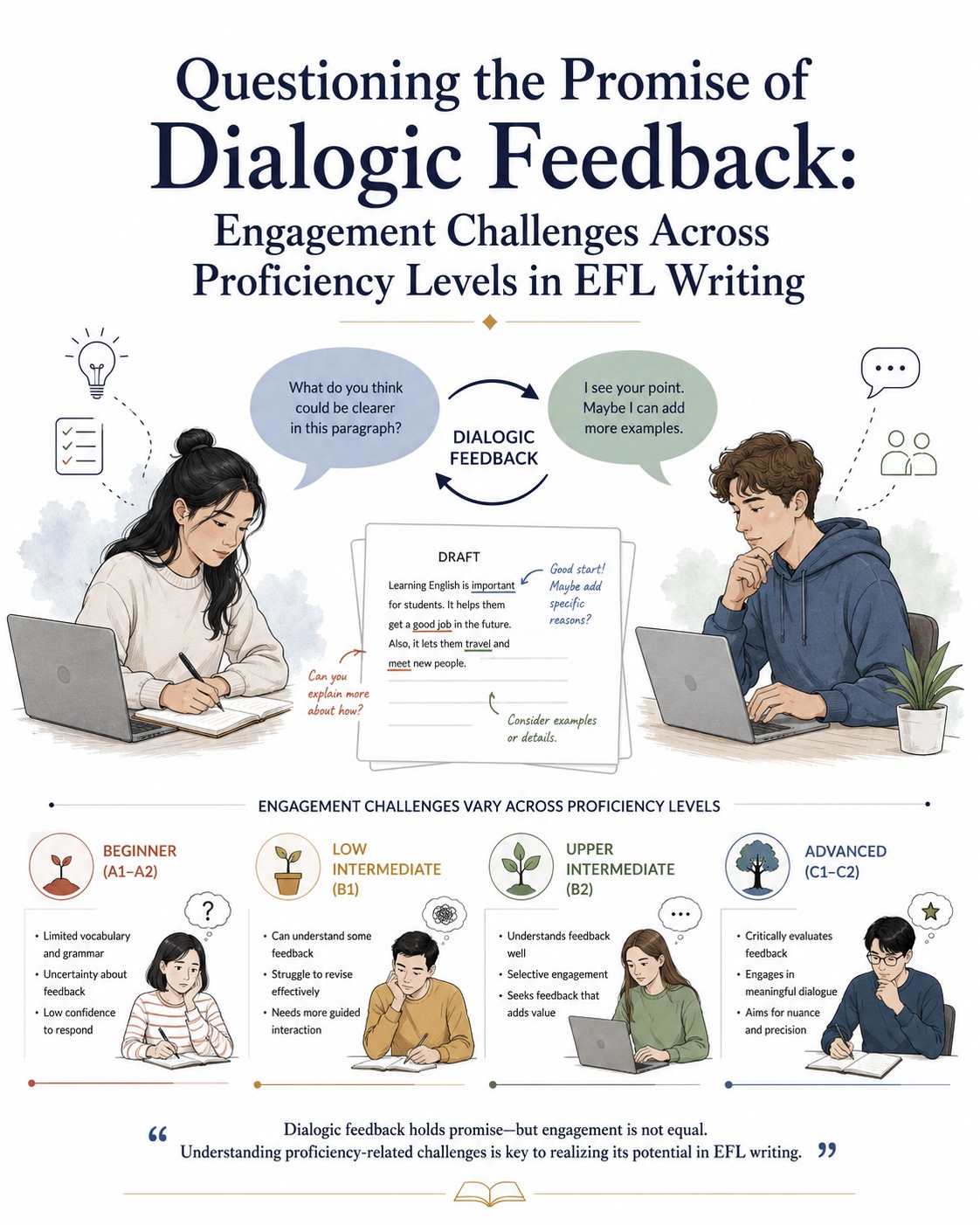
Background:Although dialogic feedback has received increasing attention in EFL writing research, little is known about whether students with different proficiency levels experience similar engagement challenges during dialogic feedback. This study aims to explore the engagement challenges experienced by low-proficiency and intermediate-proficiency EFL students.
Methodology:This study employed a qualitative multiple-case study design involving six undergraduate EFL students at an Indonesian public university. Participants were purposively selected based on their proficiency levels from an in-house essay diagnostic test assessed using the IELTS Writing Task 2 band scale (1–9). Students scoring below Band 3 were classified as A1 (low proficiency), while those scoring Band 4–5 were classified as B1 (intermediate proficiency). Three students from each group were selected to form two contrasting cases. Data were collected through semi-structured interviews and analysed thematically using within-case and cross-case comparisons.
Findings:The findings revealed both shared and proficiency-specific engagement challenges among the six participants. Both low-proficiency and intermediate-proficiency students experienced unclear feedback, revisions limited to lecturer corrections, and low self-confidence. However, low-proficiency students also faced dependence on lecturer authority, difficulty transferring feedback to future writing tasks, limited clarification-seeking, inadequate preparation, and greater fear and anxiety during feedback interactions. In contrast, intermediate-proficiency students mainly experienced inconsistent clarification-seeking, anxiety related to extensive revisions, and sensitivity to lecturers’ attitudes and appreciation.
Conclusion:The findings suggest that engagement challenges during dialogic feedback vary across proficiency levels. Common challenges were evident in both groups, whereas proficiency-specific challenges reflected differences in students’ experiences and support needs. Therefore, dialogic feedback should be adapted to accommodate these differences in order to promote more effective student engagement.
Originality:This study contributes to the dialogic feedback literature by providing insights into engagement challenges during dialogic feedback interactions among low- and intermediate-proficiency EFL students in an Indonesian higher education context. It extends previous proficiency-based research by highlighting how students at different proficiency levels experience and navigate challenges in dialogic feedback.
References
Ajjawi, R., & Boud, D. (2017). Researching feedback dialogue: an interactional analysis approach. Assessment and Evaluation in Higher Education, 42(2), 252–265. https://doi.org/10.1080/02602938.2015.1102863
Alsariera, A. H., & Alsaraireh, M. Y. (2024). Advancing EFL Writing Proficiency in Jordan: Addressing Challenges and Embedding Progressive Strategies. International Journal of Arabic-English Studies, 22(2), 267–290. https://doi.org/10.33806/ijaes.v24i2.664
Alzahrani, G. A. S. (2025). Academic Writing Difficulties of EFL Learners at Najran University. Journal of Educational and Social Research, 15(3), 217–229. https://doi.org/10.36941/jesr-2025-0093
Bambaeeroo, F., & Shokrpour, N. (2017). The impact of the teachers’ non-verbal communication on success in teaching. Journal of Advances in Medical Education & Professionalism, 5, 51–59. https://consensus.app/papers/the-impact-of-the-teachers-nonverbal-communication-on-bambaeeroo-shokrpour/b86105e7e1b55ba6bfdb6d3c840f4912/
Braun, V., & Clarke, V. (2006). Using thematic analysis in psychology. Qualitative Research in Psychology, 3(2), 77–101. https://doi.org/10.1191/1478088706qp063oa
Carless, D. (2020). From teacher transmission of information to student feedback literacy: Activating the learner role in feedback processes. Active Learning in Higher Education, 23, 143–153. https://doi.org/10.1177/1469787420945845
Carless, D., & Boud, D. (2018). The development of student feedback literacy: enabling uptake of feedback. Assessment & Evaluation in Higher Education, 43(8), 1315–1325. https://doi.org/https://doi.org/10.1080/02602938.2018.1463354
Carless, D., & Winstone, N. (2020). Teacher feedback literacy and its interplay with student feedback literacy. Teaching in Higher Education, 28, 150–163. https://doi.org/10.1080/13562517.2020.1782372
Cheng, X., & Zhang, L. (2021). Sustaining University English as a Foreign Language Learners’ Writing Performance through Provision of Comprehensive Written Corrective Feedback. Sustainability, 13(8192). https://doi.org/10.3390/su13158192
Dong, A., Jong, M. S.-Y., & King, R. B. (2020). How Does Prior Knowledge Influence Learning Engagement? The Mediating Roles of Cognitive Load and Help-Seeking. Frontiers in Psychology, Volume 11-2020. https://www.frontiersin.org/journals/psychology/articles/10.3389/fpsyg.2020.591203
Er, E., Dimitriadis, Y., & Gašević, D. (2020). A collaborative learning approach to dialogic peer feedback: a theoretical framework. Assessment & Evaluation in Higher Education, 46, 586–600. https://doi.org/10.1080/02602938.2020.1786497
Hattie, J., & Timperley, H. (2007). The power of feedback. Review of Educational Research, 77(1), 81–112. https://doi.org/10.3102/003465430298487
Hentasmaka, D., & Cahyono, B. Y. (2021). Peer Feedback Uptakes and Outcomes across EFL Students ’ Proficiency Levels : A Study at Tertiary Education in Indonesia. International Journal of Instruction, 14(3), 271–286.
Hill, J., Berlin, K., Choate, J., Cravens-Brown, L., McKendrick-Calder, L., & Smith, S. (2021). Exploring the Emotional Responses of Undergraduate Students to Assessment Feedback: Implications for Instructors. Teaching & Learning Inquiry, 9(1), 294–316. https://doi.org/10.20343/teachlearninqu.9.1.20
Liu, F., Du, J., Zhou, D. Q., & Huang, B. (2021). Exploiting the potential of peer feedback: The combined use of face-to-face feedback and e-feedback in doctoral writing groups. Assessing Writing, 47, 100482. https://doi.org/https://doi.org/10.1016/j.asw.2020.100482
Liu, K. (2025). How language proficiency and peer familiarity shape engagement with feedback in English as a Foreign Language writing. Language Teaching Research. https://doi.org/10.1177/13621688251369331
Mary, S., S, D., & K, D. (2026). Self-Confidence and Academic Achievement Among College Students. International Journal of Drug Delivery Technology, 16(22s), 533–539. https://doi.org/10.25258/ijddt.16.22s.65
Monteiro, V., Carvalho, C., & Santos, N. (2021). Creating a Supportive Classroom Environment Through Effective Feedback: Effects on Students’ School Identification and Behavioral Engagement. Frontiers in Education, 6, 1–14. https://doi.org/10.3389/feduc.2021.661736
Murtisari, E. T., Januardi, J. I., Bonar, G., & Kurniawan, D. (2026). Beyond error correction: lower-proficiency EFL learners’ engagement with Grammarly. Language Awareness, 35(3), 766–791. https://doi.org/10.1080/09658416.2025.2585004
Nicol, D. (2010). From monologue to dialogue: Improving written feedback processes in mass higher education. Assessment and Evaluation in Higher Education, 35(5), 501–517. https://doi.org/10.1080/02602931003786559
Reeve, J., & Tseng, C.-M. (2011). Agency as a fourth aspect of students’ engagement during learning activities. Contemporary Educational Psychology, 36(4), 257–267. https://doi.org/https://doi.org/10.1016/j.cedpsych.2011.05.002
Ryan, T., Henderson, M., Ryan, K., & Kennedy, G. (2022). Feedback in higher education: aligning academic intent and student sensemaking. Teaching in Higher Education, 29, 860–875. https://doi.org/10.1080/13562517.2022.2029394
Ryoo, S. M. (2023). Efficacy of Hedges in Formative Feedback on L2 Writing. International Journal on Studies in Education, 5(4), 550–567. https://doi.org/10.46328/ijonse.171
Schmidt, R. (2001). Attention. In P. Robinson (Ed.), Cognition and Second Language Instruction (pp. 3–32). Cambridge University Press. https://doi.org/DOI: 10.1017/CBO9781139524780.003
Spies, T. G., Carcoba-Falomir, G., Sarisahin, S., Deniz, F. K., & Xu, Y. (2023). Writing feedback and the fuccess of English as an dditional Language (EAL) doctoral students: The role of dialogue. International Journal of Doctoral Studies, 18, 230–250. https://doi.org/10.28945/5202
Tam, A. (2020). Undergraduate students’ perceptions of and responses to exemplar-based dialogic feedback. Assessment & Evaluation in Higher Education, 46, 269–285. https://doi.org/10.1080/02602938.2020.1772957
Vysotska, O. (2022). Writing Skills: Challenges and Solutions. Scientific Notes of Ostroh Academy National University, Philology Series, 13(81), 208–211. https://doi.org/10.25264/2519-2558-2022-13(81)-208-211
Williams, A. (2024). Delivering Effective Student Feedback in Higher Education: An Evaluation of the Challenges and Best Practice. International Journal of Research in Education and Science, 10(2), 473–501. https://doi.org/10.46328/ijres.3404
Winstone, N., Nash, R., Rowntree, J., & Parker, M. (2017). ‘It’d be useful, but I wouldn’t use it’: Barriers to university students’ feedback seeking and recipience. Studies in Higher Education, 42, 2026–2041. https://doi.org/10.1080/03075079.2015.1130032
Wu, Z. (2019). Lower English proficiency means poorer feedback performance? A mixed-methods study. Assessing Writing, 41, 14–24. https://doi.org/https://doi.org/10.1016/j.asw.2019.05.001
Yang, M., & Carless, D. (2013). The feedback triangle and the enhancement of dialogic feedback processes. Teaching in Higher Education, 18(3), 285–297. https://doi.org/10.1080/13562517.2012.719154
Zhang, Y., Zhao, F., & Mayer, R. (2025). Effects of Feedback Providers’ Positive Emotional Tone and Gender on Learning From a Multimedia Lesson. J. Comput. Assist. Learn., 41. https://doi.org/10.1111/jcal.70052
Zhang, Z. (Victor), & Hyland, K. (2018). Student engagement with teacher and automated feedback on L2 writing. Assessing Writing, 36, 90–102. https://doi.org/https://doi.org/10.1016/j.asw.2018.02.004
Zhao, Y., Zhang, F., Schunn, C. D., He, P., Li, D., & Zhao, Y. (2024). Feedback, feedback-on-feedback and re-feedback: effects of written dialogic peer feedback on English as a foreign language writing. Assessment and Evaluation in Higher Education, 49(4), 523–538. https://doi.org/10.1080/02602938.2023.2278017
Downloads
Published
Issue
Section
License
Copyright (c) 2026 Nur Fadillah Nurchalis, Nurdin Noni, Geminastiti Sakkir, Amra Ariyani, Muhammad Aswad

This work is licensed under a Creative Commons Attribution-ShareAlike 4.0 International License.
Authors retain copyright and grant the journal right of first publication with the work simultaneously licensed under a Creative Commons Attribution 4.0 International License that allows others to share the work with an acknowledgement of the work's authorship and initial publication in this journal.