
The Influence of Green Education-Based Teacher Performance, Digital Platforms, and Self-Efficacy on Sustainable Teaching Practices among Senior High School Teachers in East Kalimantan
DOI:
https://doi.org/10.24903/bej.v9i1.2517Keywords:
sustainable teaching practices, education for sustainable development, digital platform engagement, general teaching self-efficacy, discriminant validityAbstract
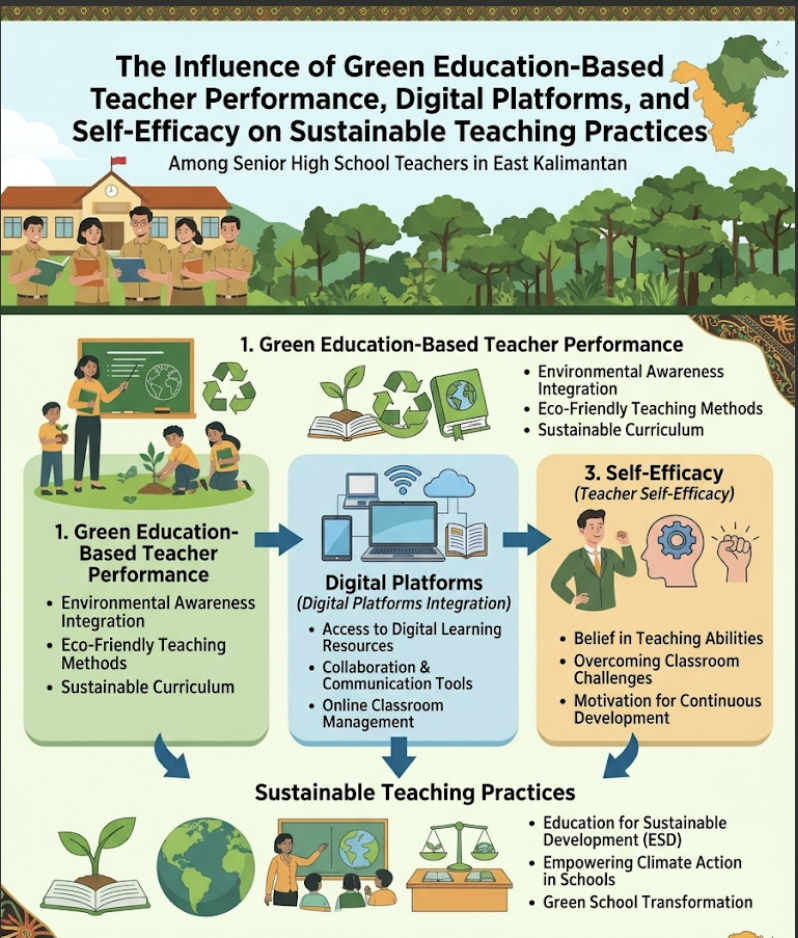
Education for Sustainable Development requires teachers to integrate sustainability into learning; however, professional, technological, and psychological factors have rarely been examined together among senior high school teachers in East Kalimantan. This study examined the relationships of green education-based teacher performance, digital platform use, and self-efficacy with sustainable teaching practices. A cross-sectional online survey conducted across nine regencies/cities yielded 72 responses after one duplicate was removed. The instrument comprised 60 five-point Likert-scale items. The analysis included descriptive statistics, Pearson correlations, multiple regression, HC3 robust standard errors, and a sensitivity analysis after four responses with uniform answer patterns were excluded. The three predictors explained 70.7% of the variance in sustainable teaching practices (R² = 0.707; F(3, 68) = 54.609; p < 0.001). Self-efficacy (β = 0.404; HC3 p = 0.006) and digital platform use (β = 0.291; HC3 p = 0.007) remained significant, whereas green education-based performance was not robust to the HC3 correction (β = 0.287; p = 0.071). The model provides context-specific evidence and highlights the need for professional development that strengthens teacher self-efficacy and the pedagogical integration of technology. Given the cross-sectional design and non-probability sample, the findings indicate associations rather than causality.
References
Amirullah, M. Y., & Maksudi, E. I. (2024). Implementing green economy concepts to realise IKN’s vision as a green city. Jurnal Lemhannas RI, 12(3), 349–360. https://doi.org/10.55960/jlri.v12i3.982
Andrade, C. (2021). The inconvenient truth about convenience and purposive samples. Indian Journal of Psychological Medicine, 43(1), 86–88. https://doi.org/10.1177/0253717620977000
Azen, R., & Budescu, D. V. (2003). The dominance analysis approach for comparing predictors in multiple regression. Psychological Methods, 8(2), 129–148. https://doi.org/10.1037/1082-989X.8.2.129
Backfisch, I., Lachner, A., Hische, C., Loose, F., & Scheiter, K. (2020). Professional knowledge or motivation? Investigating the role of teachers’ expertise on the quality of technology-enhanced lesson plans. Learning and Instruction, 66, Article 101300. https://doi.org/10.1016/j.learninstruc.2019.101300
Baumgartner, H., Weijters, B., & Pieters, R. (2021). The biasing effect of common method variance: Some clarifications. Journal of the Academy of Marketing Science, 49, 221–235. https://doi.org/10.1007/s11747-020-00766-8
Boeve-de Pauw, J., Olsson, D., Berglund, T., & Gericke, N. (2022). Teachers’ ESD self-efficacy and practices: A longitudinal study on the impact of teacher professional development. Environmental Education Research, 28(6), 867–885. https://doi.org/10.1080/13504622.2022.2042206
Chang, S., Liu, S., & Zhang, Y. (2025). Integrating digital learning platforms to raise awareness of environmental sustainability among teachers. Lex Localis – Journal of Local Self-Government. https://doi.org/10.52152/800005
Daumiller, M. H., Keller, M. V., & Dresel, M. (2025). Exploring the role of teacher self-efficacy and personal environmental practices in integrating sustainability into teaching: A network analysis of German teachers. Sustainability, 17(16), Article 7533. https://doi.org/10.3390/su17167533
Fischer, D., King, J., Rieckmann, M., Barth, M., Büssing, A., Hemmer, I., & Lindau-Bank, D. (2022). Teacher education for sustainable development: A review of an emerging research field. Journal of Teacher Education, 73(5), 509–524. https://doi.org/10.1177/00224871221105784
Fornell, C., & Larcker, D. F. (1981). Evaluating structural equation models with unobservable variables and measurement error. Journal of Marketing Research, 18(1), 39–50. https://doi.org/10.1177/002224378101800104
Ghazali, M., Makrakis, V., Kostoulas-Makrakis, N., Yakob, N., Ahmad Rashid, R. A., Othman, W., & Fitriyanto, N. A. (2024). Predicting teacher’s information and communication technology-enabled education for sustainability self-efficacy. Sustainability, 16(13), Article 5323. https://doi.org/10.3390/su16135323
Handtke, K., Richter-Beuschel, L., & Bögeholz, S. (2022). Self-efficacy beliefs of teaching ESD: A theory-driven instrument and the effectiveness of ESD in German teacher education. Sustainability, 14(11), Article 6477. https://doi.org/10.3390/su14116477
Hatlevik, I. K. R., & Hatlevik, O. E. (2018). Examining the relationship between teachers’ ICT self-efficacy for educational purposes, collegial collaboration, lack of facilitation and the use of ICT in teaching practice. Frontiers in Psychology, 9, Article 935. https://doi.org/10.3389/fpsyg.2018.00935
Hayes, A. F., & Cai, L. (2007). Using heteroskedasticity-consistent standard error estimators in OLS regression: An introduction and software implementation. Behavior Research Methods, 39(4), 709–722. https://doi.org/10.3758/BF03192961
Henseler, J., Ringle, C. M., & Sarstedt, M. (2015). A new criterion for assessing discriminant validity in variance-based structural equation modeling. Journal of the Academy of Marketing Science, 43(1), 115–135. https://doi.org/10.1007/s11747-014-0403-8
Herranen, J., & Aksela, M. (2024). Fostering teachers as sustainability and climate change educators through understanding of teachers’ self-efficacy beliefs. LUMAT: International Journal on Math, Science and Technology Education, 12(3), 30–52. https://doi.org/10.31129/LUMAT.12.3.2085
Isac, M. M., Sass, W., Boeve-de Pauw, J., De Maeyer, S., Schelfhout, W., Van Petegem, P., & Claes, E. (2022). Differences in teachers’ professional action competence in education for sustainable development: The importance of teacher co-learning. Sustainability, 14(2), Article 767. https://doi.org/10.3390/su14020767
Jensen, M. M., & Baagø, J. (2023). Designing an online platform for supporting Education for Sustainable Development (ESD): To deliver knowledge, influence attitudes and enable actions for sustainable development in secondary school. Futures of Education, Culture and Nature – Learning to Become, 2(2). https://doi.org/10.7146/fecun.v2i2.140351
Lakens, D. (2022). Sample size justification. Collabra: Psychology, 8(1), Article 33267. https://doi.org/10.1525/collabra.33267
Little, T. D., Rhemtulla, M., Gibson, K., & Schoemann, A. M. (2013). Why the items versus parcels controversy needn’t be one. Psychological Methods, 18(3), 285–300. https://doi.org/10.1037/a0033266
Maslamany, K., Chua, K. H., & Sathasivam, R. (2025). Predicting science teachers’ pedagogical approaches to sustainable development: The role of self-efficacy, attitude, knowledge and school support. Malaysian Online Journal of Educational Sciences, 13(3), 61–73. https://doi.org/10.22452/mojes.vol13no3.5
Maxwell, S. E., & Cole, D. A. (2007). Bias in cross-sectional analyses of longitudinal mediation. Psychological Methods, 12(1), 23–44. https://doi.org/10.1037/1082-989X.12.1.23
McGarr, O. (2023). Investigating student teachers’ responses to including sustainable development as part of their professional digital competence development. Technology, Pedagogy and Education, 32(5), 653–665. https://doi.org/10.1080/1475939X.2023.2265934
Mulyadi, D., Ali, M., Ropo, E., & Dewi, L. (2023). Junior high school teacher’s perception on implementation of education for sustainable development: A study in West Java Province. Pedagogia: Jurnal Ilmu Pendidikan, 21(1), 1–12. https://doi.org/10.17509/pdgia.v21i1.59685
Paetsch, J., Franz, S., & Wolter, I. (2023). Changes in early career teachers’ technology use for teaching: The roles of teacher self-efficacy, ICT literacy, and experience during COVID-19 school closure. Teaching and Teacher Education, 135, Article 104318. https://doi.org/10.1016/j.tate.2023.104318
Podsakoff, P. M., Podsakoff, N. P., Williams, L. J., Huang, C., & Yang, J. (2024). Common method bias: It’s bad, it’s complex, it’s widespread, and it’s not easy to fix. Annual Review of Organizational Psychology and Organizational Behavior, 11, 17–61. https://doi.org/10.1146/annurev-orgpsych-110721-040030
Pratiwi, H., Ismail, M., Yarliani, I., Riwanda, A., & Islamy, M. I. (2025). Integrating education for sustainable development (ESD) into the Kurikulum Merdeka: Pedagogical practices in early childhood education centers in Indonesia. Environmental Education Research, 31(5), 920–934. https://doi.org/10.1080/13504622.2025.2462254
Sass, W., Claes, E., Boeve-de Pauw, J., De Maeyer, S., Schelfhout, W., Van Petegem, P., & Isac, M. M. (2022). Measuring professional action competence in education for sustainable development (PACesd). Environmental Education Research, 28(2), 260–275. https://doi.org/10.1080/13504622.2021.1976731
Shaffer, J. A., DeGeest, D., & Li, A. (2016). Tackling the problem of construct proliferation: A guide to assessing the discriminant validity of conceptually related constructs. Organizational Research Methods, 19(1), 80–110. https://doi.org/10.1177/1094428115598239
Sharma, A., Minh Duc, N. T., Luu Lam Thang, T., Nam, N. H., Ng, S. J., Abbas, K. S., Huy, N. T., Marušić, A., Paul, C. L., Kwok, J., Karbwang, J., de Waure, C., Drummond, F. J., Kizawa, Y., Taal, E., Vermeulen, J., Lee, G. H. M., Gyedu, A., To, K. G., … Karamouzian, M. (2021). A consensus-based checklist for reporting of survey studies (CROSS). Journal of General Internal Medicine, 36(10), 3179–3187. https://doi.org/10.1007/s11606-021-06737-1
Sijtsma, K., & Pfadt, J. M. (2021). Part II: On the use, the misuse, and the very limited usefulness of Cronbach’s alpha: Discussing lower bounds and correlated errors. Psychometrika, 86, 843–860. https://doi.org/10.1007/s11336-021-09789-8
Šimkovic, M., & Träuble, B. (2019). Robustness of statistical methods when measure is affected by ceiling and/or floor effect. PLOS ONE, 14(8), Article e0220889. https://doi.org/10.1371/journal.pone.0220889
Sutriadi, R., Yudanto, M. I., Romdan, R. A., Araminta, B. A., & Alifa, I. (2024). The multiple effects of mining activities on the ecology and economic development in East Kalimantan Province, Indonesia. Evergreen, 11(2), 1016–1027. https://doi.org/10.5109/7183384
Zeng, Y., Wang, Y., & Li, S. (2022). The relationship between teachers’ information technology integration self-efficacy and TPACK: A meta-analysis. Frontiers in Psychology, 13, Article 1091017. https://doi.org/10.3389/fpsyg.2022.1091017
Downloads
Published
How to Cite
Issue
Section
License
Copyright (c) 2026 Zulfarhan Ibrahim, Usfandi Haryaka, Haeruddin, Afrini Hidayanti, Meisa Nur Andini, Ita Andriani, Wahyu Fajaryanti

This work is licensed under a Creative Commons Attribution 4.0 International License.
Authors retain copyright and grant the journal right of first publication with the work simultaneously licensed under a Creative Commons Attribution 4.0 International License that allows others to share the work with an acknowledgment of the work's authorship and initial publication in this journal.

