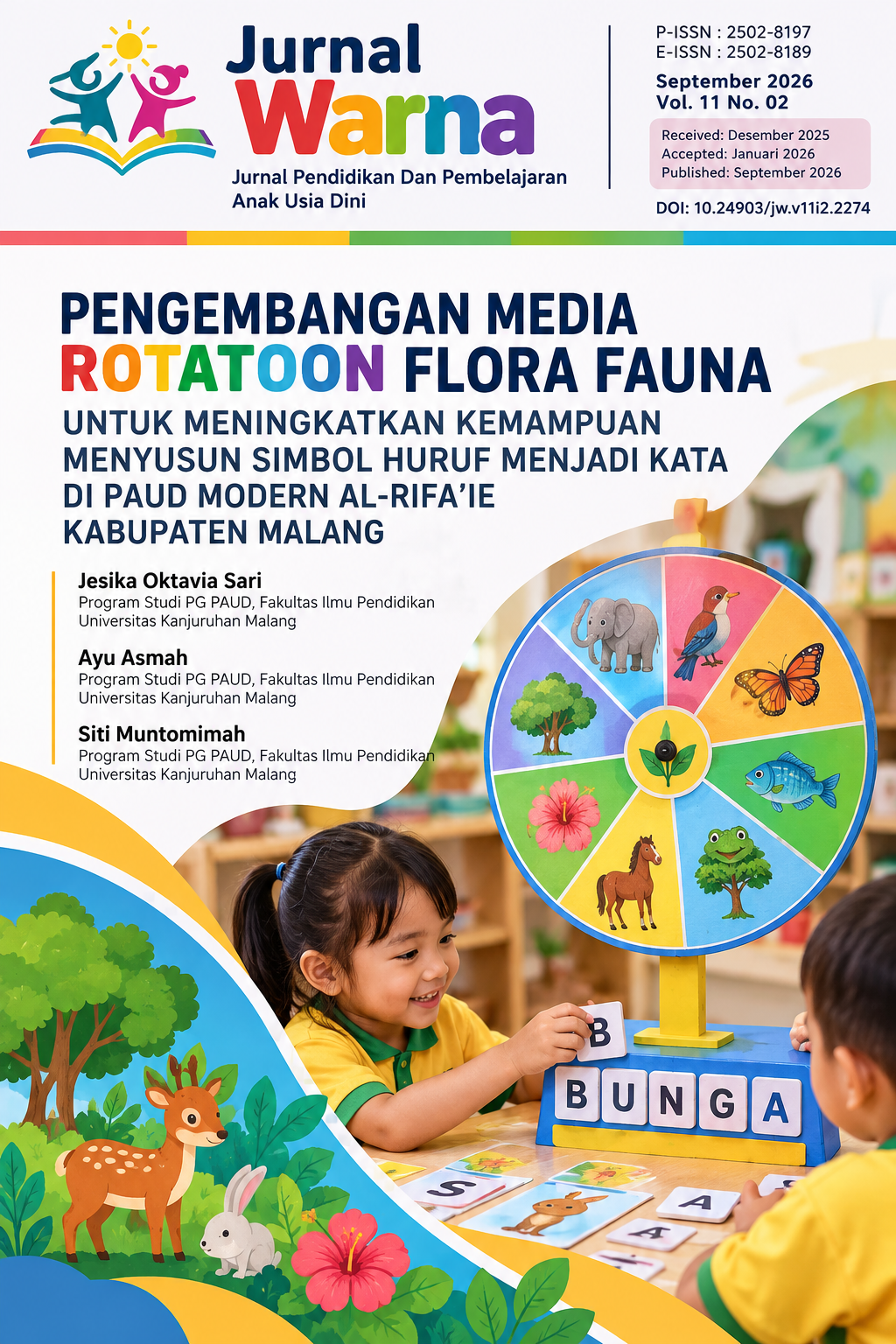
Pengembangan media rotatoon flora fauna untuk meningkatkan kemampuan menyusun simbol huruf menjadi kata di PAUD Modern Alrifaie
DOI:
https://doi.org/10.24903/jw.v11i2.2274Keywords:
Rotatoon, early literacy, early childhood education, learning media, arranging letters into words, interactiv, flora and faunaAbstract
Early literacy is a basic skill that needs to be developed from an early age, because it is the foundation for children's cognitive, social, and language development. This study aims to develop an innovative learning media called Rotatoon Flora and Fauna to improve the ability of children aged 5–6 years in arranging letter symbols into meaningful words in PAUD. This study uses a research and development (R&D) method with the Borg & Gall model, including product development stages, expert validation, revision, and field trials. The research subjects consisted of children aged 5–6 years who already know letters but are not yet fluent in composing words. The results of the study indicate that the Rotatoon media is very feasible and practical to use to improve the early literacy skills of children aged 5–6 years in PAUD Modern Al-Rifa'ie Malang Regency, especially in arranging letter symbols into words. The results of validation by material experts (98%) and media experts (80%) show that this media meets practical standards, is safe, attractive, and in accordance with the characteristics of child development. Staged trials also prove high practicality with results reaching up to 94.8%, where most children are able to compose words independently. In addition to improving literacy skills, Rotatoon creates fun, interactive learning experiences that support children's social-emotional development.
References
Amallia, R., Suriansyah, A., & Amelia, R. (2025). Learning Through Screens: A Literature Review on the Role of Visual and Digital Media in Early Childhood Education. International Journal of Research in Education, 5(2), 358-369.
Aulina, C. N., Masitoh, S., & Arianto, F. (2024). Whole Brain Teaching and Multi-Sensory Environments on Cognitive Science Development: Moderated by Children's Learning Preferences. IJORER: International Journal of Recent Educational Research, 5(4), 963-977.
Firdaus, U. R., & Prasetyo, S. (2025). Effectiveness of Using Interactive Multimedia For Early Childhood Learning. Jurnal Anak Usia Dini Holistik Integratif (AUDHI), 7(2), 102-112.
Handoko, Y., Putri, K. U., & Rahayu, N. A. (2025). Perkembangan Kognitif Anak Usia 0–11 Tahun: Studi Kualitatif Berbasis Teori Piaget. Jurnal Inovasi dan Teknologi Pendidikan Berkelanjutan, 9(2).
Hobbs, R. (2016). Literacy. The international encyclopedia of communication theory and philosophy, 1-11.
Marjuk, Y., & Ursia, F. (2025). Peran Orang Tua dalam Perkembangan Emosional Anak di TK Yamko Konja Maybrat. Indonesian Research Journal on Education, 5(3), 297-303.
Nafiqoh, H., & Nurcahyani, R. D. (2025). Development of E-Books as Educational Media to Introduce Disasters to Early Childhood. AL-ISHLAH: Jurnal Pendidikan, 17(2), 2021-2029.
Ponticorvo, M., Di Fuccio, R., Ferrara, F., Rega, A., & Miglino, O. (2018, June). Multisensory educational materials: five senses to learn. In International Conference in Methodologies and intelligent Systems for Techhnology Enhanced Learning (pp. 45-52). Cham: Springer International Publishing.
Rahmawati, N. (2023). Implementasi pembelajaran model project based learning pada Kurikulum Merdeka di TK Islam Orbit 2 Surakarta Tahun Ajaran 2022/2023. Jurnal Pendidikan Anak Usia Dini, 11(1), 45–57.
Rohde, L. (2015). The comprehensive emergent literacy model: Early literacy in context. Sage Open, 5(1), 2158244015577664.
Sulistiyawati, N. (2024). Pentingnya Pengembangan Kemampuan Membaca Pada Anak Usia Dini Dalam Menumbuhkan Minat Literasi Sejak Dini. Journal Central Publisher, 2(9), 2548-2555.
Suyadi. (2013). Psikologi belajar anak usia dini. Pedagogia.
Wulandari, D. (2022). Pengembangan media papan pintar untuk meningkatkan kemampuan mengenal huruf siswa Cerebral Palsy di SLB Negeri Lutang. Jurnal Pendidikan Khusus, 9(2), 88–97.
Downloads
Published
How to Cite
Issue
Section
License
Copyright (c) 2026 Jesika Oktavia Sari, Ayu Asmah

This work is licensed under a Creative Commons Attribution-ShareAlike 4.0 International License.
Authors retain copyright and grant the journal right of first publication with the work simultaneously licensed under a Creative Commons Attribution 4.0 International License that allows others to share the work with an acknowledgement of the work's authorship and initial publication in this journal.