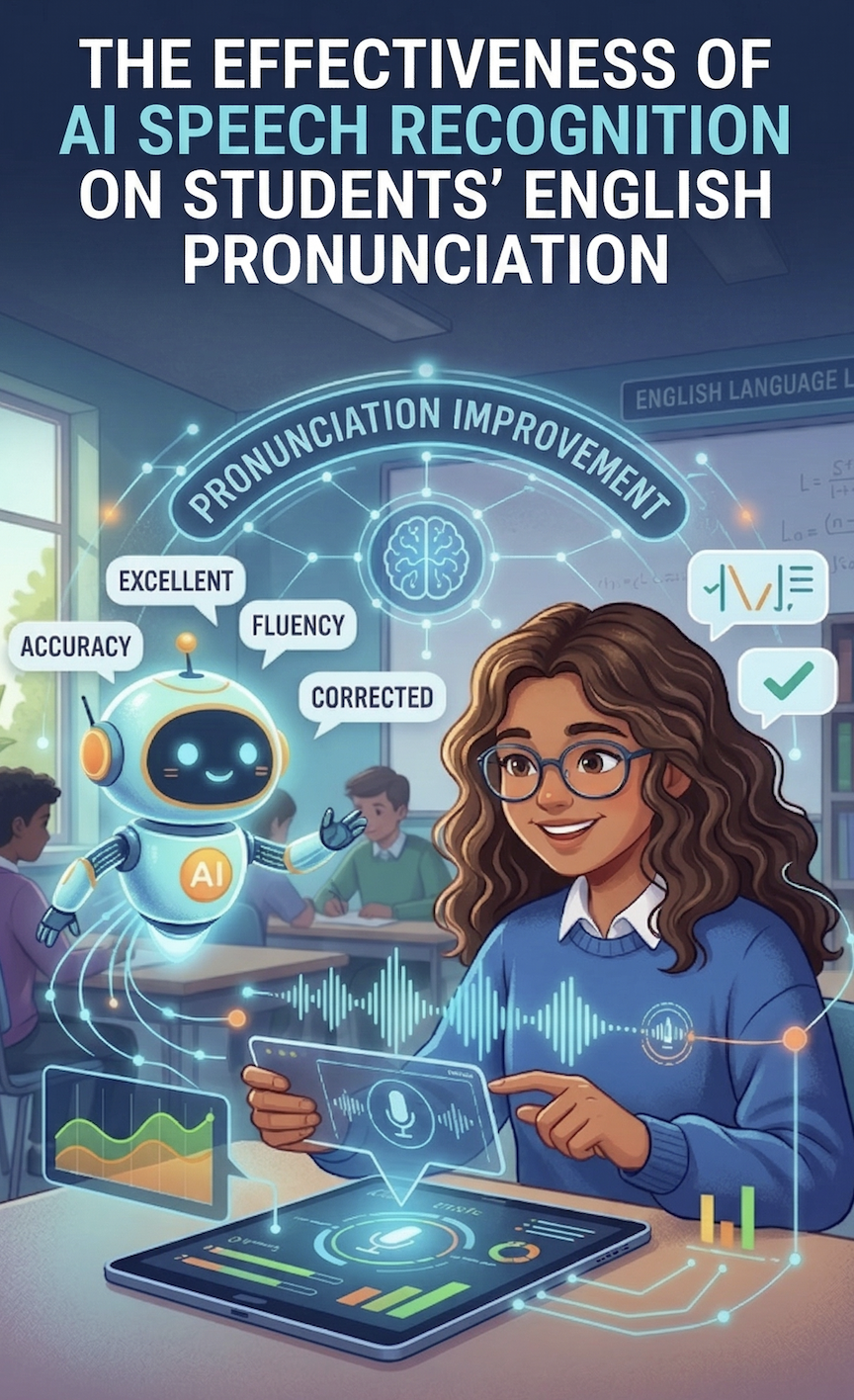
The Effectiveness of AI Speech Recognition on Students’ English Pronunciation
DOI:
https://doi.org/10.24903/sj.v11i1.2282Keywords:
AI Speech Recognition, Effectiveness, English PronunciationAbstract
Background:
Pronunciation is probably one of the most problematic and the conventional teaching approaches do not tend to offer the immediate, personal feedback, which is required to achieve effective pronunciation. But AI speech recognition applications can provide a real-time corrective response that may be used to overcome these drawbacks in teaching.
Methodology:
The research utilized a pre experimental one group pre-test post-test study design whose qualitative observations were supported by 30 first-semester students purposely selected to participate in the study. The information was gathered by means of pre- and post-teaching tests, observation forms, and AI-based feedback. The quantitative analysis was based on descriptive statistics and paired sample t-test, and instead, thematic coding based on observation was applied to qualitative data.
Findings:
The results showed that the pronunciation of students has been significantly improved, and the average scores have increased by 68.4 to 81.7 (p < 0.05). The qualitative observations revealed the enhancement of the accuracy in the production of segmental characteristics, including the interdental sounds (/θ/, /ð/), voicing contrasts (/v/ vs. /f/), and vowel length differences, and advances in supra segmental characteristics, which included word stress, rhythm, and intonation. Besides, self-confidence, motivation, and independence of the students in practicing pronunciation using AI-supported learning also improved.
Conclusion:
AI speech recognition technology is a priceless aid in enhancing the English pronunciation. Feedback that was given to the learners was both regular, individualized, and timely and this resulted to a rise in accuracy and self-regulated learning.
Originality:
The study provides classroom-based evidence concerning the application of AI speech recognition in learning English pronunciation. It shows the possibilities of using AI in teaching pronunciation and increasing the level of learner autonomy and positive results of learning.
References
Abimanto, D., & Sumarsono, W. (2024). Improving English pronunciation with AI speech-recognition technology. Acitya: Journal of Teaching and Education, 6(1), 146–156. https://doi.org/https://doi.org/10.30650/ajte.v6i1.3810
Aryanti, R. D., & Santosa, M. H. (2024). A systematic review on artificial intelligence applications for enhancing EFL students’ pronunciation skill. The Art of Teaching English as a Foreign Language (TATEFL), 5(1), 102–113. https://doi.org/https://doi.org/10.36663/tatefl.v5i1.718
Benson, P. (2011). Autonomy in language learning. Language Teaching, 44(2), 149–171. https://doi.org/https://doi.org/10.1017/S026144481000040X
Benson, P. (2013). Teaching and researching autonomy (2nd ed.). Routledge.
Celce-Murcia, M., Brinton, D., & Goodwin, J. (2010). Teaching pronunciation: A course book and reference guide (2nd ed.). Cambridge University Press.
Clarke-Jones, L. (2021). Engaging learners in pronunciation: Developing learner autonomy via an action research approach. Language Teaching, 54(3), 434–437. https://doi.org/https://doi.org/10.1017/S0261444821000112
Creswell, J. W. (2014). Research Design Qualitative, Quantitative, and Mixed Methods Approaches Fourth Edition. SAGE Publication, Inc.
Cutler, A. (2018). Suprasegmentals: Prosody in English pronunciation teaching. Language Teaching, 51(2), 228–246. https://doi.org/https://doi.org/10.1017/S0261444817000361
Dennis, N. K. (2024). Using AI-Powered Speech Recognition Technology to Improve English Pronunciation and Speaking Skills. IAFOR Journal of Education, 12(2). https://doi.org/https://doi.org/10.22492/ije.12.2.05
Derwing, T. M., & Munro, M. J. (2005). Second language accent and pronunciation teaching: A research-based approach. TESOL Quarterly, 39(3), 379–397. https://doi.org/https://doi.org/10.2307/3588486
Derwing, T. M., & Munro, M. J. (2009). Put on your listening ears: The role of pronunciation in ESL teaching. Language Teaching, 42(4), 482–504. https://doi.org/https://doi.org/10.1017/S0261444809990144
Derwing, T. M., & Munro, M. J. (2015). Pronunciation fundamentals: Evidence-based perspectives for L2 teaching and research. Language Learning & Language Teaching, 42. https://doi.org/https://doi.org/10.1075/lllt.42
Dja’far, V. H., & Hamidah, F. N. (2023). Improving English pronunciation skills through AI-based speech recognition technology. Ethical Lingua: Journal of Language Teaching and Literature, 11(2). https://doi.org/https://doi.org/10.30605/25409190.747
Dutta, P., & Arora, P. (2021). Exploring AI-based tools for improving pronunciation skills in ESL learners. Journal of Applied Linguistics, 42(2), 231–248. https://doi.org/https://doi.org/10.1080/17501229.2021.1887984
Hidayatulllah, M., Zainuddin, Z., & Hamdani, B. (2025). Exploring speech-recognition technology on English pronunciation skills: A qualitative study. Jo-ELT, 12(1). https://doi.org/https://doi.org/10.33394/jo-elt.v12i1.15230
Hsu, L. (2023). Integrating AI-based feedback and human mediation in pronunciation instruction: A hybrid CALL approach. Language Learning & Technology, 27(2), 48–65. https://www.lltjournal.org/27.2/hsu
Indari, A. (2023). The detection of pronunciation errors in English speaking skills based on artificial intelligence (AI). Jurnal Serunai Bahasa Inggris, 15(2). https://ejournal.stkipbudidaya.ac.id/index.php/jd/article/view/1007
Jenkins, J. (2000). The phonology of English as an international language. Oxford University Press.
Junining, E., Alif, S., & Setiarini, N. (2020). Automatic speech recognition in computer-assisted language learning for individual learning in speaking. JEES (Journal of English Educators Society), 5(2), 219–223. https://doi.org/https://doi.org/10.21070/jees.v5i2.867
Kenworthy, J. (1987). Teaching English pronunciation. Longman.
Kholis, A. (2021). ELSA Speak App: Automatic Speech Recognition (ASR) for supplementing English pronunciation skills. Pedagogy: Journal of English Language Teaching, 9(1). https://doi.org/https://doi.org/10.32332/joelt.v9i1.2723
Khurshedjonovna, O. S. (2025). AI technologies for assessing students’ pronunciation. Web of Humanities: Journal of Social Science and Humanitarian Research, 3(2), 163–167. https://webofjournals.com/index.php/9/article/view/3275
Kruk, M. (2012). Using online resources in the development of learner autonomy and English pronunciation: The case of individual learners. Journal of Second Language Teaching & Research, 1(2), 113–142. https://pops.uclan.ac.uk/index.php/jsltr/article/view/28
Levis, J. M. (2018). Technology and pronunciation. In Cambridge Handbook of English Pronunciation (pp. 487–504). Cambridge University Press. https://doi.org/https://doi.org/10.1017/9781316688973.033
Martin, I. A. (2023). Motivation in computer-assisted pronunciation training: Online and face-to-face environments. Language Learning & Technology, 27(1), 1–21. https://doi.org/https://doi.org/10.64152/10125/73526
Miladiyenti, F., Rozi, F., Haslina, W., & Marzuki, D. (2022). Incorporating mobile-based artificial intelligence to English pronunciation learning in tertiary-level students: Developing autonomous learning. International Journal of Advanced Science Computing and Engineering, 4(3), 220–232. https://doi.org/https://doi.org/10.62527/ijasce.4.3.92
Nasir, M., Nazar, F., Abbas, M. K., Waheed, A., & Ahmad, J. (2023). Enhancing pronunciation skills of intermediate students through computer assisted language learning (CALL). Al-Qanṭara, 9(3), 142–160. https://www.alqantarajournal.com/index.php/Journal/article/view/300
Neri, A., Cucchiarini, C., & Strik, H. (2008). The effectiveness of computer-based speech corrective feedback for improving segmental quality in L2 Dutch. ReCALL, 20(2), 225–243. https://doi.org/https://doi.org/10.1017/S0958344008000724
Ngo, T. T. N., Chen, H. H. J., & Lai, K. K.-W. (2023). The effectiveness of automatic speech recognition in ESL/EFL pronunciation: A meta-analysis. ReCALL, 36(1), 4–21. https://doi.org/https://doi.org/10.1017/S0958344023000113
Nguyen, T. S., Nguyen, T. D. T., & Hoang, N. Q. N. (2025). How AI-powered voice recognition has supported pronunciation competence among EFL university learners. Computer-Assisted Language Learning Electronic Journal, 26(3), 64–83. https://doi.org/https://doi.org/10.54855/callej.252634
Noviyanti, S. D. (2022). Artificial intelligence (AI)-based pronunciation checker: An alternative for independent learning in pandemic situation. ELT Echo: The Journal of English Language Teaching in Foreign Language Context, 5(2). https://doi.org/https://doi.org/10.24235/eltecho.v5i2.7246
Nursyafida, & Putri, R. E. (2025). Exploring technology use in English pronunciation instruction: A systematic review of trends and tools. SALEE: Study of Applied Linguistics and English Education, 6(2), 414–436. https://doi.org/https://doi.org/10.35961/salee.v6i2.414-436
Saeed, A. (2020). The impact of speech recognition technology on language learning. International Journal of Educational Technology in Higher Education, 17(1), 1–15. https://doi.org/https://doi.org/10.1186/s41239-020-00209-w
Saeed, A., & Sharma, K. (2020). AI in ESL classrooms: Improving pronunciation through speech recognition tools. Journal of Language Teaching and Research, 11(6), 967–975. https://doi.org/https://doi.org/10.17507/jltr.1106.14
Sardegna, V. G., & McGregor, A. (2022). Classroom research for pronunciation. In J. M. Levis & T. M. Drewing (Eds.), Second Language Pronunciation: Bridging the Gap Between Research and Teaching. John Wiley & Sons, Inc.
Schmidt, R. W. (1990). The role of consciousness in second language learning. Applied Linguistics, 11(2), 129–158. https://doi.org/https://doi.org/10.1093/applin/11.2.129
Spring, R., & Tabuchi, R. (2022). The role of ASR training in EFL pronunciation improvement: An in-depth look at the impact of treatment length and guided practice on specific pronunciation points. Computer-Assisted Language Learning Electronic Journal, 23(3), 163–185. https://callej.org/index.php/journal/article/view/417
Sun, W. (2023). The impact of automatic speech recognition technology on second language pronunciation and speaking skills of EFL learners: A mixed methods investigation. Frontiers in Psychology, 14. https://doi.org/https://doi.org/10.3389/fpsyg.2023.1210187
Sun, Y. (2024). The application of intelligent speech recognition in the teaching of spoken English in colleges and universities. Applied Mathematics and Nonlinear Sciences, 9(1). https://doi.org/https://doi.org/10.2478/amns-2024-2125
Thomson, R. I., & Derwing, T. M. (2015). The effectiveness of L2 pronunciation instruction: A narrative review. Applied Linguistics, 36(3), 326–344. https://doi.org/https://doi.org/10.1093/applin/amu076
Vančová, H. (2024). AI and AI-powered tools for pronunciation training. Journal of Language and Cultural Education, 11(3), 12–24. https://doi.org/https://doi.org/10.2478/jolace-2023-0022
Vassallo, S., Boulos, M. N. K., & Goller, P. (2019). AI in language learning: Challenges and opportunities for speech recognition. Computers & Education, 137, 1–12. https://doi.org/https://doi.org/10.1016/j.compedu.2019.04.007
Wen, X., & Li, Y. (2023). Beyond accuracy: Teacher mediation in AI-assisted pronunciation learning. ReCALL, 35(1), 88–106. https://www.cambridge.org/core/journals/recall/issue/E9F26F8863E0DDA0DF264E2A888D518F
Zainuddin, N. (2024). Technology enhanced language learning research trends and practices: A systematic review (2020–2022). Electronic Journal of E-Learning (EJEL), 21(2). https://doi.org/https://doi.org/10.34190/ejel.21.2.2835
Zimmerman, B. J. (2002). Becoming a self-regulated learner: An overview. Theory Into Practice, 41(2), 64–70. https://doi.org/https://doi.org/10.1207/s15430421tip4102_2
Downloads
Published
Issue
Section
License
Copyright (c) 2026 Woro Kusmaryani, Ramli, Winarno

This work is licensed under a Creative Commons Attribution-ShareAlike 4.0 International License.
Authors retain copyright and grant the journal right of first publication with the work simultaneously licensed under a Creative Commons Attribution 4.0 International License that allows others to share the work with an acknowledgement of the work's authorship and initial publication in this journal.