Technology Integration for Promoting Deep Learning in EFL Contexts
DOI:
https://doi.org/10.24903/sj.v11i2.2370Keywords:
deep learning approach, technology integration, EFL speaking, artificial intelligence in education, border area educationAbstract
Background
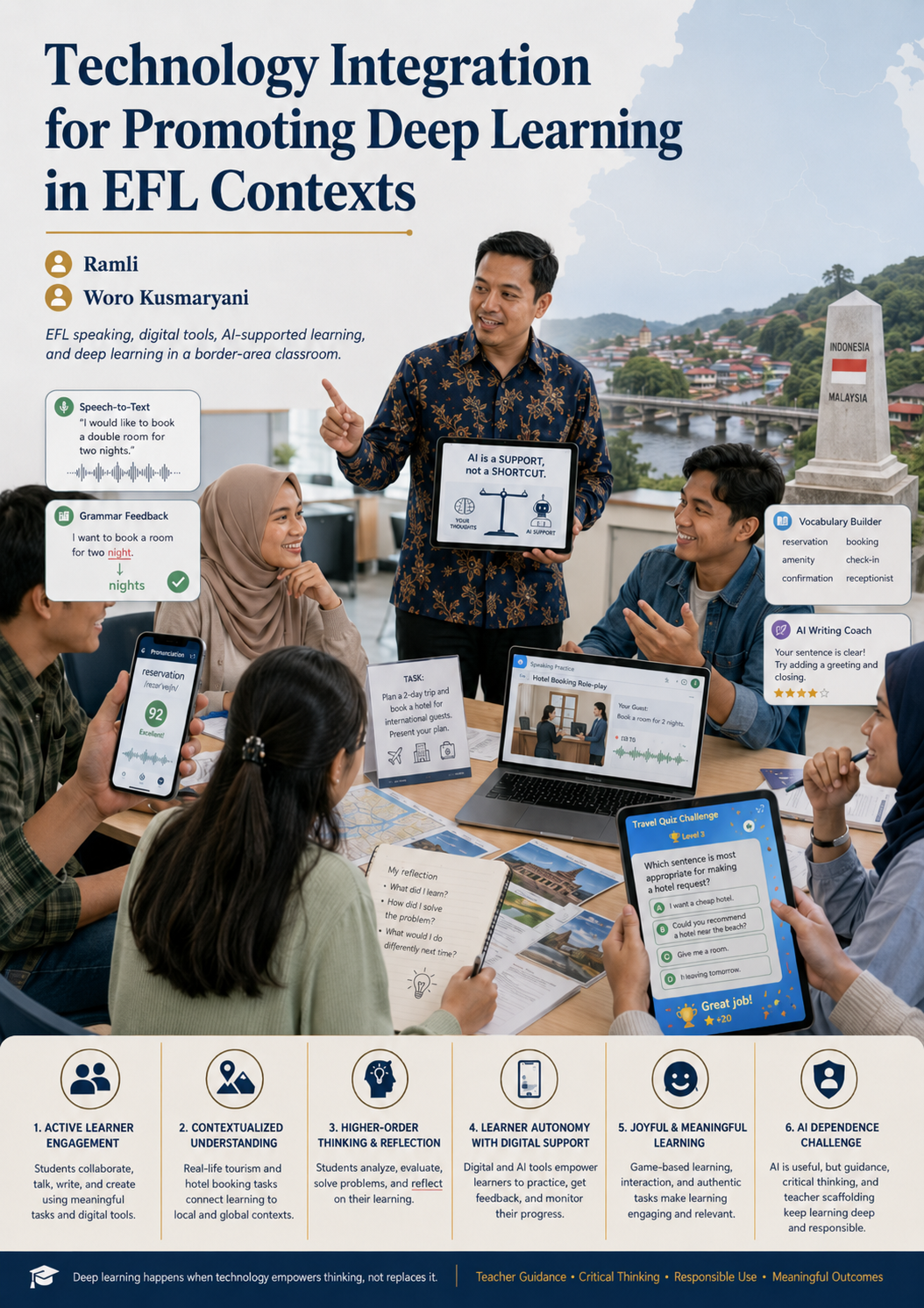
This study explored how an EFL lecturer understands deep learning as a pedagogical approach, how digital and AI-supported tools are integrated into EFL speaking instruction, and what challenges emerge when these tools are used in a classroom located in the Indonesia-Malaysia border area.
Methodology
This study employed an interpretive qualitative case-study design at the English Education Department of Universitas Borneo Tarakan, North Kalimantan, Indonesia. The participant was one purposively selected EFL lecturer who taught a speaking class and had already used digital and AI-supported applications in classroom practice. Data were collected through a semi-structured interview, four classroom observations, field notes, and video recordings of classroom activities.
Findings
The findings suggested that technology-supported activities appeared to create classroom conditions associated with deep learning. Students participated in group discussions, short writing activities, spontaneous speaking, oral presentations, and communicative tasks related to familiar contexts such as tourism, travel, hotel booking, and personal experiences. The lecturer used digital and AI-supported tools, including Duolingo, Elsa Speak, Cake, Busuu, Blooket, speech-to-text tools, QuillBot, and Grammarly, to support vocabulary learning, pronunciation practice, speaking rehearsal, gamified review, language feedback, revision, and learner engagement. These tools extended classroom practice and made learning more meaningful and enjoyable. However, the findings also indicated that technology did not automatically create deep learning. Its value depended on the lecturer's pedagogical guidance and on how the tools were connected to speaking tasks, reflection, and communicative purposes.
Conclusion
In this observed case, technology integration appeared to support active participation, contextualized language use, learner autonomy, reflection, and positive engagement in an EFL speaking classroom. At the same time, some students tended to rely too quickly on AI tools for ready-made answers, highlighting the need for teacher mediation, digital literacy, and ethical awareness. Technology can enrich EFL learning when it is used with a clear pedagogical purpose, but it should not replace students' own thinking or the teacher's instructional role.
Originality
This study provided context-specific evidence from a higher-education EFL classroom in the Indonesia-Malaysia border area. It demonstrated how one lecturer interpreted and enacted technology integration to support learning conditions associated with deep learning in speaking instruction.
References
Alsayed, S., Alshammari, F., Pasay-an, E., & Dator, W. (2021). Investigating the learning approaches of students in nursing education. Journal of Taibah University Medical Sciences, 16(1), 43–49. https://doi.org/10.1016/j.jtumed.2020.10.008
Andrews, N., Gabbay, J., Le-May, A., Miller, E., Petch, A., & O’Neill, M. (2020). Story, dialogue, and caring about what matters to people: Progress towards evidence-enriched policy and practice. Evidence & Policy, 16(4), 597–618. https://doi.org/10.1332/174426420X15825349063428
Awofala, A., Lawani, A., & Oraegbunam, C. (2020). A factor analytic structure of the conceptions of mathematics scale among pre-service mathematics teachers. Journal of Research and Advances in Mathematics Education, 5(1), 94–104. https://doi.org/10.23917/jramathedu.v5i1.9491
Braun, V., & Clarke, V. (2006). Using thematic analysis in psychology. Qualitative Research in Psychology, 3(2), 77–101.
Cao, Y., & Sun, Y. (2024). The research on the application of deep learning in education. IETI Transactions on Data Analysis and Forecasting, 2(3), 4–11. https://doi.org/10.3991/itdaf.v2i3.51413
Creswell, J. W., & Creswell, J. D. (2018). Research Design: Qualitative, Quantitative, and Mixed Methods Approaches (5th ed.). SAGE Publications.
Cui, H. (2024). Exploration of deep learning evaluation from the perspective of multimodal data analysis. Journal of Artificial Intelligence Practice, 7(1). https://doi.org/10.23977/jaip.2024.070110
Fatimah, A. S., & Santiana, S. (2017). Teaching in 21st century: Students-teachers’ perceptions of technology use in the classroom. Script Journal: Journal of Linguistics and English Teaching, 2(2), 125–134. https://doi.org/10.24903/sj.v2i2.132
Fullan, M., Quinn, J., & McEachen, J. (2018). Deep learning: Engage the world, change the world. Corwin.
Guo, B., Mondol, E., Karim, A., & Musallami, N. (2024). Impact of artificial intelligence on the enhancement of the quality of teaching in the private sector tertiary education. International Journal of Academic Research in Progressive Education and Development, 13(4). https://doi.org/10.6007/IJARPED/v13-i4/23546
Gurav, R., Mehta, Y., & Nahar, S. (2020). Assessing study approach in postgraduate physiotherapy students. Journal of Education Technology in Health Sciences, 5(1), 45–48. https://doi.org/10.18231/2393-8005.2018.0009
Hattie, J., & Donoghue, G. (2016). Learning strategies: A synthesis and conceptual model. Npj Science of Learning, 1(1).
Huang, D., & Hoon-Yang, J. (2022). Artificial intelligence combined with deep learning in film and television quality education for youth. International Journal of Humanoid Robotics, 20(6). https://doi.org/10.1142/S0219843622500190
Huang, E., Jiang, L., & Yang, M. (2021). The affordances of a technology-aided formative assessment platform for the assessment and teaching of English as a foreign language: An ecological perspective. Educational Technology Research and Development, 69, 3391–3412. https://doi.org/10.1007/s11423-021-10047-y
Kandula, N., & Kumar, R. (2023). A deep dive into academic excellence: Using deep learning to evaluate and improve engineering students’ performance. https://doi.org/10.21203/rs.3.rs-3675317/v1
Krishnagiri, S., Hooper, B., Price, P., Taff, S., & Bilics, A. (2019). A national survey of learning activities and instructional strategies used to teach occupations. American Journal of Occupational Therapy, 73(5). https://doi.org/10.5014/ajot.2019.032789
Kusmaryani, W., & Tanjung, F. Z. (2023). The use of mobile applications in digital project-based learning to improve students’ English speaking skill. Script Journal: Journal of Linguistics and English Teaching, 8(2), 163–179. https://doi.org/10.24903/sj.v8i2.1422
Lau, Y. (2015). Learning approaches in accounting education: Towards deep learning. Management Science Letters, 861–866. https://doi.org/10.5267/j.msl.2015.6.011
Limbong, E., Setiawan, I., & Hamilton, A. (2024). Bridging the gap: The reality of digital technology integration by Indonesian pre-service EFL teachers. Script Journal: Journal of Linguistics and English Teaching, 9(1), 58–78. https://doi.org/10.24903/sj.v9i1.1524
Mansfield, K., Peoples, G., Parker-Newlyn, L., & Skropeta, D. (2020). Approaches to learning in medical education. Education Sciences, 10(11). https://doi.org/10.3390/educsci10110302
McDonald, F., Reynolds, J., Bixley, A., & Spronken-Smith, R. (2017). Changes in approaches to learning over three years of undergraduate study. Teaching and Learning Inquiry, 5(2). https://doi.org/10.20343/teachlearninqu.5.2.6
Mishra, P., & Koehler, M. J. (2006a). Technological pedagogical content knowledge. Teachers College Record, 108(6), 1017–1054.
Mishra, P., & Koehler, M. J. (2006b). Technological pedagogical content knowledge: A framework for teacher knowledge. Teachers College Record, 108(6), 1017–1054. https://doi.org/10.1111/j.1467-9620.2006.00684.x
Öhrstedt, M., & Lindfors, P. (2015). Students’ adoption of course-specific learning approaches. European Journal of Psychology of Education, 31(2), 209–223. https://doi.org/10.1007/s10212-015-0256-7
Pan, Z., Zhang, X., Wang, Y., & Liu, Q. (2023). Effects of a SPOC-based blended learning model on students’ deep learning and learning performance in higher education. Education and Information Technologies, 28, 12293–12312. https://doi.org/10.1007/s10639-023-11684-6
Stasya, S., & Emaliana, I. (2021). Examining the relationship between EFL students’ OSEL and their achievement. Script Journal: Journal of Linguistics and English Teaching, 6(1), 27–40. https://doi.org/10.24903/sj.v6i1.553
Su, H., & Huang, H. (2022). Augmented reality-assisted language learning: Effects on motivation and achievement. Frontiers in Psychology, 13, 996162. https://doi.org/10.3389/fpsyg.2022.996162
Tamire, T. N., Eshete, M. T., & Hanago, G. A. (2022). Students’ learning approaches as a factor of academic achievement at selected public universities. Frontiers in Education, 7, 965573. https://doi.org/10.3389/feduc.2022.965573
Tang, H. (2024). Construction of a vocational undergraduate education teacher team based on deep learning. Journal of Computational Methods in Sciences and Engineering, 24(1), 201–216. https://doi.org/10.3233/JCM-237041
Tovar Viera, R., & Velasco Sanchez, D. I. (2020). Research on technology competencies in EFL language instructors: Technology-pedagogy-content in language teaching. Script Journal: Journal of Linguistics and English Teaching, 5(1), 32–43. https://doi.org/10.24903/sj.v5i1.414
Walankar, P. P., Panhale, V. P., & Situt, S. A. (2019). Evaluation of learning approaches in physiotherapy students: A valuable insight. Journal of Education and Health Promotion, 8, 167. https://doi.org/10.4103/jehp.jehp_215_18
Wang, C., Zou, B., Du, Y., & Wang, Z. (2024). The impact of different conversational generative AI chatbots on EFL learners. System, 127, 103533. https://doi.org/10.1016/j.system.2024.103533
Weng, C.-H., & Wang, B. (2024). The effectiveness of immersive learning in second language acquisition: A meta-analysis. ReCALL, 36(3), 384–406. https://doi.org/10.1017/S0958344024000041
Winje, Ø., & Løndal, K. (2020). Bringing deep learning to the surface: A systematic mapping review of 48 years of research in primary and secondary education. Nordic Journal of Comparative and International Education, 4(2), 25–41. https://doi.org/10.7577/njcie.3798
Wu, C., & Liu, G. (2022). Analysis of physical education based on deep learning. Frontiers in Psychology, 13. https://doi.org/10.3389/fpsyg.2022.963155
Wu, Z., & Pan, D. (2024). Optimisation of deep learning in recognising student learning emotions. Traitement Du Signal, 41(1), 391–399. https://doi.org/10.18280/ts.410133
Xu, G., & Wong, C. (2024). Deep learning-based educational image understanding and personalised learning path recommendation. Traitement Du Signal, 41(1), 459–467. https://doi.org/10.18280/ts.410140
Zawacki-Richter, O., Marin, V. I., Bond, M., & Gouverneur, F. (2019). Systematic review of AI applications in higher education. International Journal of Educational Technology in Higher Education, 16(39).
Zhang, J. (2019). Research on deep learning through micro-video. https://doi.org/10.2991/sschd-18.2019.44
Zhang, X., & Cao, Z. (2021). Intelligent education system framework based on deep learning. International Journal of Emerging Technologies in Learning, 16(7), 233. https://doi.org/10.3991/ijet.v16i07.22123
Downloads
Published
Issue
Section
License
Copyright (c) 2026 Ramli Ramli, Woro Kusmaryani

This work is licensed under a Creative Commons Attribution-ShareAlike 4.0 International License.
Authors retain copyright and grant the journal right of first publication with the work simultaneously licensed under a Creative Commons Attribution 4.0 International License that allows others to share the work with an acknowledgement of the work's authorship and initial publication in this journal.