Strategies for Reading Online Academic Texts: A Comparative Qualitative Study Of High- and Low-English Reading Proficiency Learners
DOI:
https://doi.org/10.24903/sj.v11i1.2179Keywords:
global strategies, online reading strategies, problem-solving strategies, reading difficulties, support strategiesAbstract
Background:
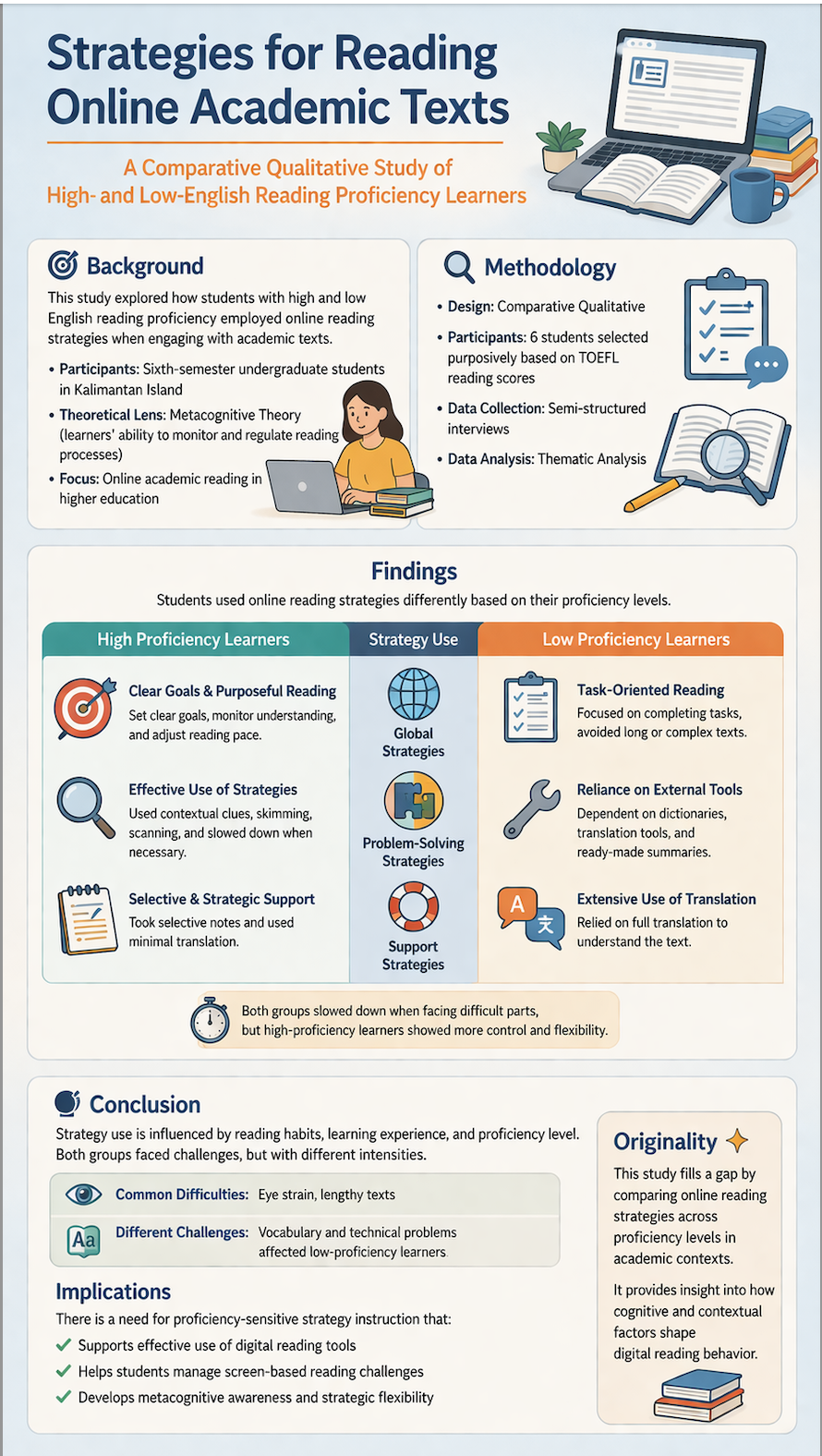
This study explored how students with high and low English reading proficiency employed online reading strategies when engaging with academic texts. It focused on sixth-semester of undergraduate students in Kalimantan Island. Guided by metacognitive theory, which highlights learners’ ability to monitor and regulate reading processes, this study addressed the growing importance of online academic reading in higher education.
Methodology:
A comparative qualitative design was employed. Six students were purposively selected based on their TOEFL reading scores to represent different proficiency levels. Data were gathered through semi-structured interviews and analyzed thematically to identify strategy use, reasons behind their choices, and the difficulties encountered.
Findings:
Students applied global, problem-solving, and support strategies differently based on proficiency. High-proficiency students read with clear goals, adjusted pace, and used contextual clues. Low-proficiency students focused on task completion, avoided long texts, and depended on external tools. While both slowed down when necessary, high-proficiency students showed more control. In support strategies, high-proficiency students used selective notes and minimal translation, while low-proficiency students relied on full translation.
Conclusion:
Strategy use was shaped by reading habits, learning experience, and proficiency level. Common difficulties included eye strain and lengthy texts, while vocabulary and technical problems varied. These findings highlight the need for proficiency-sensitive strategy instruction that also supports effective use of digital reading tools and helps students manage screen-based reading challenges.
Originality:
This study fills a gap by comparing online reading strategies across proficiency levels in academic contexts. It provides insight into how cognitive and contextual factors shape digital reading behavior
References
Abdul Rahim, M., Zainuddin, A., Mahamad Aziz, F. M., Mohd Shazilli, M. S., Shaiful Nizam, S. N., & Rahmat, N. H. (2023). Perceived Use of Online Reading Strategies Online Reading Problems: A Study of Relationships between Reading Strategies. International Journal of Academic Research in Business and Social Sciences, 13(7), 234–252. https://doi.org/10.6007/ijarbss/v13-i7/17188
Al-Qahtani, A. A. (2021). Reading English as a foreign language: The interplay of abilities and strategies. Indonesian Journal of Applied Linguistics, 10(3). https://doi.org/10.17509/ijal.v10i3.31738
Ali, A. M., & Razali, A. B. (2019). A Review of Studies on Cognitive and Metacognitive Reading Strategies in Teaching Reading Comprehension for ESL/EFL Learners. English Language Teaching, 12(6), 94. https://doi.org/10.5539/elt.v12n6p94
Aljabri, S. (2024). Exploring EFL students’ preferences and practices of study strategies: repeated reading versus testing. Frontiers in Education, 9. https://doi.org/10.3389/feduc.2024.1457504
Anderson, N. J. (2003). Scrolling, Clicking, and Reading English: Online Reading Strategies in a Second/Foreign Language. The Reading Matrix, 3(3), 1–15.
Anwar, I. W., & Sailuddin, S. P. (2022). Academic reading difficulties in higher education. JOLLT Journal of Languages and Language Teaching, 10(2), 309-314. https://doi.org/10.33394/jollt.v10i2.4849
Bernardo, A. B., & Mante-Estacio, M. J. (2023). Metacognitive reading strategies and its relationship with Filipino high school students’ reading proficiency: insights from the PISA 2018 data. Humanities and Social Sciences Communications, 10(1), 1-9. https://doi.org/10.1057/s41599-023-01886-6
Braun, V., & Clarke, V. (2006). Using thematic analysis in psychology. Qualitative Research in Psychology, 3(2), 77–101. https://doi.org/10.1191/1478088706qp063oa
Dakakni, D., & Safa, N. (2023). Reading Patterns, Scanning, and the “Control F”/Search Icon: How Students Really (Don’t) Read. International Research in Education, 11(1), 128. https://doi.org/10.5296/ire.v11i1.20943
Denton, C. A., Wolters, C. A., York, M. J., Swanson, E., Kulesz, P. A., & Francis, D. J. (2015). Adolescents’ use of reading comprehension strategies: Differences related to reading proficiency, grade level, and gender. Learning and Individual Differences, 37, 81–95. https://doi.org/10.1016/j.lindif.2014.11.016
Farid, A., Ishtiaq, M., & Hussain, M. S. (2020). A review of effective reading strategies to teach text comprehension to adult English language learners. Global Language Review, 5(3), 77-88. https://doi.org/10.31703/glr.2020(v-iii).09
Farsani, M. A., & Ghyasi, M. (2013). Metacognitive Awareness of Reading Strategies : A Triangulated Study. Modern Journal of Language Teaching Methods, 3(2).
Fauziyyah, G. L., Alina Lemieshevska, A., Nurjamin, L. R., & Suparman, A. (2023). Barriers of Online Reading Learning Faced by College Students. English Education and Applied Linguistics Journal (EEAL Journal), 6(1), 33–41. https://doi.org/10.31980/eealjournal.v6i1.2907
Habók, A., Oo, T. Z., & Magyar, A. (2024). The effect of reading strategy use on online reading comprehension. Heliyon, 10(2). https://doi.org/10.1016/j.heliyon.2024.e24281
Harputra, Y., Ramadhani, Y. R., & Siregar, M. N. H. (2023). Identifying Metacognitive Online Reading Strategies Of Students Universitas Graha Nusantara. ETANIC Journal Of English Language Teaching And Applied Linguistics, 1(1 SE-Artikel), 20–30. https://www.jurnal.radisi.or.id/index.php/JournalETANIC/article/view/257
Hartati, S., Syam, U. K., & Hijrah. (2022). An Analysis Digital Reading Challenges and Strategies. Journal of Computer Interaction in Education, 5(1), 29–37. https://doi.org/10.56983/jcie.v5i1.35
Hermida, R. (2021). Students' strategies in cultivating their reading habit. Accentia: Journal of English Language and Education, 1(1), 17-23. https://doi.org/10.37598/accentia.v1i1.980
Laila, N., Abrar, M., Hidayat, M., Rika, S., & Rahayu, M. (2024). The Students ’ Digital Reading Comprehension. IDEAS: Journal of Language Teaching and Learning, Linguistics and Literature, 4778, 477–486. https://doi.org/10.24256/ideas. v12i1.4955
Li, X., Ahmad, N. K., & Jamil, H. B. (2024). Factors Influencing EFL/ESL Students’ Use of Reading Strategies: A Systematic Review. International Journal of Learning, Teaching and Educational Research, 23(11), 89–112. https://doi.org/10.26803/ijlter.23.11.5
Mahdavi, A., & Azimi, S. (2012). The effects of cognitive strategies i.e. note-making and underlining on iranian efl learners’ reading comprehension. International Journal of Applied Linguistics and English Literature, 1(6), 1–6. https://doi.org/10.7575/ijalel.v.1n.6p.1
Melati, Mardiah, R., & Safitri, N. T. (2023). Digital reading strategies of undergraduate English language learners. In Proceedings of the 20th AsiaTEFL–68th TEFLIN–5th iNELTAL Conference (ASIATEFL 2022) (pp. 402–409). Atlantis Press. https://doi.org/10.2991/978-2-38476-054-1_35
Mohr, H., Zwosta, K., Markovic, D., Bitzer, S., Wolfensteller, U., & Ruge, H. (2018). Deterministic response strategies in a trial-and-error learning task. PLOS Computational Biology, 14(11), e1006621. https://doi.org/10.1371/journal.pcbi.1006621
Mokhtari, K., & Sheorey, R. (2002). Measuring ESL students' awareness of reading strategies. Journal of Developmental Education , 25 (3), 2-10.
Oakhill, J., Cain, K., & Elbro, C. (2019). Reading comprehension and reading comprehension difficulties. In Reading development and difficulties: Bridging the gap between research and practice (pp. 83-115). Cham: Springer International Publishing. https://doi.org/10.1007/978-3-030-26550-2
Pandey, S. R. (2023). Reading: An Active Language Learning Skill. Pragyaratna प्रज्ञारत्न, 5(1), 99–107. https://doi.org/10.3126/pragyaratna.v5i1.59276
Par, L. (2020). The relationship between reading strategies and reading achievement of the EFL students. International Journal of Instruction, 13(2), 223-238. https://doi.org/10.29333/iji.2020.13216a
Peras, I., Klemenčič Mirazchiyski, E., Japelj Pavešić, B., & Mekiš Recek, Ž. (2023). Digital versus Paper Reading: A Systematic Literature Review on Contemporary Gaps According to Gender, Socioeconomic Status, and Rurality. European Journal of Investigation in Health, Psychology and Education, 13(10), 1986–2005. https://doi.org/10.3390/ejihpe13100142
Pookcharoen, S. (2009). Metacognitive online reading strategies among Thai EFL university students (Doctoral dissertation). ProQuest Dissertations & Theses Global. https://www.proquest.com/docview/304902052
Pozdeeva, S. I., & Sobinova, L. A. (2015). Implementing of Reading Strategies in the Academic Process as the Productive Way of Foreign Text Understanding. Mediterranean Journal of Social Sciences, 6(6), 390–395. https://doi.org/10.5901/mjss.2015.v6n6s4p390
Prichard, C. (2014). Reading strategy use of low-and high-proficiency learners and the effect of reading instruction. 大学教育研究紀要, 10, 115-122.
Rahayu, S. R. M. (2024). Students’ Digital Reading Comprehension Challenges On Academic Text. Jambi-English Language Teaching Journal, 15(1), 37–48. https://doi.org/https://doi.org/10.22437/jelt.v8i1.31211
Raja Yacob, R. N. H., & Mohamad, M. M. (2024). the Influence of Learners’ Perception of Reading Difficulties and Their Online Reading Strategies. International Journal of Modern Education, 6(21), 112–130. https://doi.org/10.35631/ijmoe.621009
Rianto, A. (2021). Indonesian efl university students’ metacognitive online reading strategies before and during the covid-19 pandemic. Studies in English Language and Education, 8(1), 16–33. https://doi.org/10.24815/siele.v8i1.18110
Riddell, J. E. (2019). Online Reading. The International Encyclopedia of Media Literacy, 1–10. https://doi.org/10.1002/9781118978238.ieml0174
Sohail, S. (2015). Academic reading strategies used by leeds metropolitan university graduates: A case study. Journal of Education and Educational Development, 2(2), 115-133. https://doi.org/10.22555/joeed.v2i2.442
Syam, A. T., & Furwana, D. (2023). The Lecturers and Students’ Voice about Digital Reading: Does it Influence the Students’ Reading Skill?. Linguistics Initiative, 3(1), 66-78. https://doi.org/10.53696/27753719.3193
Rahman, S. A. S. A., Yunos, D. R. M., Whancit, W., Rahmat, N. H., & Ngadiran, N. M. (2023). Perceived difficulties and use of online reading strategies: A study among undergraduates. International Journal of Academic Research in Business and Social Sciences, 13(7), 997-1013. https://doi.org/10.6007/ijarbss/v13-i7/17414
Tanjung, F. Z., Ridwan, R., & Gultom, U. A. (2017). Reading habits in digital era: A research on the students in Borneo university. LLT Journal: A Journal on Language and Language Teaching, 20(2), 147-157. https://doi.org/10.24071/llt.v20i2.742
Thi Bich Thuy, N. (2021). Reading Strategies Used By Students of Different Levels of English Reading Proficiency. VNU Journal of Foreign Studies, 37(4), 111–127. https://doi.org/10.25073/2525-2445/vnufs.4684
Downloads
Published
Issue
Section
License
Copyright (c) 2026 Febiyani Febiyani, Weningtyas Parama Iswari, Maria Teodora Ping, Susilo Susilo, Noor Rachmawaty, Syamdianita Syamdianita

This work is licensed under a Creative Commons Attribution-ShareAlike 4.0 International License.
Authors retain copyright and grant the journal right of first publication with the work simultaneously licensed under a Creative Commons Attribution 4.0 International License that allows others to share the work with an acknowledgement of the work's authorship and initial publication in this journal.