Evaluative Language in Heritage Exploration: A Cultural Approach to Tourism Discourse Analysis
DOI:
https://doi.org/10.24903/sj.v11i1.2345Keywords:
heritage tourism, tourism discourse analysis, appraisal system, genre, registerAbstract
Abstract
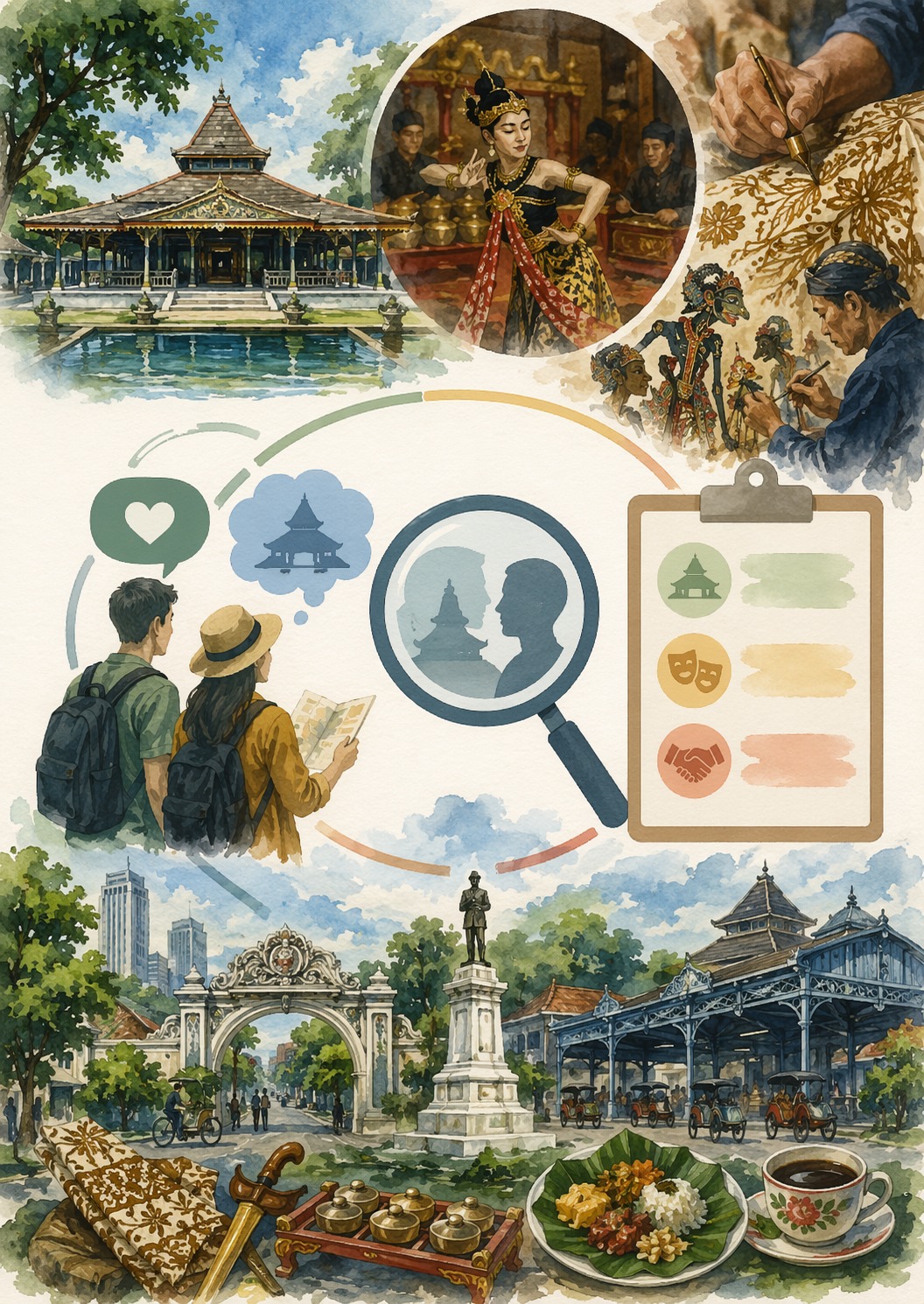
Background:This article presents a discourse analysis of online heritage tourism posts about archaeological and cultural tourist destinations in Surakarta. The objective is to examine the use of evaluative language in cultural contexts for the promotion of local attractions to the international audience.
Methodology:
The sample texts, selected from two prominent tourism websites (www.lonelyplanet.com and www.javaheritagetour.com), are analyzed through the lens of Appraisal theory, complemented with SFL's concept of Register and Genre.
Findings:
The results demonstrate that the deployment of evaluative linguistic resources serves not only to promote destinations but also to represent specific cultural and social processes. The discourse on Surakarta's heritage tourism places emphasis on the city's archaeological and cultural significance through Monoglossic language, presenting factual, reactive evaluations that enhance focalization on heritage sites but overlook broader socio-economic and political dimensions, limiting alternative angles and inclusivity.
Conclusion:
The paper concludes by discussing potential reasons for the evaluative pattern and providing several implications for online heritage tourism cultural communication.
Originality:
The paper not only discusses conservation, traditions, site management, and visitor experiences, but also applies Appraisal analysis, SFL Genre mapping, and an extended Cultural Approach to Discourse applied to Surakarta's online heritage promotion.
References
Baibatyrova, A. A., & Zharkynbekova, S. K. (2021). Promotional rhetorical strategies in topic generalizations of increasing specificity. Revista de Lingüística y Lenguas Aplicadas, 16, 25–35. https://doi.org/10.4995/rlyla.2020.14445
Chartady, R., Suhardjanto, D., Sudaryono, E. A., Widarjo, W., & Supriyono. (2024). Assessment of Tangible Cultural Heritage of Penyengat Island: Evidence from the Indonesian Riau Islands. Kurdish Studies, 12(1), Article 1.
Crowe, S., Cresswell, K., Robertson, A., Huby, G., Avery, A., & Sheikh, A. (2011). The case study approach. BMC Medical Research Methodology, 11(1), 100. https://doi.org/10.1186/1471-2288-11-100
Dai, T., Zheng, X., & Yan, J. (2021). Contradictory or aligned? The nexus between authenticity in heritage conservation and heritage tourism, and its impact on satisfaction. Habitat International, 107, 102307. https://doi.org/10.1016/j.habitatint.2020.102307
Don, A. (2021). An Introduction to Theme Issue: Systemic Functional Linguistics and Appraisal Analysis: Recent Contributions to English Language Research. Journal of Research in Applied Linguistics, 12(2). https://doi.org/10.22055/rals.2021.17005
Elechi, O. O., Piper, D., & C. Morris, S. V. (2014). Case Study Research. In The Encyclopedia of Criminology and Criminal Justice (pp. 1–5). John Wiley & Sons, Ltd. https://doi.org/10.1002/9781118517383.wbeccj358
Gerlach, A. (2018). A Cultural Approach to Discourse. In Psychoanalysis and Psychotherapy in China (pp. 169–174). Routledge. https://www.taylorfrancis.com/chapters/edit/10.4324/9780429478772-17/cultural-approach-discourse-shi-xu-palgrave-macmillan-alf-gerlach
Gomez-Oliva, A., Alvarado-Uribe, J., Parra-Meroño, M. C., & Jara, A. J. (2019). Transforming Communication Channels to the Co-Creation and Diffusion of Intangible Heritage in Smart Tourism Destination: Creation and Testing in Ceutí (Spain). Sustainability, 11(14), Article 14. https://doi.org/10.3390/su11143848
Hadidi, Y., & Mohammadbagheri-Parvin, L. (2015). Systemic Functional Linguistics as Interpersonal Semantics: Appraisal and Attitude in the Stylistic Analysis of an English Novel. International Journal of Linguistics, 7(1), Article 1. https://doi.org/10.5296/ijl.v7i1.7199
Halliday, M. A. K., & Matthiessen, C. M. I. M. (2014). Halliday’s introduction to functional grammar (Fourth Edition). Routledge.
Hausmann, A., & Schuhbauer, S. (2021). The role of information and communication technologies in cultural tourists’ journeys: The case of a World Heritage Site. Journal of Heritage Tourism, 16(6), 669–683. https://doi.org/10.1080/1743873X.2020.1819300
Hausmann, A., & Weuster, L. (2018). Possible marketing tools for heritage tourism: The potential of implementing information and communication technology. Journal of Heritage Tourism, 13(3), 273–284. https://doi.org/10.1080/1743873X.2017.1334786
Işık, E. E. (2023). A corpus-based genre analysis of promotional-informational discourse in online painting exhibition overviews. English for Specific Purposes, 70, 44–56. https://doi.org/10.1016/j.esp.2022.11.002
Istianah, A., & Suhandano, S. (2022). Appraisal patterns used on the kalimantan tourism website: An ecolinguistics perspective. Cogent Arts & Humanities, 9(1), 2146928. https://doi.org/10.1080/23311983.2022.2146928
Martin, J. R. (2014). Evolving systemic functional linguistics: Beyond the clause. Functional Linguistics, 1(1), 3. https://doi.org/10.1186/2196-419X-1-3
Martin, J. R. (2016). Meaning matters: A short history of systemic functional linguistics. WORD, 62(1), 35–58. https://doi.org/10.1080/00437956.2016.1141939
Martin, J. R., & Rose, D. (2007). Working with discourse: Meaning beyond the clause (2nd ed). Continuum.
Martin, J. R., & White, P. R. R. (2005). The Language of Evaluation. Palgrave Macmillan UK. https://doi.org/10.1057/9780230511910
Matthiessen, C. M. I. M., & Teruya, K. (2023). Systemic Functional Linguistics: A Complete Guide (1st ed.). Routledge. https://doi.org/10.4324/9781315675718
Merwe, C. D. van der. (2016). Tourist guides’ perceptions of cultural heritage tourism in South Africa. Bulletin of Geography. Socio-Economic Series, 34, Article 34. https://doi.org/10.1515/bog-2016-0039
Pasaribu, A. N., Sinambela, E., & Manik, S. (2020). The Contributions of Systemic Functional Linguistics to Literary Text Analysis. International Journal of Linguistics, Literature and Translation, 3(9), 81–86. https://doi.org/10.32996/ijllt.2020.3.9.8
Priatmoko, S., Kabil, M., Magda, R., Pallas, E., & David, L. D. (2021). Bali and the next proposed tourism development model in Indonesia. Regional Science Inquiry, 13(2), 161–180.
Priyomarsono, N. W. (2023). Approaches to revitalization of areas with historical and cultural values: The Baluwerti Royal Surakarta Palace, Surakarta, Indonesia. ISVS E-Journal, 10(4), 90–101.
Purwani, O., Rahmatulloh, O. R., & Rahayu, P. (2022). Invented traditions in Surakarta after decentralisation. Cities, 131, 103985.
Ramírez-Gutiérrez, D., Fernández-Betancort, H., & Santana-Talavera, A. (2018). Talking to others: Analysing tourists’ communications on cultural heritage experiences. International Journal of Heritage Studies, 24(6), 634–648. https://doi.org/10.1080/13527258.2017.1413674
Rasoolimanesh, S. M., Seyfi, S., Rather, R. A., & Hall, C. M. (2022). Investigating the mediating role of visitor satisfaction in the relationship between memorable tourism experiences and behavioral intentions in heritage tourism context. Tourism Review, 77(2), 687–709. https://doi.org/10.1108/TR-02-2021-0086
Regueira, I. (2020). Un soneto de Shakespeare desde la Teoría de la Valoración. Saga. Revista de Letras, 13, Article 13. https://doi.org/10.35305/sa.v2i13.107
Santosa, R. (2021). Dasar-dasar Metode Penelitian Kualitatif Kebahasaan. UNS Press.
Shi-xu. (2005). A Cultural Approach to Discourse. Palgrave Macmillan UK. https://doi.org/10.1057/9780230505391
Shi-xu. (2016). Cultural Discourse Studies through the Journal of Multicultural Discourses: 10 years on. Journal of Multicultural Discourses, 11(1), 1–8. https://doi.org/10.1080/17447143.2016.1150936
Siegmund, G. (2017). Subjects of Discourse. In G. Siegmund (Ed.), Jérôme Bel: Dance, Theatre, and the Subject (pp. 55–101). Palgrave Macmillan UK. https://doi.org/10.1057/978-1-137-55272-3_3
Taw, L. W., Libert, A. R., & Paramasivam, S. (2022). Building Virtual Rapport with Emotion Expressions: Hotel Responses to Positive Online Reviews. LEARN Journal: Language Education and Acquisition Research Network, 15(2), 80–103.
Timothy, D. J. (2018). Making sense of heritage tourism: Research trends in a maturing field of study. Tourism Management Perspectives, 25, 177–180. https://doi.org/10.1016/j.tmp.2017.11.018
Tobback, E. (2019). Telling the world how skilful you are: Self-praise strategies on LinkedIn. Discourse & Communication, 13(6), 647–668. https://doi.org/10.1177/1750481319868854
Unger, J. W. (2006). SHI-XU, A cultural approach to discourse. Language in Society, 35(04). https://doi.org/10.1017/S0047404506220281
Wang, J. (2015). Chinese discourse studies. Language and Intercultural Communication, 15(3), 449–452. https://doi.org/10.1080/14708477.2015.1013267
Wang, Y., & Chen, H. (2019). The influence of dialogic engagement and prominence on visual product placement in virtual reality videos. Journal of Business Research, 100, 493–502. https://doi.org/10.1016/j.jbusres.2019.01.018
Wu, G. (2018). Official websites as a tourism marketing medium: A contrastive analysis from the perspective of appraisal theory. Journal of Destination Marketing & Management, 10, 164–171. https://doi.org/10.1016/j.jdmm.2018.09.004
Zhang, G., Chen, X., Law, R., & Zhang, M. (2020). Sustainability of Heritage Tourism: A Structural Perspective from Cultural Identity and Consumption Intention. Sustainability, 12(21), Article 21. https://doi.org/10.3390/su12219199
Zhang, S., Liang, J., Su, X., Chen, Y., & Wei, Q. (2023). Research on global cultural heritage tourism based on bibliometric analysis. Heritage Science, 11(1), 139. https://doi.org/10.1186/s40494-023-00981-w
Zyubina, I. (2023). Political discourse as a subject of research in linguistics. Language and Culture, 30, Article 30. https://doi.org/10.52340/lac.2023.30.03
Downloads
Published
Issue
Section
License
Copyright (c) 2026 Riyadi Santosa, Rara Sugiarti, Tri Wiratno, Djatmika, Agus Hari Wibowo

This work is licensed under a Creative Commons Attribution-ShareAlike 4.0 International License.
Authors retain copyright and grant the journal right of first publication with the work simultaneously licensed under a Creative Commons Attribution 4.0 International License that allows others to share the work with an acknowledgement of the work's authorship and initial publication in this journal.