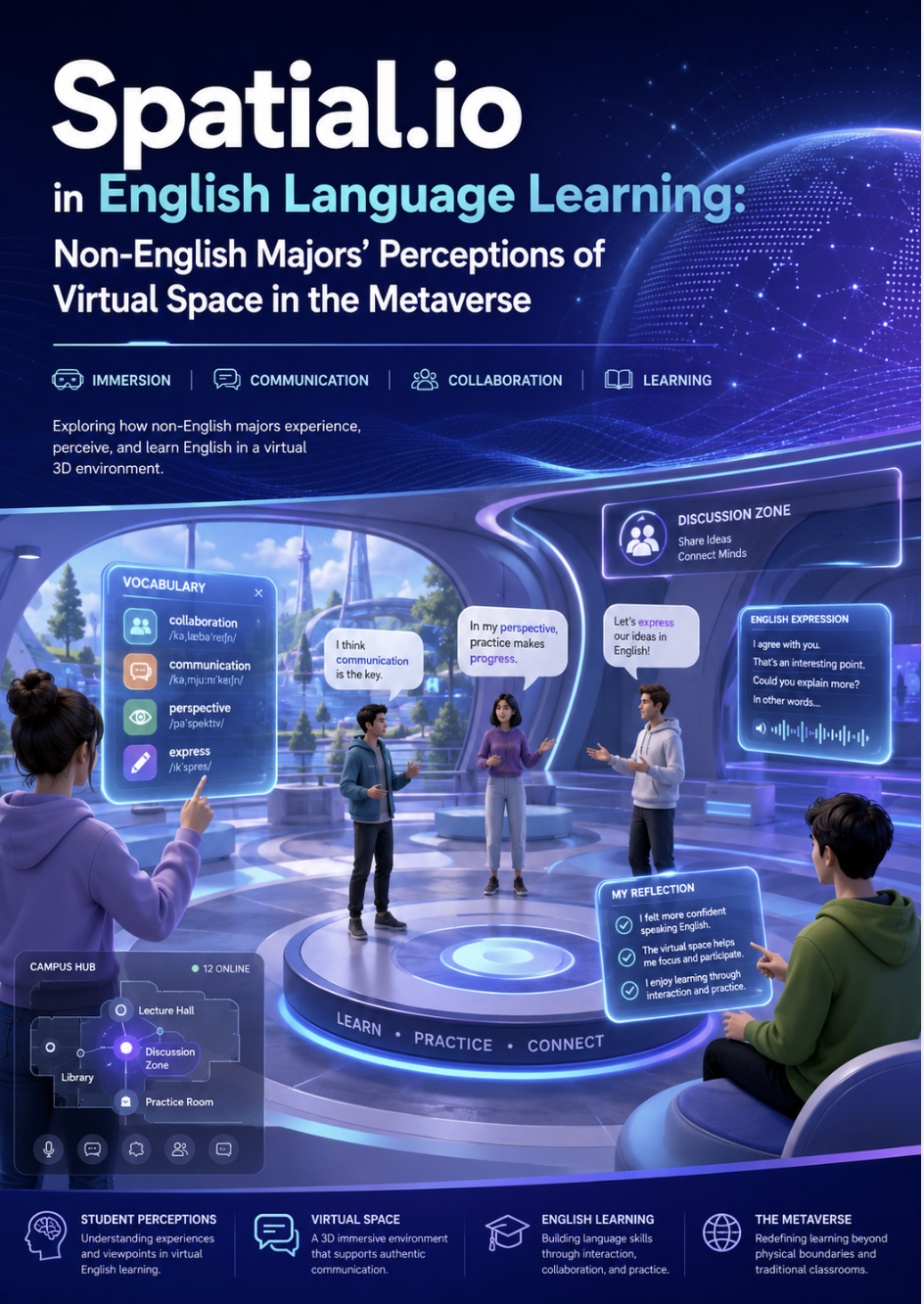
Spatial.io in English Language Learning: Non-English Majors’ Perceptions of Virtual Space in the Metaverse
DOI:
https://doi.org/10.24903/sj.v11i2.1892Keywords:
Metaverse, Technology Enhanced language Learning, PerceptionAbstract
Background:
Despite the promise of immersive education for metaverses, empirical evidence regarding the specific role in English language learning for non-English majors remains scarce. This study addresses the gap by examining students’ perceptions of the metaverse platform, Spatial.io, to inform more inclusive teaching strategies.
Methodology:
This study employed a qualitative case study design. Semi-structured interviews were conducted with four non-English major students selected to provide insight into early user experiences, and thematic analysis was utilized to interpret the interview data.
Findings:
Drawing on the Technology Acceptance Model (TAM), the analysis revealed three key themes. First, regarding perceived usefulness, participants reported that the metaverse enhanced interactivity, collaboration, and English language skills through immersive features. Second, perceived ease of use attributed to the platform’s flexibility and intuitive interface. However, significant challenged identified regarding technical infrastructure, internet instability and device compatibility, which hindered equitable access.
Conclusion:
The metaverse shows promise as a supplementary tool for enhancing English language skills development. However, because this study only involved a small group of students, these results are preliminary. Future implementation implies the needs for improved infrastructure and hardware compatibility to ensure inclusive learning environment.
Originality:
This study provides a closer look at how non-English majors perceive the metaverse (Spatial.io), offering early insight into how this technology might change language education before it is widely adopted.
References
Al-kfairy, M., Alomari, A., Al-Bashayreh, M., Alfandi, O., & Tubishat, M. (2024). Unveiling the Metaverse: A survey of user perceptions and the impact of usability, social influence and interoperability. Heliyon, 10(10), e31413. https://doi.org/10.1016/j.heliyon.2024.e31413
Aydın, S. (2022). The Metaverse in Foreign Language Learning: A Theoretical Framework. Innovational Research in ELT, 3(2), 12–19. https://doi.org/10.29329/irelt.2022.505.2
Braun, V., & Clarke, V. (2006). Using thematic analysis in psychology. Qualitative Research in Psychology, 3(2), 77–101. https://doi.org/10.1191/1478088706qp063oa
Davis, F. D. (1989). Perceived usefulness, perceived ease of use, and user acceptance of information technology. MIS Quarterly: Management Information Systems, 13(3), 319–339. https://doi.org/10.2307/249008
Dwi Hatmanto, E., Widi Pratolo, B., Intansari, M., Muhammadiyah Yogyakarta, U., Brawijaya, J., Kasihan, K., Bantul, K., & Istimewa Yogyakarta, D. (2023). Metaverse magic: Unveiling the pedagogical potential and transformative effects on intercultural communication in English language teaching. English Language Teaching Educational Journal, 6(1), 14–31. https://doi.org/10.12928/eltej.v6i1.8627http://journal2.uad.ac.id/index.php/eltej/index
Fatimah, A. S., & Santiana, S. (2017). Teaching in 21st century: Students-teachers’ perceptions of technology use in the classroom. Script Journal: Journal of Linguistic and English Teaching, 2(2), 125.
Gualano, R. J., & Campbell, S. W. (2024). Classrooms in the metaverse: educational applications and levels of learner interaction in virtual reality. Communication Education, 73(2), 212–225. https://doi.org/10.1080/03634523.2024.2312873
Guest, G., Namey, E., Chen, M., 2020. A simple method to assess and report thematic saturation in qualitative research. PLoS One 15 (5), e0232076. https://doi.org/10.1371/journal.pone.0232076
Hennink, M., Kaiser, B.N., 2022. Sample sizes for saturation in qualitative research: A systematic review of empirical tests. Social Science & Medicine 292, 114523. https://doi.org/10.1016/j.socscimed.2021.114523
Hennig-Thurau, T., Aliman, D. N., Herting, A. M., Cziehso, G. P., Linder, M., & Kübler, R. V. (2023). Social interactions in the metaverse: Framework, initial evidence, and research roadmap. Journal of the Academy of Marketing Science, 51(4), 889–913. https://doi.org/10.1007/s11747-022-00908-0
İbi̇li̇, E., Ölmez, M., İbi̇li̇, A. B., Bi̇lal, F., Ci̇han, A., & Okumuş, N. (2024). Assessing the effectiveness and student perceptions of synchronous online flipped learning supported by a metaverse-based platform in medical English education: A mixed-methods study. Education and Information Technologies. https://doi.org/10.1007/s10639-024-12542-0
Jiao, Y., Dewitt, D., & Razak, R. B. A. (2024). Exploring the Potential of Metaverse-Based Platforms for Enhancing English as a Foreign Language (EFL) Learning: A Comprehensive Systematic Review. International Journal of Information and Education Technology, 14(2), 231–239. https://doi.org/10.18178/ijiet.2024.14.2.2044
Khaira, M., Lesmana, D. C., Agustina, P., & Saputra, D. (2024). Utilization of the metaverse in the context of interactive learning. Hipkin Journal of Educational Research, 1(2), 151–162.
Kim, H.-S. (2023). Impact of Metaverse-Based Speaking Activities for Second Language Learning. STEM Journal, 24(4), 57–72. https://doi.org/10.16875/stem.2023.24.4.57
Li, M., & Yu, Z. (2023). A systematic review on the metaverse-based blended English learning. Frontiers in Psychology, 13. https://doi.org/10.3389/fpsyg.2022.1087508
Lyu, Z. (2023). State-of-the-Art Human-Computer-Interaction in Metaverse. International Journal of Human-Computer Interaction, 0(0), 1–19. https://doi.org/10.1080/10447318.2023.2248833
Nur, D. R., Widodo, P., & Putro, N. H. P. S. (2023). Digital Natives Generation Enjoyment Using Online Resources as Virtual Learning Environment in Learning English Speaking. International Journal of Language Education, 7(4), 602-614.
Pujasari, R. S., Fatimah, A. S., Sri, M., & Sulastri, F. (2024). Potential Benefits of Metaverse Concept Implementation in English for Tourism Course: A Case Study in Indonesian Higher Education Contexts. International Journal of Language Education, 8(3), 520-532.
Puncreobutr, V., Dhamacharoen, A., & Tapaneeyakorn, W. (2022). Factors Affecting The Readiness Of Thai Universities To Organize Learning Activities In The Metaverse Era. Webology, Volume 19(No. 2), 9285–9296. http://www.webology.org/abstract.php?id=2702
Reisoğlu, I., Topu, B., Yılmaz, R., Karakuş Yılmaz, T., & Göktaş, Y. (2017). 3D virtual learning environments in education: a meta-review. Asia Pacific Education Review, 18(1), 81–100. https://doi.org/10.1007/s12564-016-9467-0
Santiana, S., Silvani, D., & Ruslan, R. (2021). Optimizing LMS CANVAS for interactive online learning perceived by the students. Journal of English Education and Teaching, 5(4), 529-543.
Santiana, S., Margana, M., Putro, N. H. P. S., & Widodo, P. (2024). Students' Attitudes toward the Use of CANVAS in the EFL Virtual Learning Environment. International Journal of Language Education, 8(2), 267-290.
Tlili, A., Huang, R., Shehata, B., Liu, D., Zhao, J., Metwally, A. H. S., Wang, H., Denden, M., Bozkurt, A., Lee, L. H., Beyoglu, D., Altinay, F., Sharma, R. C., Altinay, Z., Li, Z., Liu, J., Ahmad, F., Hu, Y., Salha, S., … Burgos, D. (2022). Is Metaverse in education a blessing or a curse: a combined content and bibliometric analysis. Smart Learning Environments, 9(1). https://doi.org/10.1186/s40561-022-00205-x
Wang, M., Wang, H., & Shi, Y. (2022). The role of English as a foreign language learners’ grit and foreign language anxiety in their willingness to communicate: Theoretical perspectives. Frontiers in Psychology, 13(September), 1–11. https://doi.org/10.3389/fpsyg.2022.1002562
Yin, R. K. (2018). Case Study Research and Applications Design and Methods (6th ed.). Thousand Oaks, CA Sage.
Zhang, X., Chen, Y., Hu, L., & Wang, Y. (2022). The metaverse in education: Definition, framework, features, potential applications, challenges, and future research topics. Frontiers in Psychology, 13(October), 1–18. https://doi.org/10.3389/fpsyg.2022.1016300
Downloads
Published
Issue
Section
License
Copyright (c) 2026 Nita Sari Narulita Dewi, Yusup Supriyono, Ratu Sarah Pujasari; Muhammad Adlan Faishal; Luis Luigi Eugenio A, Santiana Santiana

This work is licensed under a Creative Commons Attribution-ShareAlike 4.0 International License.
Authors retain copyright and grant the journal right of first publication with the work simultaneously licensed under a Creative Commons Attribution 4.0 International License that allows others to share the work with an acknowledgement of the work's authorship and initial publication in this journal.