Utilizating Artificial Intelligence Magic School Apps and Invideo. Ai In Designing Lesson Plans
DOI:
https://doi.org/10.24903/sj.v11i2.1893Keywords:
Artificial Intelligence; Magic School AI; Invideo.AI; Lesson PlansAbstract
Background:
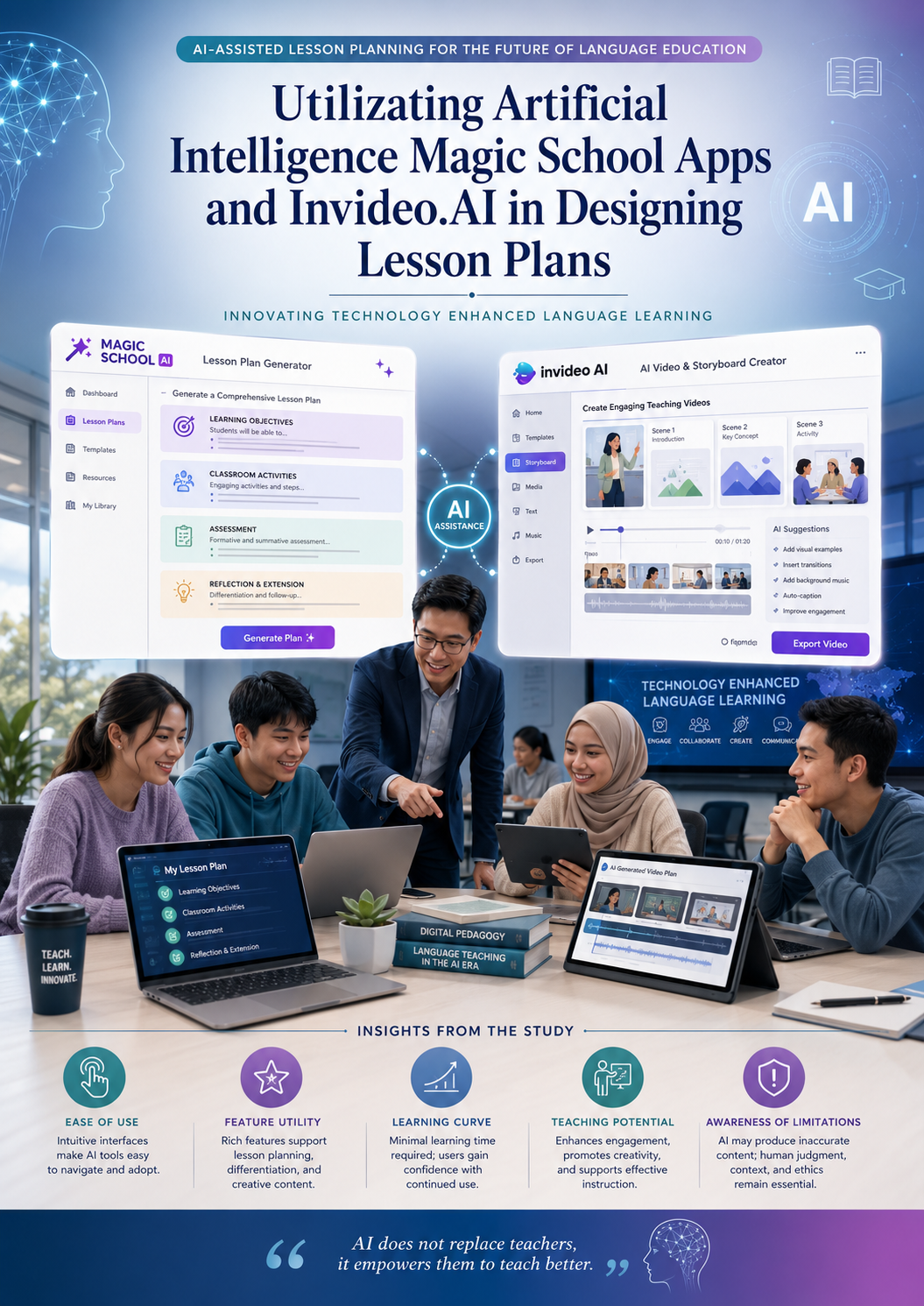
The digital era requires the realm of education to continue to develop in integrating innovative approaches, especially when designing lesson plansor learning plans. This study explored the potential of artificial intelligence, Artificial Intelligence (AI), with a focus on two main platforms, namely magic school apps and invideo.ai. The researchers investigated how the Magic School Apps and Invideo applications simplify learningdesign by producing innovative learning plans that can be adapted to learning objectives, class activities, and required assessments according to therequested promt.
Methodology
This study used a qualitative descriptive case study to investigate the phenomenon of using artificial intelligence at the tertiary level in TechnologyEnhanced Language Learning courses. Six Participants in this research are students in the TELL course. In collecting data the researchers interviewed these students and collect learning process information related to the use of Magic school Ai and invideo.Ai. In analyzing the data the researchers used thematic analysis.
Findings:
The researchers analyzed the data and they found five themes. The themes are (1) Initial Impressions and Ease of Use, (2) Feature Utility and Variety,(3) Learning Curve and Familiarity, (4) Potential in Teaching and Learning, (5) Concerns About AI Limitations.
Conclusion:
Exploring the development and future direction of AI in learning plans also has limitations, such as dependence on created content, this requires lecturer supervision to ensure quality and looks to the future where AI can be integrated as an adaptive learning platform and real time assessment tool to further personalize the learning experience.
Originality:
The issue of the utilization of Artificial Intelligence magic School AI and Invideo.AI on classroom context.
References
Baidoo-Anu, D., & Ansah, L. (2023). Education in the Era of Generative Artificial Intelligence (AI): Understanding the Potential Benefits of ChatGPT in Promoting Teaching and Learning. SSRN Electronic Journal. https://doi.org/10.2139/ssrn.4337484.
Cantos, K., Giler, R., & Magayanes, I. (2023). Artificial Intelligence In Language Teaching And Learning. Ciencia Latina Revista Científica Multidisciplinar. https://doi.org/10.37811/cl_rcm.v7i4.7368.
Cen, C., Luo, G., Li, L., Liang, Y., Li, K., Jiang, T., & Xiong, Q. (2023). User-Centered Software Design: User Interface Redesign for Blockly–Electron, Artificial Intelligence Educational Software for Primary and Secondary Schools. Sustainability. https://doi.org/10.3390/su15065232.
F. Pedro, M. Subosa, A. Rivas, and P. Valverde. (2019). “Artificial Intelligence in Education: Challenges and Opportunities for Sustainable Development Education Sector United NationsEducational, Scientific and Cultural Organization,” Minist. Educ., pp. 1–46, 2019, [Online]. Available: https://en.unesco.org/themes/education-policy-
F. Kamalov, D. Santandreu Calonge, and I. Gurrib, (2023).“New Era of Artificial Intelligence in Education: Towards a Sustainable Multifaceted Revolution,” Sustain., vol. 15, no. 16, pp. 1– 27, 2023, doi: 10.3390/su151612451.
F. Ouyang and P. Jiao. (2021). “Artificial intelligence in education: The three paradigms,” Comput.Educ. Artif. Intell., vol. 2, no. April, 2021, doi: 10.1016/j.caeai.2021.100020.
González-Carrillo, C., Restrepo-Calle, F., Ramírez-Echeverry, J., & González, F. (2021). Automatic Grading Tool for Jupyter Notebooks in Artificial Intelligence Courses. Sustainability. https://doi.org/10.3390/su132112050.
Guest, G., Bunce, A., & Johnson, L. (2006). How Many Interviews Are Enough? An Experiment with Data Saturation and Variability. Field Methods, 18(1), 59–82.
H. Heriyanto, D. Sator, A. Komariah, and A. Suryana, (2019). Character education in the era of industrial revolution 4.0 and its relevance to the high school learning transformation process,” Utop. y Prax. Latinoam., vol. 24, no. 5, pp. 327–340.[Online]. Available: https://dialnet.unirioja.es/descarga/articulo/7531750.pdf.
Katsarou, E., Wild, F., Sougari, A., & Chatzipanagiotou, P. (2023). A Systematic Review of Voice-based Intelligent Virtual Agents in EFL Education. International Journal of Emerging Technologies in Learning (iJET). https://doi.org/10.3991/ijet.v18i10.37723.
Lee, S. (2023). Otherwise than Teaching by Artificial Intelligence. Journal of Philosophy of Education. https://doi.org/10.1093/jopedu/qhad019.
Lin, Y., Luo, Q., & Qian, Y. (2023). Investigation of Artificial Intelligence algorithms in education. Applied and Computational Engineering. https://doi.org/10.54254/2755-2721/16/20230886.
Liu, Y., Chen, L., & Yao, Z. (2022). The application of artificial intelligence assistant to deep learning in teachers' teaching and students' learning processes. Frontiers in Psychology, 13. https://doi.org/10.3389/fpsyg.2022.929175.
Luo, D. (2018). Guide Teaching System Based on Artificial Intelligence. Int. J. Emerg. Technol. Learn., 13, 90-102. https://doi.org/10.3991/IJET.V13I08.9058.
M. Pikhart, (2020). “Intelligent information processing for language education: The use of artificial intelligence in language learning apps,” Procedia Comput. Sci., vol. 176, pp. 1412–1419.doi: 10.1016/j.procs.2020.09.15
Moundridou, M., Matzakos, N., & Doukakis, S. (2024). Generative AI tools as educators' assistants: Designing and implementing inquiry-based lesson plans. Comput. Educ. Artif. Intell., 7, 100277. https://doi.org/10.1016/j.caeai.2024.100277
Nourani, M., Honeycutt, D., Block, J., Roy, C., Rahman, T., Ragan, E., & Gogate, V. (2020). Investigating the Importance of First Impressions and Explainable AI with Interactive Video Analysis. Extended Abstracts of the 2020 CHI Conference on Human Factors in Computing Systems. https://doi.org/10.1145/3334480.3382967.
R. E. Stake, (1995) “The Art of Case Study Research by Robert E. Stake (z- lib.org).pdf,” SagePublications, Inc.
T. K. F. Chiu, Q. Xia, X. Zhou, C. S. Chai, and M. Cheng, (2023) “Systematic literature review on opportunities, challenges, and future research recommendations of artificial intelligence in education,” Comput. Educ. Artif. Intell., vol. 4, no. November 2022, p. 100118, 2023, doi: 10.1016/j.caeai.2022.100118
Tomasi, S., Schuff, D., & Turetken, O. (2018). Understanding novelty: how task structure and tool familiarity moderate performance. Behaviour & Information Technology, 37, 406 - 418. https://doi.org/10.1080/0144929X.2018.1441325.
T. Oko,. (1992) Review of Interviewing as Qualitative Research: A Guide for Researchers in Education and the Social Sciences., vol. 37, no. 7.
V. Braun and V. Clarke, (2006) “Using thematic analysis in psychology,” Qual. Res. Psychol., vol. 3, no. 2, pp. 77–101.doi: 10.1191/1478088706qp063oa.
W. Ritonga, (2022).“Role of Teachers and Parents in Realizing Character Education in the DigitalEra,” Indones. Values Character Educ. J., vol. 5, no. 1, pp. 9–18, 2022, doi: 10.23887/ivcej.v5i1.39729.
Xue, Y., & Wang, Y. (2022). Artificial Intelligence for Education and Teaching. Wireless Communications and Mobile Computing. https://doi.org/10.1155/2022/4750018
Downloads
Published
Issue
Section
License
Copyright (c) 2026 Ratu Sarah Pujasari, Melisa Sri, Yuyus Saputra, Nanak Hikmatullah, Santiana Santiana

This work is licensed under a Creative Commons Attribution-ShareAlike 4.0 International License.
Authors retain copyright and grant the journal right of first publication with the work simultaneously licensed under a Creative Commons Attribution 4.0 International License that allows others to share the work with an acknowledgement of the work's authorship and initial publication in this journal.